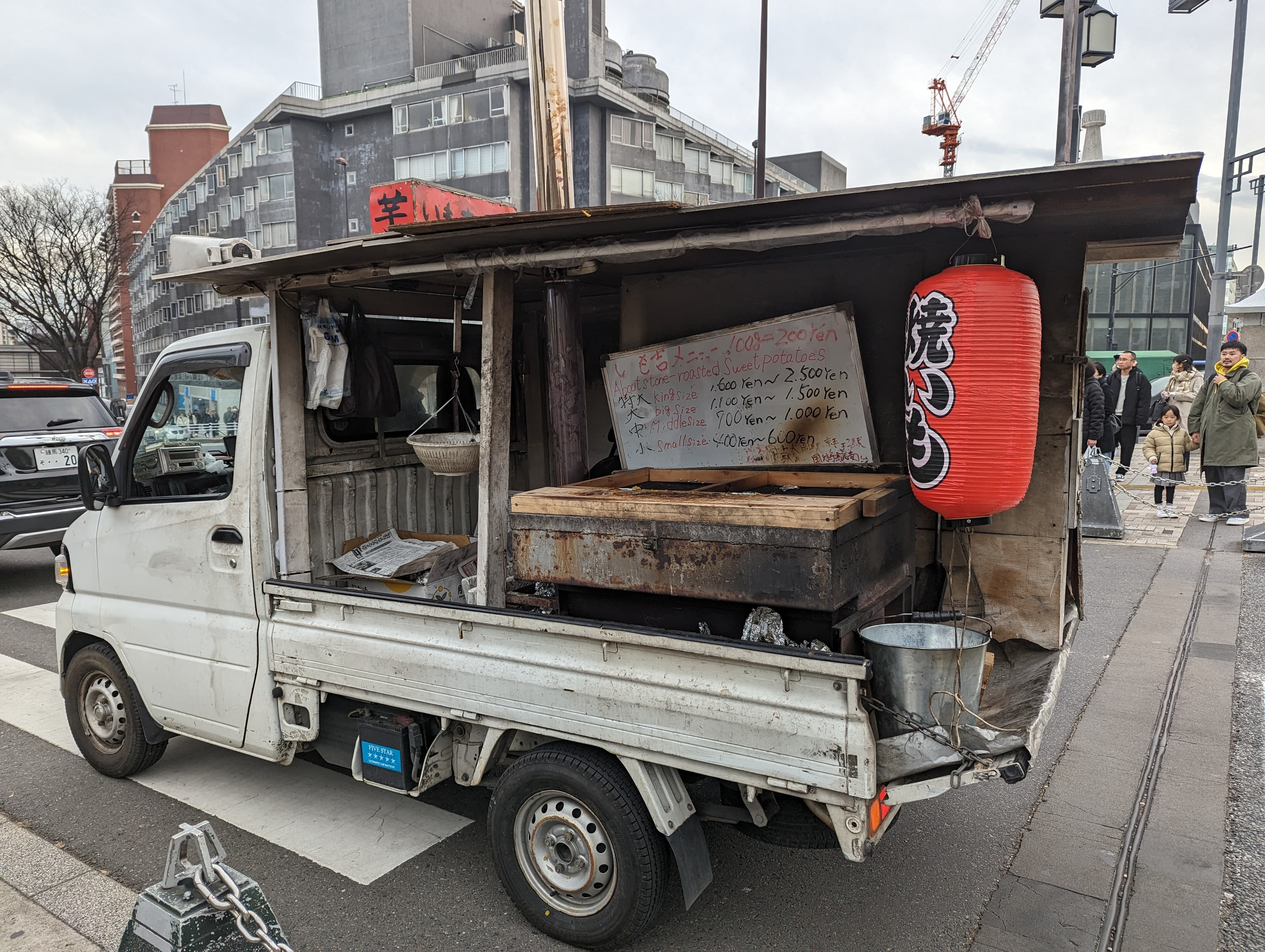
The first time my Carry played Beethoven's "Fur Elise" when I shifted into reverse, I thought I was losing my mind.
I was in a Costco parking lot in Portland, backing out of a spot, and suddenly — classical music. Tinny, electronic, unmistakably coming from somewhere under the truck. My passenger looked at me. I looked at my passenger. Neither of us had an explanation.
It took a Reddit post and 47 comments to learn that this is completely normal in Japan. And it was just the beginning of discovering how wonderfully weird Japanese-market vehicles can be.
The most common surprise for new kei vehicle owners is the reversing melody. Many Japanese vehicles — especially commercial trucks and vans — have a small speaker that plays a tune or chime when backing up, a safety feature for Japan's impossibly tight streets and parking areas. The most common melody is "Fur Elise" by Beethoven, though you might also get a simple beep-beep-beep, a woman's voice announcing "バックします" (bakku shimasu — "backing up"), or — yes, really — "It's a Small World." You can disable it by disconnecting the speaker, usually a small buzzer under the bed or bumper, but honestly — why would you? It's the most charming feature on any vehicle I've ever owned.
Open the driver's door with the key in the ignition and you'll hear a chime that sounds like it belongs in a department store elevator. It's polite, gentle, and very Japanese — a soft reminder rather than an aggressive buzz. Some models have different chimes for different conditions: key in ignition with the door open, lights left on, seatbelt not fastened. Each one is a different, equally polite melody. American cars scream at you. Japanese cars suggest.
Many kei vehicles — even basic work trucks — have heated side mirrors. In Japan's snowy northern regions, this is a practical necessity. In the US, it's a delightful surprise when you discover the little switch on the dashboard marked with a mirror icon and a wavy heat symbol.
Almost every kei vehicle from the 80s and 90s has a built-in ashtray and cigarette lighter — Japan had incredibly high smoking rates during this era, and the ashtrays are usually well-designed, slide-out units that fit perfectly in the dashboard. Most American owners repurpose the lighter socket for phone charging and use the ashtray for coins, or small parts, or nothing at all. But the craftsmanship of these tiny ashtrays — smooth action, perfect fit — is a testament to Japanese attention to detail even in disposable items.
Look at the top of your rearview mirror. Many Japanese vehicles have a small hook or loop designed for hanging an お守り (omamori) — a Japanese good luck charm from a shrine. These charms are traditionally hung in vehicles for safe driving. It's a tiny cultural detail that tells a story about the vehicle's homeland.
Check under your seats or in a side panel. Many kei vehicles came with a factory tool kit — typically a basic wrench set, a screwdriver, and a jack handle — all wrapped in a fabric roll and tucked into a purpose-built compartment. The quality of these factory tool kits is remarkable. The wrenches are properly sized for the vehicle's bolt heads, the screwdriver fits the dashboard screws exactly. It's as if someone thought about every fastener on the truck and made sure you could reach it.
Japanese vehicles display engine temperature differently than American cars. The gauge sits at the bottom for a long time after cold start, rises slowly to the middle — normal operating temperature — and stays there. American owners sometimes panic that the gauge "isn't working" because they're used to gauges that move more actively. If it's in the middle, your engine is happy. If it goes above middle, pull over.
This sounds like a joke but it's not: the interior cabin lights in kei vehicles actually illuminate the entire cab. American trucks from the same era had dome lights that lit up approximately three square inches. The kei vehicle dome light — usually a fluorescent tube or a well-placed incandescent — fills the entire cab with usable light.
Dashboard labels, warning stickers, and gauge markings are in Japanese — simultaneously confusing and beautiful. You'll encounter 暖 (dan) for warm/heat on the heater controls, 冷 (rei) for cold/cool on the AC, 前 (mae) for front on the 4WD selector, 後 (ushiro) for rear, 高 (taka) for the high beam indicator, and 低 (tei/hiku) for low range. Learning even a few of these adds to the experience. Your truck is a tiny piece of Japan in your driveway.
This is the most Japanese feature of all, and it's not a feature — it's a philosophy.
Kei vehicles don't have unnecessary anything. No fake chrome. No vestigial body lines that serve no structural purpose. No screens where a gauge would work better. Every element exists because it's needed, and nothing exists because it looks cool. In Japanese design, this is called 引き算の美学 (hikizan no bigaku) — the aesthetics of subtraction. Beauty through what you remove, not what you add. When you sit in a kei vehicle cab and look at the dashboard — simple gauges, physical switches, no decoration — you're looking at this philosophy in action. Everything has a purpose. Nothing is performance.
That's the most Japanese feature of all.