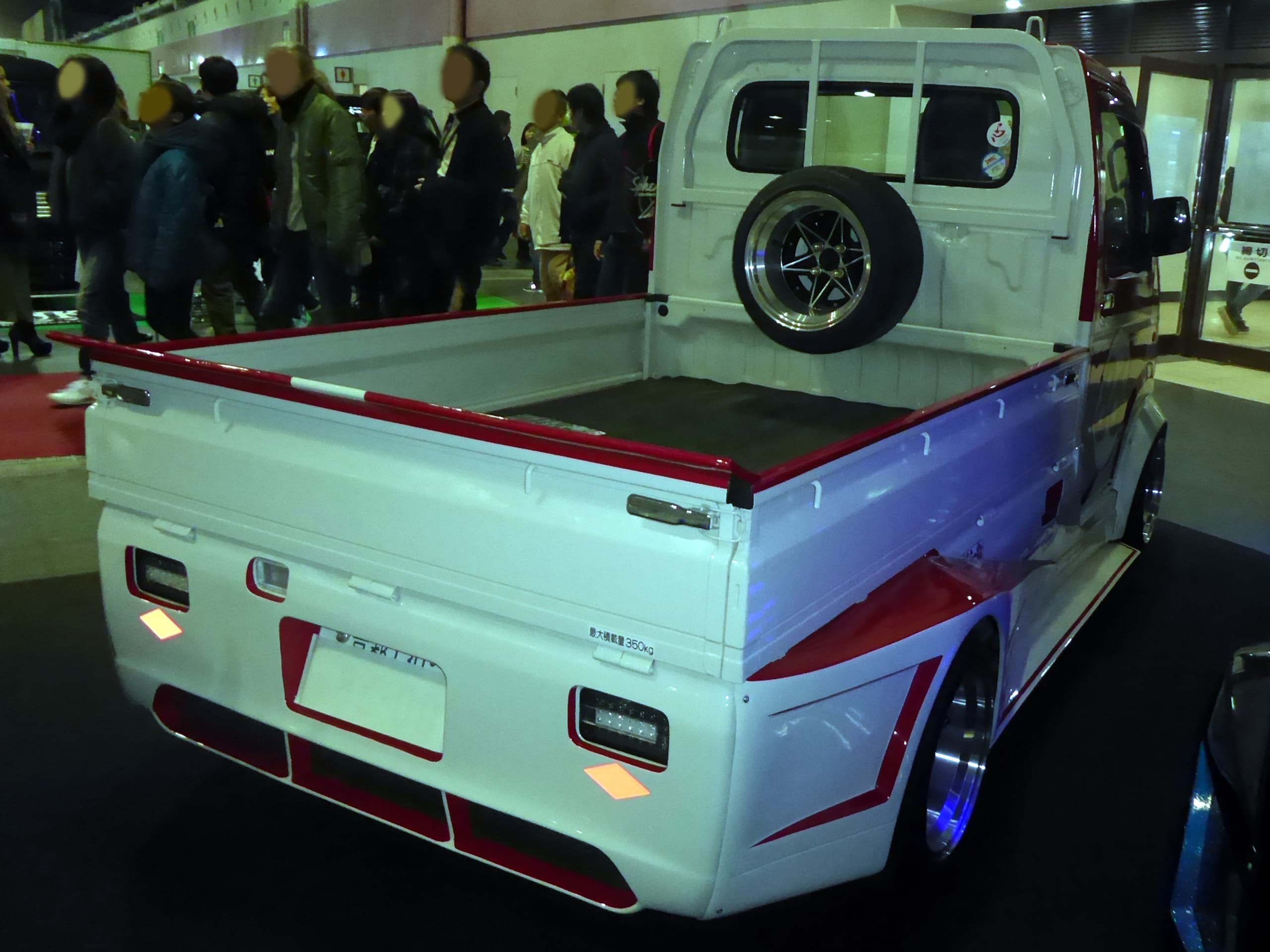
There's a Reddit post with 978 upvotes and 110 comments that has become something of a foundational text for the kei truck community. The title, delivered with the weary authority of someone who has learned a lesson the hard way: "Just for the record, 1 1/2 yards of gravel is way too much for a kei truck."
The photo told the whole story. A Suzuki Carry with its rear suspension completely bottomed out, the bed sitting so low on the axle that the tires looked like they were being swallowed by the fender wells. The truck had made it home — barely — at what the owner described as "a very careful 15 mph."
The comments were magnificent. Not judgment. Not lectures. Just 110 people sharing their own versions of the exact same mistake. Because here's the thing about kei truck owners: we all know the payload rating is roughly 770 lbs. We all know a cubic yard of gravel weighs somewhere north of 2,800 lbs. And yet, standing in front of a pile of gravel at the landscape supply yard, something happens to us. A voice in the back of our heads says, "It'll be fine."
It is, reliably, not fine.
The gravel post may be the most famous overloading story, but it's far from the only one. The kei truck community has built an unofficial archive of "things we probably shouldn't have done," and every story follows the same three-act structure: confidence, regret, and a surprisingly good photo.
Someone — and they know who they are — loaded a full-size John Deere riding mower onto the bed of a Honda Acty. Not a small push mower. A sit-on, turn-the-key, cup-holder-having riding mower that weighed somewhere around 500 lbs before you added the operator climbing up to strap it down. The ramps alone were an engineering challenge, because the bed of an Acty is approximately the width of the mower's wheelbase, minus an inch of clearance on each side. They made it home — the Acty's rear end sagged like a hammock, and the front wheels felt "a little light" through the turns, but they made it home. The mower now lives at a property 22 miles from the nearest equipment rental place, and the owner has sworn — publicly, on Reddit — that they will rent a trailer next time. They will not rent a trailer next time.
Firewood is the kei truck community's gateway drug to overloading. It starts innocently — you split a few rounds, toss them in the bed, and think, "Look at all that space left." So you add another layer, and then another, and then you're standing on the tailgate stacking logs like a game of Tetris, telling yourself that wood is lighter than gravel so it's probably fine. The bed of a Carry or a Hijet looks like it was designed for firewood; the dimensions are perfect. The problem is that a full cord of seasoned hardwood weighs around 3,000 lbs, and a bed that looks half-full can easily be holding 1,200. The telltale sign: you hit a bump and nothing happens. No bounce. The suspension has nowhere left to travel. You are now driving a vehicle with the ride quality of a skateboard, and every pothole is a direct conversation between your spine and the road.
"It'll fit" are the two most dangerous words in the kei truck vocabulary — usually spoken while standing in a driveway, looking at a couch that is clearly, obviously, mathematically wider than the truck bed, by someone who has already told their friend with a full-size pickup that they won't need help. The kei truck bed is roughly 6 feet long by 4.5 feet wide. A standard three-seat sofa is 7 to 8 feet long. These numbers do not work together. But with the tailgate down and some creative angling and a ratchet strap that's doing more structural work than it was designed for, people make it happen. The couch hangs off the back by two feet, the cushions are bungee-corded to the cab roof, and the whole thing looks like a parade float designed by someone who lost a bet. The real danger with furniture isn't the weight — a sofa is light. It's the wind resistance. A couch sticking up above the cab turns your aerodynamic little kei truck into a sail, and at highway speed you discover what "crosswind sensitivity" really means.
Bags of concrete, mulch, and soil are the most deceptive overloaders because they come in such reasonable-looking packages. One bag of concrete weighs 60 lbs — that's nothing. So you buy twenty, because you've got a project and the truck is right there, and twenty bags of concrete is only 1,200 lbs. Only. The landscaping supply run is how most people first learn that their kei truck has a payload rating. You pull up to the register and the cashier says, "You're putting all that in that?" and you say yes with the unearned confidence of someone who has never Googled "kei truck payload capacity." Bags of wet soil are the worst offenders — a cubic yard of topsoil weighs around 2,000 lbs, and even a "light" load of ten bags at the garden center can put you right at the limit before you've added the bag of fertilizer, the flat of plants, and yourself.
The hot tub story has achieved legendary status, and the details vary depending on who's telling it, but the core narrative is consistent: someone loaded a hot tub — empty, mercifully — onto a flatbed kei truck. An empty hot tub weighs 400-600 lbs depending on the model, which is technically within payload limits. The issue was not weight. The issue was that a hot tub is approximately the same size as the entire truck bed, extending past every edge, turning the kei truck into something that looked like a very small tugboat pushing a very large barge. The community's response was, predictably, not horror but admiration.
The stories are funny. The consequences sometimes aren't. Overloading compresses the rear leaf springs or coil springs fully until the bump stops make contact — every impact transfers directly to the frame, and repeated abuse permanently sags the springs so your truck sits lower even when empty. You'll notice the headlights pointing upward at night; that's your suspension telling you it's given up. The brakes suffer too — sized for a vehicle that weighs about 1,800 lbs fully loaded, they overheat, fade, and in extreme cases fail entirely when you double the cargo weight. Going downhill with an overloaded bed and fading brakes is genuinely dangerous. The stock tires — 145/80R12 or 145/80R13, small tires rated for small loads — build up heat, wear at the sidewalls, and risk a blowout. A blowout on a tiny, top-heavy, overloaded kei truck at speed is not a funny Reddit story. And the frame itself — whether ladder or monocoque — develops metal fatigue, bent crossmembers, and cracked welds under chronic abuse. The bed mounts take the worst of it; that's where you'll see the first cracks if you've been ignoring the payload rating.
It's worth remembering what these trucks were designed for. In Japan, kei trucks are workhorses for small farms, urban deliveries, and construction sites with tight access. They carry bags of rice, crates of vegetables, small tools, and building materials — in quantities that respect the payload rating. Japanese farmers aren't loading 1.5 yards of gravel because they have infrastructure for that. The local JA (agricultural cooperative) delivers bulk materials, the construction company sends a proper truck, and the kei truck does what it does best: small loads, tight spaces, short distances. When these trucks arrive in America, they enter a culture that looks at a truck bed and sees a challenge. Americans have a fundamentally different relationship with the concept of "rated capacity" — we treat it as a suggestion, a starting point for negotiation, a number that applies to other people. This isn't criticism. It's observation. And it's part of what makes the community so entertaining.
For those who want to stay within the approximately 770 lb payload limit and still get real work done: ten to twelve bags of mulch, a cord of kindling or a quarter cord of split firewood, eight to ten bags of concrete mix, small furniture like chairs and end tables, a push mower with yard tools, camping gear for two, or even an ambitious grocery run — all comfortably within limits. Right at the edge — and you should be careful here — are twelve to fifteen bags of soil, half a cord of seasoned hardwood, a riding mower alone with nothing else, a small motorcycle, or two sheets of plywood plus a stack of two-by-fours. And in the "absolutely not" category: a cubic yard of anything wet, a full cord of firewood, a hot tub even empty, that couch plus the love seat plus the coffee table, or "I'll make two trips" worth of concrete crammed into one.
What makes the overloading stories special isn't the recklessness — it's the honesty. Nobody in the kei truck community pretends they haven't done it. The gravel post didn't get 978 upvotes because people were shocked. It got 978 upvotes because 978 people saw themselves in it.
Every overloading story is really a love story. You overload a kei truck because you believe in it — because you looked at this tiny, cheerful, 660cc machine and thought, "You can do this." And sometimes it can. And sometimes it can't. And either way, you post about it afterward, and a hundred people share their own version. The kei truck community owns these stories the way veterans own war stories. There's no shame in admitting you bottomed out the suspension on a load of gravel. There's only the camaraderie of shared experience, the mutual understanding that we all thought we were the exception, and the quiet pride of knowing that the little truck made it home anyway.
It always makes it home. Eventually. At 15 mph. With the hazards on.
Have your own overloading story? The community wants to hear it. That's not a joke — these posts consistently get the most engagement of anything on r/keitruck. Your moment of poor judgment is someone else's entertainment and education.
Related reading:
- Payload & Hauling Guide — detailed specs and safe hauling practices for every model
- Love It or Hate It: The Most Polarizing Kei Vehicle Builds — more community stories about pushing boundaries