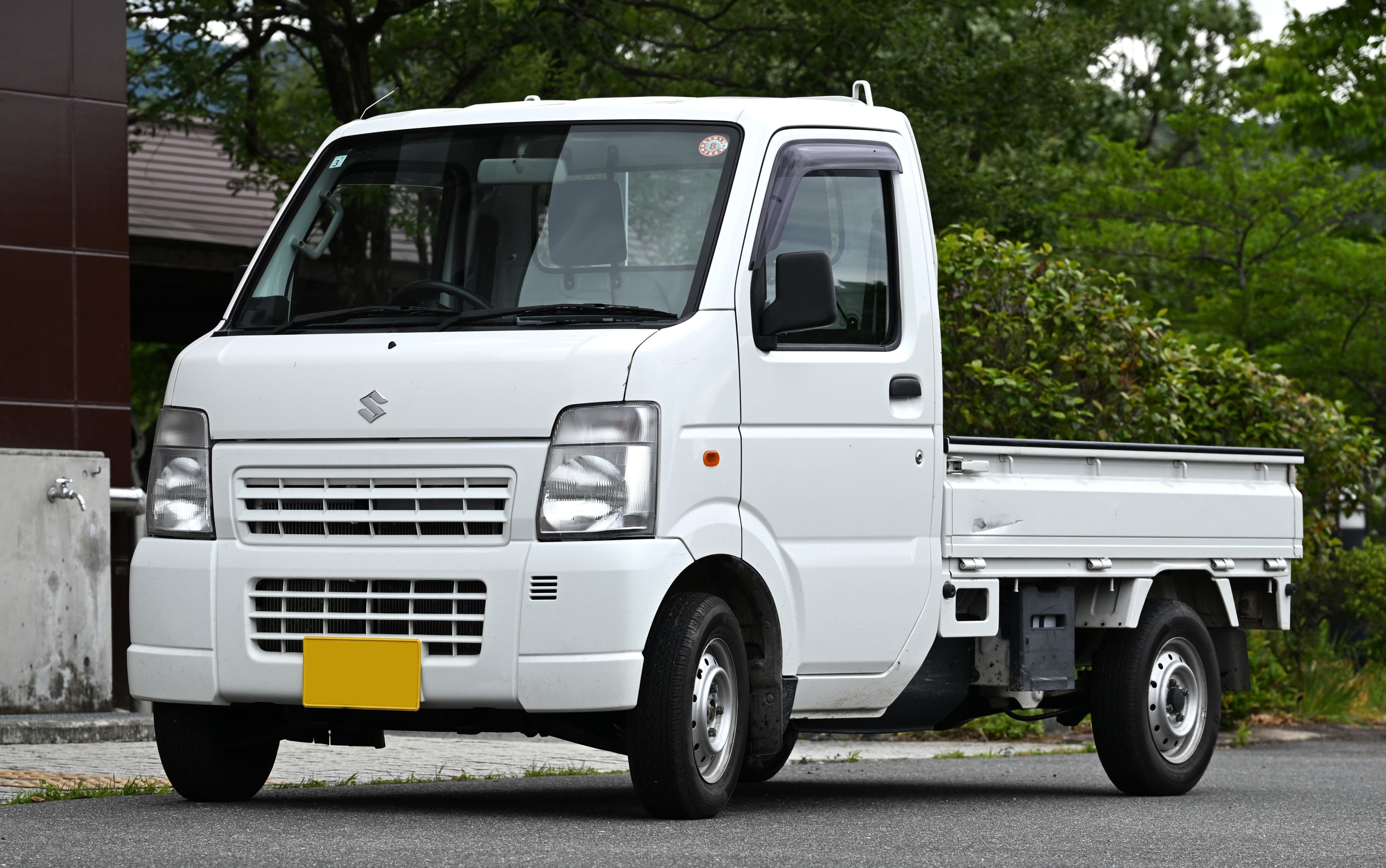
There's a Reddit post from October 2025 that became the most-discussed thread in kei vehicle history. The title: "The perfect protest truck." It received 287 comments and nearly 1,500 upvotes.
The photo showed a Suzuki Carry parked next to a new Ford F-250 Super Duty. The Carry's roof barely reached the F-250's door handle. The contrast was comical, then absurd, then — if you looked long enough — kind of profound.
The comments told the real story. They weren't about trucks. They were about America.
Something happened to American trucks over the last thirty years. They got bigger. Then bigger again. Then bigger still. A 1990 Ford F-150 was 198 inches long and weighed 3,800 pounds. The 2025 model is 232 inches long and weighs 5,400 pounds. That's three feet longer and 1,600 pounds heavier — roughly the weight of an entire Suzuki Carry added on top.
Front-end heights rose to the point where a small sedan can disappear behind a modern truck's grille. The National Highway Traffic Safety Administration has documented the pedestrian safety implications. The cultural implications are harder to measure but just as real. Trucks stopped being tools and became identities — the bigger the truck, the more powerful you felt, the more aggressive the styling, the more commanding you looked. Manufacturers understood this and leaned into it, each model year bringing more chrome, more height, more visual aggression.
And then some people bought Suzuki Carrys instead.
Nobody buys a kei vehicle to make a statement. They buy one because it's practical for their farm, or because they think it's cute, or because they did the math and realized it costs a tenth of a new truck to own. But the moment a 1,600-pound Carry parks next to a 5,500-pound Super Duty, a statement gets made whether the owner intended it or not. The visual contrast is so dramatic that it forces a question: do we really need all that?
This is what resonated in that Reddit thread. Comment after comment from people who used their kei trucks for the same tasks their neighbors used F-250s for — hauling feed, running to the hardware store, maintaining property. The kei truck did it for $7,000 instead of $70,000, at 40 mpg instead of 15, in a parking spot instead of taking two. The "protest" isn't angry. It's cheerful. That's what makes it effective.
There's an irony that Suki Tanaka — that's me — finds particularly delicious as someone who grew up between two cultures. In Japan, kei vehicles aren't protest vehicles. They're the default. They're what most people drive because Japanese cities are narrow, parking is expensive, and the kei tax class makes economic sense. There's no statement in driving a kei vehicle in Tokyo — it's like wearing sneakers.
But transplant that same vehicle to America — a country that has spent decades equating vehicle size with personal worth — and it becomes radical. The most ordinary vehicle in Japan becomes the most extraordinary vehicle in an American parking lot. This cultural translation is what makes the kei vehicle movement in America so fascinating. Americans aren't just buying Japanese trucks. They're borrowing a Japanese philosophy — the idea that enough is enough, that small can be beautiful, that a vehicle is a tool rather than an extension of ego.
The Japanese have a word for this: 足るを知る (taru wo shiru) — to know what is sufficient. It's a Zen concept, the idea that contentment comes from recognizing when you have enough rather than always pursuing more. A kei vehicle is taru wo shiru on wheels.
What started as individual purchase decisions has become something larger. Kei vehicle owners have become — almost by accident — the automotive counterculture. At car meets, the kei vehicles draw the biggest crowds, not because they're the most impressive, but because they're the most interesting. They provoke thought in a way that another modified Supra or lifted Wrangler simply doesn't. On social media, kei vehicle content consistently outperforms content about more expensive vehicles. The algorithms have figured out what the comment sections already knew: people have strong feelings about tiny trucks. Some love them. Some mock them. Almost nobody scrolls past. In rural communities, kei trucks are spreading by word of mouth — one rancher buys a Carry, three neighbors see it working, and six months later there are four kei trucks in the county. It's not marketing. It's demonstration.
The backlash exists, and it's worth acknowledging honestly. "You'll die in that thing" is the most common criticism, and it's not entirely wrong — in a collision with a vehicle three times its weight, physics favors the bigger vehicle. Kei vehicle owners accept this trade-off, but it's a real trade-off, not something to dismiss. Then there's "it's a toy, not a real truck" — an objection that dissolves the moment you watch a Carry haul hay bales through a muddy pasture at 6 AM in January. The "toy" criticism comes from people who've never actually used one. And finally, "you're just being contrarian." Maybe. But if being contrarian means spending $7,000 instead of $70,000 for the same utility — well, contrarian sounds pretty smart.
The kei vehicle movement in America isn't really about trucks. It's about a question that's getting louder in American culture: how much is enough?
Enough house. Enough car. Enough stuff. The tiny house movement asked it about living spaces. The van life movement asked it about travel. The kei vehicle movement is asking it about transportation — the most visible, most public consumption choice most Americans make. And the answer these little trucks propose is both radical and obvious: a lot less than you think.
The 287 people who commented on "the perfect protest truck" already knew this. They weren't debating automotive specifications. They were having a conversation about values, disguised as a conversation about trucks.
That's the power of a really good protest. It doesn't shout. It parks quietly next to an F-250 and lets you draw your own conclusions.