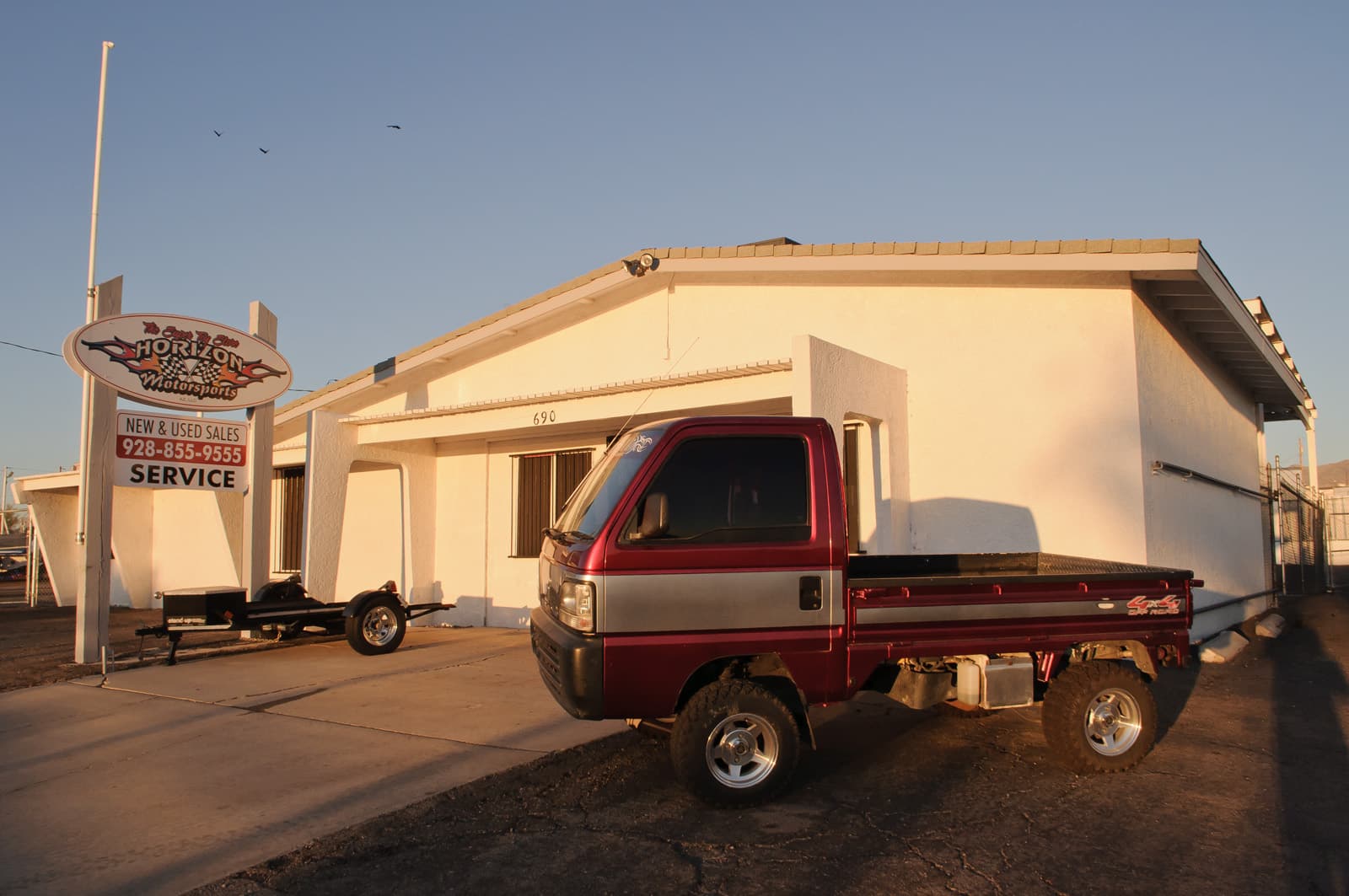
The $5,000 Work Truck
Every Saturday morning at the Sellwood Farmers Market in Portland, I park Samu-chan between a coffee truck and a plant vendor. I unload pottery from the back — mugs, bowls, the occasional vase — and set up my table. The coffee truck is a converted Sprinter that cost $65,000. The plant vendor uses a rented U-Haul. My '94 Sambar Van cost $6,200, and people photograph it more than the pottery. I'm not sure how I feel about that.
But I've started noticing something — it's not just me. A landscaper pulls up to a job in something tiny. A plumber unloads tools from something that looks like it was designed for a different country — because it was. A bookshop owner — Sarah, who we profiled — opens a Hijet into a mobile library and kids lose their minds.
They're all running businesses from kei trucks. And they're all spending a fraction of what their competitors spend on vehicles.
This isn't a novelty trend. It's an economic argument that makes so much sense it's almost embarrassing that more people haven't caught on. A used Honda Acty costs less than six months of payments on a new F-150. It hauls enough for most small jobs. And it does something no full-size truck can do: it makes people stop, stare, and pull out their phones.
That last part? For customer-facing businesses, it's worth more than any advertising budget.
Eight Businesses, Eight Stories
1. Landscaping: The Crew That Runs Light
Carlos runs a three-person landscaping crew in central Texas. Two years ago, he was spending $650 a month on payments for a Ram 1500 that spent most of its time hauling a push mower, a string trimmer, and some bags of mulch. He didn't need a half-ton truck. He needed a wheelbarrow with an engine.
He bought a 1994 Honda Acty for $5,200 from a dealer in Houston. Cash. No payments.
The Acty hauls his mowers, blowers, and hand tools. He built a simple plywood rack system for the bed that keeps everything organized. For bigger jobs — bulk mulch, sod deliveries — he rents a trailer for $50 a day, which happens maybe twice a month.
His monthly vehicle cost went from $650 plus insurance to essentially just gas and liability coverage. That freed up enough cash to hire a third crew member, which let him take on more clients, which paid for the truck several times over in the first year.
"People ask about the truck at every single job," Carlos told us. "It's the best marketing I've ever done. Clients remember the little truck guy."
2. Mobile Coffee: The $5,000 Cafe
The traditional food truck path looks like this: buy or lease a truck for $50,000 to $100,000. Spend months on permits. Hope you make enough to cover the loan.
The kei truck path looks like this: buy a truck for $5,000. Mount an espresso machine and a water tank. Start selling.
That's an oversimplification, of course — you still need health permits, a commissary kitchen arrangement, and food handler certifications. But the vehicle cost difference is staggering. A kei truck with a basic coffee setup can be road-ready for under $12,000 total. A traditional food truck rarely comes in under $60,000.
The math changes everything. At $12,000 all-in, you can afford to test a concept. If the location doesn't work, you move. If the business doesn't work, you haven't bankrupted yourself.
And the truck itself is the draw. People who would walk past a white catering van will line up to buy coffee from something that looks like it drove out of a Studio Ghibli film.
3. Farm and Ranch: The Gate Test
Ask any rancher what they need from a work vehicle and you'll hear some version of the same list: haul hay, carry feed bags, move fencing supplies, check on livestock, get through gates.
That last one is where kei trucks win outright. At under five feet wide, a Suzuki Carry fits through standard farm gates that a modern full-size truck cannot. It doesn't tear up wet fields. It doesn't compact soil. It sips fuel while you're doing fence checks across 200 acres.
Ranchers in the South and Mountain West have been buying kei trucks quietly for years. They're not posting about it on social media — they're just using them. Driving them between barns, loading them with salt blocks, tossing hay bales in the bed.
A kei truck won't replace a one-ton dually for pulling a horse trailer. But for the 80% of daily ranch work that involves moving light loads short distances? It's overqualified.
4. Mobile Retail: The Truck Is the Store
Sarah runs a mobile library called "The Rolling Read" out of a Daihatsu Hijet box truck in Portland. She bought the truck for $4,500, built cedar bookshelves inside for $400, added solar-powered LED lighting for $200, and started driving to underserved communities across rural Oregon.
Her total investment was barely $5,000. A traditional bookmobile conversion starts at $80,000.
Sarah's story is one we've covered in depth, and she's part of a growing wave of mobile retailers who've realized that a kei truck isn't just a vehicle — it's a storefront.
Flower trucks at weekend markets. Vintage clothing pop-ups at festivals. Produce stands that drive to the neighborhood instead of waiting for customers to drive to them. The kei truck format works because the truck itself signals something: this is small, this is personal, this is worth your time.
5. Last-Mile Delivery: Threading the Needle
In dense urban neighborhoods — think Brooklyn, San Francisco, Chicago's Near North Side — delivery is a spatial problem. Double-parked vans block traffic. Full-size trucks can't make the turn into alleys. Parking spots don't exist.
A Subaru Sambar van is 11 feet long and under 5 feet wide. It parks in spaces that a Sprinter can't even see. It fits down alleys that were built for horse carts. For small-package delivery, grocery runs, or florist deliveries, it turns a logistical headache into a non-issue.
Several small courier companies in East Coast cities have started running kei vans for exactly this reason. The vehicles cost less, the insurance is cheaper, and drivers waste less time circling for parking. The savings compound across a fleet — even a small one.
6. Construction and Trades: The Tool Shuttle
A plumber doesn't haul drywall. An electrician doesn't move lumber. Most tradespeople are hauling tools, parts, and themselves — loads that rarely exceed 500 pounds.
A kei truck bed holds a standard toolbox, a work ladder, and enough supplies for a day's worth of service calls. It won't replace a contractor's heavy-duty truck on a new construction site, but for the independent tradesperson doing residential repairs and installations, it's more truck than they need at a third of the cost.
The operating economics are hard to argue with. When your truck payment is zero and your gas bill is half what it used to be, you can undercut competitors on price or pocket the difference as profit. Either way, you win.
7. Event and Festival Vendors: The Instagram Booth
Here's where aesthetics become a legitimate business advantage.
At any craft fair, farmers market, or music festival, vendors compete for attention. Most are working from folding tables under pop-up canopies. Then someone rolls in with a kei truck — bed open, product displayed, fairy lights strung along the rack — and suddenly every phone in the vicinity is pointed at them.
The truck IS the booth. No setup, no teardown stress. Drive in, drop the tailgate, start selling. When the event ends, close up and drive home. The vehicle does triple duty as transportation, display, and marketing.
Event vendors report that the truck generates more social media content than any paid promotion could. People photograph it. They tag it. They share it. One vendor told us she gets more Instagram followers from a single Saturday market than from a month of paid ads.
8. Property Maintenance: The Quiet Workhorse
Campground managers. HOA maintenance crews. Golf course groundskeepers. Park rangers. University facilities teams.
These are environments where a full-size truck is overkill and a golf cart isn't enough. You need to haul tools, supplies, and occasionally a heavy load — but you also need to navigate narrow paths, avoid disturbing guests, and not tear up manicured grounds.
Kei trucks fit this niche perfectly. They're street-legal (unlike UTVs in most contexts), fully enclosed (unlike golf carts), and light enough that they won't leave ruts in soft turf. Several national campground chains have started acquiring kei trucks for site maintenance, and golf courses in the Southeast have been using them for years.
The Economics: Kei Truck vs. The Competition
Let's put real numbers on this. Here's what it costs to put a work vehicle on the road:
Used Kei Truck (1995 Suzuki Carry)
- Purchase: $5,000-$7,000
- Registration/title: $200-$500
- Basic commercial insurance: $800-$1,200/year
- Annual fuel (10,000 miles): $800-$1,000
- Year one total: $7,000-$10,000
Used Full-Size Pickup (2018 Ford F-150)
- Purchase: $25,000-$35,000
- Registration/title: $300-$800
- Commercial insurance: $1,500-$2,500/year
- Annual fuel (10,000 miles): $2,000-$2,800
- Year one total: $29,000-$41,000
Used Cargo Van (2019 Ford Transit)
- Purchase: $28,000-$38,000
- Registration/title: $300-$800
- Commercial insurance: $1,800-$3,000/year
- Annual fuel (10,000 miles): $2,200-$3,000
- Year one total: $32,000-$45,000
The gap narrows over time — a full-size truck depreciates slower and has a longer service life. But for a startup or a side hustle, that first-year difference is the difference between launching and waiting.
Insurance: The Tricky Part
Let's be honest — insuring a kei truck for commercial use is harder than insuring a standard vehicle. Many mainstream carriers don't know what a kei truck is, let alone how to write a commercial policy for one.
But it's not impossible. Here's the reality:
Specialty insurers like Hagerty, American Modern, and Grundy understand imported vehicles. They're your best starting point. Some will write commercial policies, especially if the vehicle is used for light commercial purposes (mobile retail, property maintenance) rather than heavy commercial use (delivery fleets).
Standard carriers can sometimes be convinced once the vehicle has a clean title and registration in your state. State Farm and Progressive have both written policies on titled kei vehicles, though experiences vary by agent and region.
Commercial insurance specifically for kei trucks typically runs $800 to $1,500 per year — actually cheaper than most commercial vehicle policies because the vehicle's value is lower and the liability exposure (slower speeds, lighter weight) is different.
For a deep dive on navigating insurance, read our complete insurance guide.
Permits and Commercial Registration
Using a kei truck commercially adds a layer of paperwork beyond standard registration. The specifics vary by state and by use case, but here's what you'll generally encounter:
Business license: Required regardless of vehicle type. Your city or county issues these.
Commercial vehicle registration: Some states require commercial plates for any vehicle used in business. Others only require them above certain weight thresholds — and kei trucks often fall below those thresholds, which can actually simplify things.
Food service permits: If you're serving food or beverages, you need health department approval, a commissary kitchen arrangement, and food handler certifications. The truck itself may need to pass a health inspection.
DOT numbers: Generally not required for vehicles under 10,001 pounds GVWR operating intrastate. Kei trucks are well under this limit.
Check your state's specific requirements on our regulations page before investing in a commercial setup.
The Marketing Machine You Didn't Budget For
Every business owner we spoke to said the same thing, unprompted: the truck generates attention.
Not polite interest. Not casual glances. Actual, phone-out, "what IS that?" attention. People walk up and ask questions. They take photos. They share those photos. They remember the business because they remember the truck.
For customer-facing businesses — food vendors, mobile retailers, service providers who visit homes — this is an enormous advantage. Brand recognition usually costs money. With a kei truck, it's built into the vehicle.
One flower vendor in Nashville told us she stopped running Instagram ads entirely after switching to a kei truck. "The truck is the ad," she said. "People take better photos of it than I could ever stage."
This doesn't apply to every business. A plumber working residential service calls doesn't necessarily need to stand out at the curb. But even there, customers notice. They talk about it to neighbors. The little truck becomes a word-of-mouth engine.
Is It Right for Your Business?
A kei truck won't work for every commercial application. Be honest about the limitations:
- Payload: Most kei trucks max out at 750-800 pounds. If you're hauling heavy materials regularly, you need a bigger truck.
- Highway driving: Kei trucks can manage highway speeds, but they're not comfortable at 70 mph for hours. If your business requires long highway commutes, factor that in.
- Passenger space: Two seats. That's it. If you need to carry a crew, the kei truck is one vehicle in a fleet, not the only one.
- Parts availability: Replacement parts often ship from Japan. Routine maintenance is straightforward, but a major repair can mean waiting weeks for parts.
But if your business involves moving moderate loads, operating in tight spaces, keeping overhead low, and — especially — facing customers? A kei truck might be the smartest business decision you make this year.
Getting Started
Ready to explore the idea? Here are your next steps:
- Check your state's regulations — make sure kei trucks are street-legal for commercial use in your area. Our state-by-state guide covers all 50 states.
- Find a reputable dealer — our dealer directory lists vetted importers and dealers across the country.
- Sort out insurance early — don't buy the truck before you've confirmed you can insure it commercially. Read our insurance guide for carrier recommendations.
- Start small — buy a running truck, use it for a season, and see if it fits your workflow before investing in custom builds or modifications. Check out our build showcases for inspiration on what others have done.
The businesses already running kei trucks aren't doing it because it's trendy. They're doing it because the economics are irresistible, the logistics work, and the side effect — a vehicle that markets itself — is something money can't easily buy.
Small truck. Big business. The math checks out.