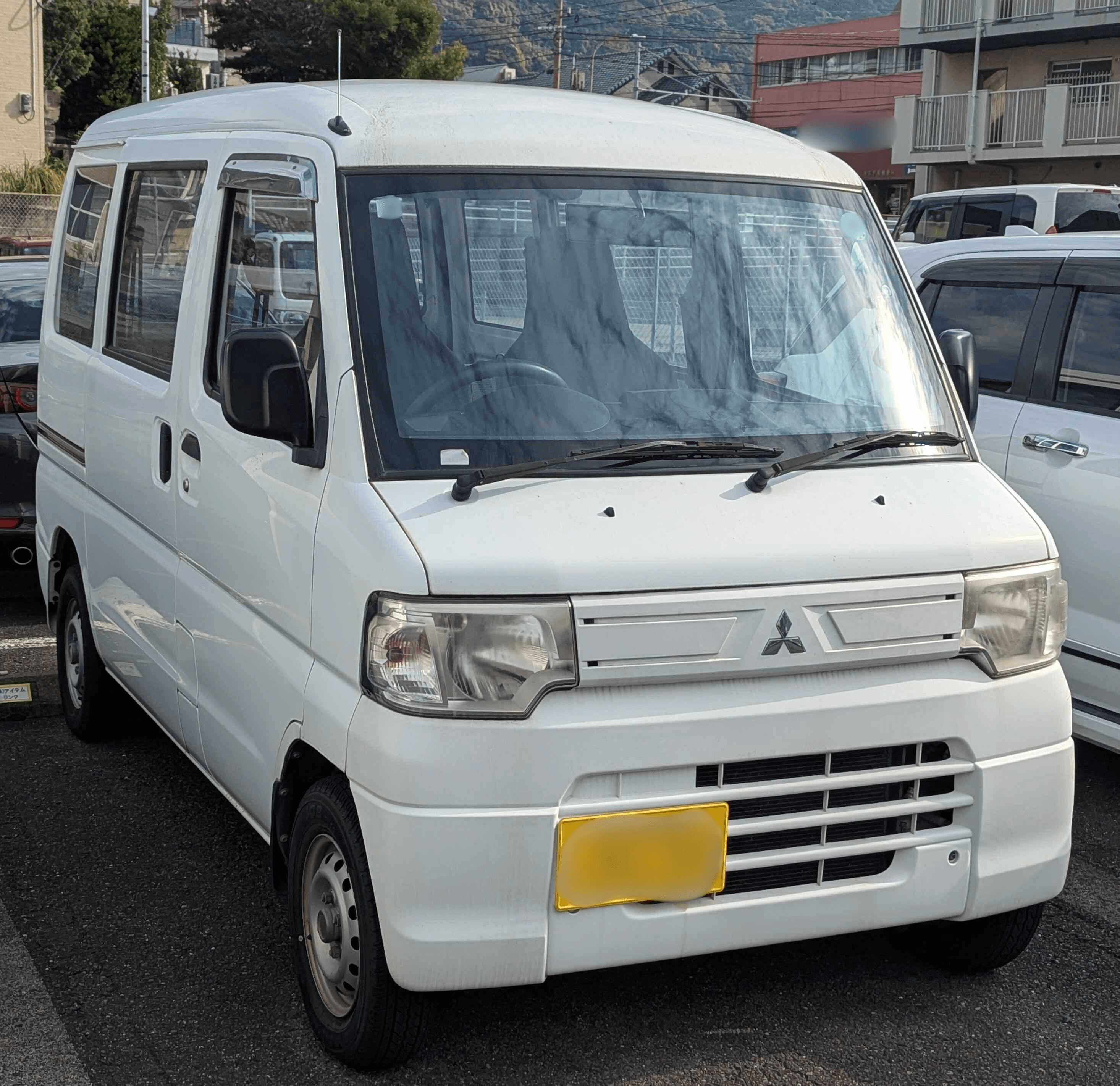
The Minicab Van is the Minicab's enclosed cousin, and just like the truck, it's criminally underpriced compared to the Suzuki Every and Subaru Sambar Van. If you're looking for a kei van and you don't care about nameplate bragging rights, this is probably the smartest money you can spend.
Origin & History
Mitsubishi has built a cargo van version of the Minicab since the original nameplate launched in 1966. The formula is dead simple: take the Minicab truck's cab-over chassis, extend the roof backward to create a boxy cargo area, add sliding side doors and rear barn doors, and sell it to every plumber, electrician, and delivery driver in Japan. The result is a van that's spent 60 years being refined for real commercial work.
By the time the U40V generation launched in 1991, Mitsubishi had the formula fully dialed in. The U60V (1999-2014) is the generation most buyers will encounter, and it's where Mitsubishi finally added creature comforts that make the van livable for non-work use — better insulation, power steering across the board, and optional air conditioning that actually works.
Generation Breakdown
U40V (1991-1999) — the stripped workhorse. Vinyl floor, steel walls, barely any insulation. Makes a great blank canvas for a camper build because there's nothing to tear out. The 45hp 3G83 is adequate empty, slow when loaded.
U60V (1999-2014) — significantly better for daily use. Mitsubishi added 5hp, power steering, and the option of a competent 3-speed automatic. Later U60V trims came with power windows and a factory CD player. Spring for a U60V if you're going to drive it regularly.
Engine & Drivetrain
Same 3G83 657cc three-cylinder as the Minicab truck, and everything I said about it there applies here. It's a commercial engine designed to last. The part-time 4WD system is available on most trims — the 4WD Minicab Van is one of the few kei vans that will confidently go off-road, which makes it a darling of the overlanding crowd. See the overlanding culture feature for what people are actually doing with these.
The 2WD variants are front-wheel drive (unlike the Sambar's rear-wheel setup), which makes them slightly less fun and slightly more practical for snowy parking lots.
What It Does Well
The Minicab Van is the perfect blank canvas for conversions. Mobile business? It's got a flat floor and tons of wall space for shelving. Camper conversion? The U60V has enough headroom to sit up straight. Just need a runabout? It'll haul a full 4x8 sheet of plywood on edge with the doors closed.
It's also one of the best kei vehicles for mobile business use because the rear cargo area is truly rectangular — no wheel wells intruding into the load space, because the rear wheels are tucked way back. For small business applications, check the business use cases article for real examples.
Known Weaknesses
- Rear barn door hinges — sag after years of opening and closing. Cheap to fix but worth checking alignment.
- Sliding door rails — rust and debris buildup causes them to stick. Lubricate quarterly.
- Cabin heater — same heater core issue as the Minicab truck. Expensive labor if it fails.
- Rear hatch struts — weak on later models. Budget $40 for replacements.
- Rust on the rocker panels and lower door edges — Japan's winter salt finds its way in.
Buying Advice
A clean U40V runs $4,500-$6,000. A U60V automatic with AC and power steering will be $7,500-$10,500. Pay the premium for a 4WD model if you live anywhere with winter or plan to go off-pavement — the 2WD to 4WD bump is usually only $1,000-$1,500 at auction and it dramatically expands the van's capability.
Inspect the rocker panels, the rear frame rails under the cargo area, and the condition of the sliding door tracks. A rusty sliding door is an expensive fix.
For the complete importing workflow, see the importing step-by-step guide. Run the total cost through the import cost calculator before you commit — a "cheap" Minicab Van can still land over $9,000 once you add shipping, customs, and registration.
Alternatives & Comparisons
Versus Suzuki Every: Every has more US market share, better parts network in California and the Pacific Northwest, and stronger resale. Minicab Van is cheaper to buy and mechanically just as good.
Versus Subaru Sambar Van: Sambar is rear-engine and more fun to drive, but the rear-engine layout eats into cargo space. Minicab Van has a genuinely flat, uninterrupted floor.
Versus Daihatsu Hijet Van: Hijet Van is a close competitor with slightly nicer interior materials. Comes down to price on the day.
Owner Experience
Driving a Minicab Van is exactly what you'd expect — you sit high, you see everything, and you feel like you're in a little delivery vehicle because you are. It's quiet enough (in U60V trim) to hold a conversation at 50 mph. Wind noise picks up above 55. It's never going to be a highway cruiser, but it handles 30-mile errand runs without complaint.
Should You Buy One?
Yes, if you want a kei van for actual work or conversion, and you don't mind that nobody at the kei meet will know what it is. The Minicab Van is the value king of the kei van segment — same reliability as the Every and Sambar for less money. Get a U60V with 4WD and air conditioning, and you've bought yourself years of practical fun for less than the cost of a used Civic.