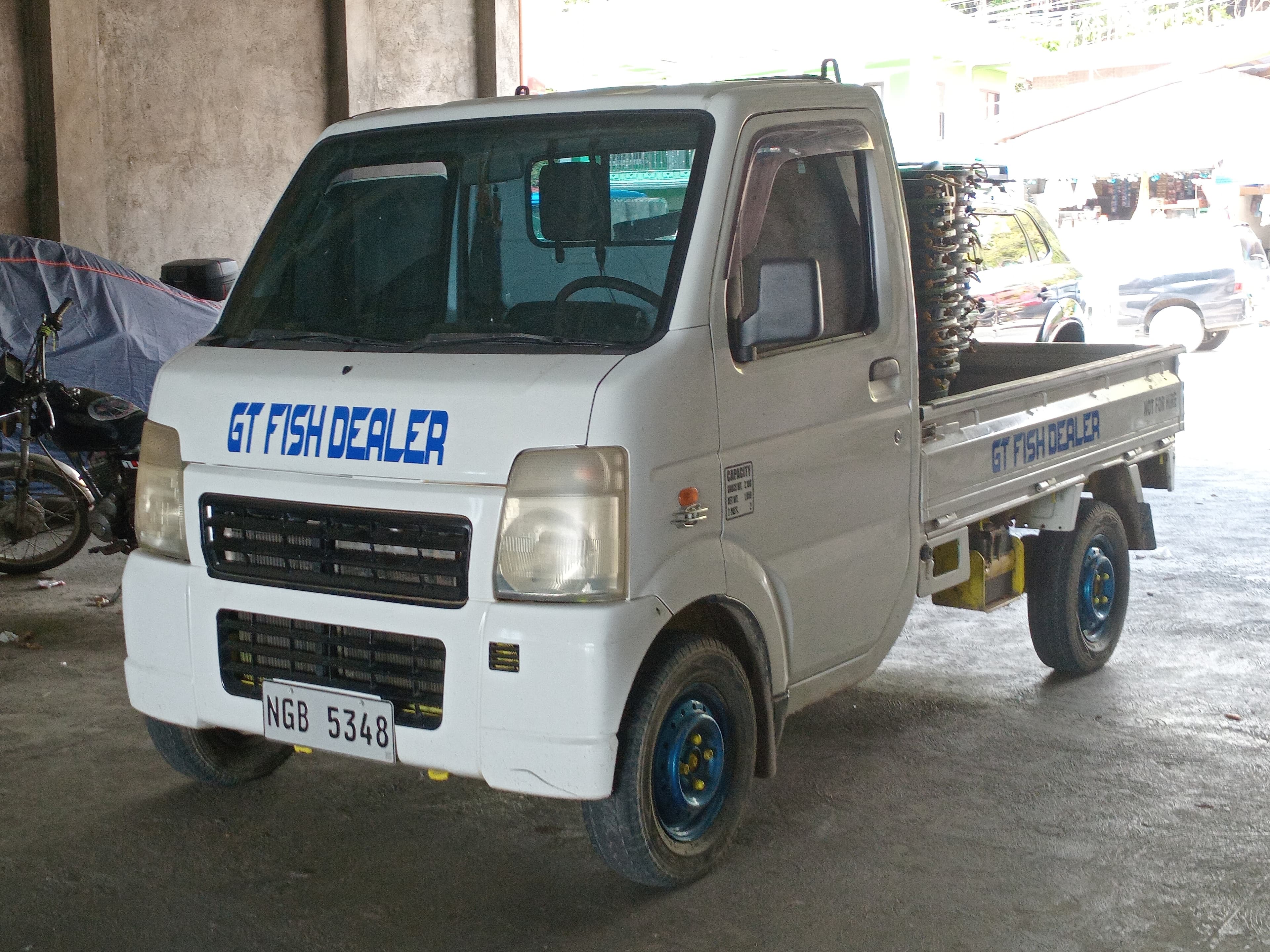
Before I became the guy who won't stop talking about kei trucks on the internet, I was the guy who couldn't afford a real truck for his landscaping side hustle. Summer of 2019. I was mowing lawns around Boise with a push mower strapped into the back of a Corolla. (Don't do this. The trunk didn't close. I used bungee cords. It was bad.)
Then a buddy showed me his Suzuki Carry, and I had one of those moments where your brain rearranges itself. A truck — a real truck with a bed, 4WD, and a tailgate — for under $7K? That could carry a mower, a trimmer, and a blower and still have room for bags of mulch? I bought Old Faithful two weeks later, and that little truck helped me run a profitable landscaping side gig for two summers before Keijira took over my life.
I'm telling you this because I'm not theorizing about kei trucks for landscaping. I did it. And I'm seeing more and more landscapers, contractors, and small service businesses figure out what I figured out: these trucks make absurd financial sense for small operations.
The Cost Comparison That'll Make You Mad
Let me lay out the numbers, because this is where it gets ridiculous. Rina helped me pull current pricing and she's annoyingly thorough (which is exactly what you want from someone crunching your business expenses).
Kei truck (Suzuki Carry or Daihatsu Hijet):
- Purchase price: $5K–$8K (landed, titled, ready to go)
- Insurance: $400–$800/year (yes, really)
- Fuel: ~45 mpg at $3.50/gallon = roughly $1,200/year at 15,000 miles
- Maintenance: $300–$500/year (these things are cheap to maintain)
Used Ford F-150 or Chevy Silverado (comparable year, decent condition):
- Purchase price: $25K–$35K
- Insurance: $1,500–$2,500/year
- Fuel: ~18 mpg at $3.50/gallon = roughly $2,900/year at 15,000 miles
- Maintenance: $800–$1,200/year
The math is stupid simple. Here's the 5-year total:
| Kei Truck | Full-Size Pickup | |
|---|---|---|
| Purchase | $7,000 | $30,000 |
| Insurance (5yr) | $3,000 | $10,000 |
| Fuel (5yr) | $6,000 | $14,500 |
| Maintenance (5yr) | $2,000 | $5,000 |
| 5-Year Total | $18,000 | $59,500 |
| Savings | $41,500 | — |
Forty-one thousand dollars. That's not a rounding error. That's a second truck, a trailer, new equipment, or just straight profit in your pocket. For a small landscaping operation doing $40K–$80K in annual revenue, that savings is the difference between scraping by and actually building a business.
What Actually Fits in a Kei Truck Bed
Let's be practical. The standard kei truck bed is roughly 6.5 feet long by 4.5 feet wide — smaller than a full-size pickup bed, but bigger than you'd think from looking at photos. During my landscaping days around Boise, I fit a 21" push mower standing upright against the cab, a string trimmer and edger laid flat along the side, a backpack blower, two 5-gallon gas cans, a toolbox full of hand tools, 10-12 bags of mulch stacked in the middle, and a small spreader. All at once. With a bed rack (which Dave has a complete build guide for), you can add extension poles, rakes, shovels mounted vertically, and even strap a ladder to the rack.
What does NOT fit? A full-size zero-turn mower — too wide, too heavy. A large commercial mower deck (52"+). Or more than about 800 lbs of anything, because you'll hit the payload limit.
The payload limit is the real constraint. Kei trucks are rated for 350-400 kg (roughly 770-880 lbs). That's plenty for a residential crew's equipment, but you need to be honest with yourself about what you're hauling. A push mower is about 80 lbs, a bag of mulch is 40 lbs, your trimmer, blower, and tools might total 60 lbs — you've got headroom.
Where it gets tight is bulk material. Gravel, soil, mulch by the yard instead of by the bag — you'll hit the weight limit fast. A cubic yard of topsoil weighs about 2,200 lbs, which is roughly 3x the kei truck's capacity. You can do partial loads (and the dump bed Hijet makes unloading a dream), but you'll be making multiple trips. I made peace with this reality pretty quickly — the fuel savings meant I could afford the extra drive time.
The Best Kei Trucks for Landscaping
Not all kei trucks are equal for this use case. Here's my ranking:
The Daihatsu Hijet with a dump bed is the landscaper's dream. If you can find one and stomach the price ($8K-$12K landed), it's purpose-built for this kind of work. Load up mulch, drive to the job site, pull the lever, done. No shoveling, no raking it out by hand, no killing your back at 7 AM before the real work starts. I used my buddy's dump bed Hijet for an entire summer and it genuinely changed how I thought about material delivery. What used to take 20 minutes of shoveling took 30 seconds of hydraulic magic. If you're primarily hauling loose material, the dump bed Hijet is the single best landscaping kei truck you can buy. Nothing else comes close for that specific job.
The Suzuki Carry is the budget workhorse — and it's what I actually used. Old Faithful doesn't have a dump option from the factory, but she's cheaper, parts are everywhere, and the aftermarket is huge. Throw on a bed rack and you've got vertical storage for poles and tools. Add a locking toolbox and you're in business — literally. The Carry is the better choice if you're watching every dollar, which most startup landscapers are.
The Honda Acty is the underdog that doesn't get enough love for commercial work. The mid-engine layout gives it slightly better weight distribution when loaded, and the build quality is Honda-level. Parts are a bit harder to find than the Carry, but not as tough as the Hijet. Good middle ground if you can find one at the right price.
Mods That Pay for Themselves
Dave would kill me if I wrote about work trucks and didn't talk mods. So here are the ones that actually make sense for a landscaping rig — not just looking cool, but earning money.
A bed rack runs $200-$400 if you DIY it or $500-$800 pre-fab, and it transforms the truck by giving you vertical storage for rakes, shovels, poles, and trimmers while freeing up bed space for heavier items. Dave has a complete build guide that you can knock out in a weekend. A locking toolbox ($150-$300) bolted across the front of the bed keeps your hand tools, fasteners, and small equipment secure overnight — Dave covers options in his toolbox and storage guide. LED work lights ($50-$150) mounted on the bed rack or cab roof extend your earning hours into early mornings and late evenings during fall and winter. And upgraded tie-down anchors ($30-$50) replace the stock tie-down points with heavy-duty cleats so your mower isn't going anywhere on a bumpy road.
Total mod investment: under $1,000. Every one of these pays for itself within a month of actual landscaping work. I wish I'd done all four on day one instead of adding them gradually over my first season.
The Tax Angle (Talk to Your Accountant, But Read This First)
Rina dug into this one and the news is good: kei trucks used for business get the same tax treatment as any other work vehicle.
Section 179 Deduction: You can deduct the full purchase price of your kei truck in the year you buy it, up to the annual limit (which is well above what you'll pay for a kei truck). If you buy a $7K Carry and use it 100% for business, that's $7K off your taxable income in year one.
Standard Mileage Deduction: For 2026, the IRS rate is 70 cents per mile. If you drive 10,000 business miles, that's a $7,000 deduction — which, yes, is roughly what the truck cost. (The math on these things is almost unfairly good.)
Actual Expense Method: Alternatively, deduct actual costs — gas, insurance, maintenance, depreciation. For a kei truck with rock-bottom operating costs, the standard mileage rate usually wins, but run both calculations.
Mixed use? If you use the truck for both business and personal driving, you can only deduct the business percentage. Keep a mileage log. There are apps for this. It takes 10 seconds per trip.
I'm not an accountant and neither is Rina (she's quick to remind people of this), so talk to yours. But the bottom line: Uncle Sam doesn't care if your work truck is 12 feet long or 10 feet long. A business vehicle is a business vehicle.
When Is a Kei Truck NOT Enough?
I'd be lying if I said a kei truck works for every landscaping operation. It doesn't, and pretending otherwise would waste your time and money.
If you run a zero-turn mower, stop here. Most zero-turns weigh 700-1,000+ lbs and are 48-60" wide. They won't fit. Period. If your business model requires a zero-turn, you need a full-size truck and a trailer. If you haul bulk materials daily — delivering yards of mulch, gravel, or topsoil as a core part of your business — the 800 lb payload limit will drive you insane. Multiple trips eat into your margins faster than the fuel savings add up.
If you need to tow heavy trailers, kei trucks can handle light trailers (1,000-1,500 lbs max, and even that's pushing it), but they're not tow vehicles. If you need to pull an enclosed trailer full of equipment, you need more truck. If your jobs are spread across a metro area and you're regularly doing 60+ mph on highways, a kei truck will feel sketchy — they're happiest under 50 mph, and local routes and residential neighborhoods are their sweet spot.
And check your state's regulations before you buy. Not every state allows kei trucks on public roads. Some are fully legal, some restrict them to off-highway use, and some are in a gray zone. If you're in a restricted state, this whole conversation only applies to private property use between job sites.
The Landscaper's Playbook
Here's the move, step by step:
- Check your state's regulations — if kei trucks aren't street legal where you operate, this conversation is over (or you're using it strictly on private property between job sites)
- Buy a Carry if budget matters, a dump bed Hijet if you haul loose material — both are excellent, the Carry is $1K–$2K cheaper
- Add a bed rack and toolbox immediately — under $500 in parts, one weekend of work, transforms the truck's utility
- Set up a mileage tracking app — you'll thank yourself at tax time
- Talk to your accountant about Section 179 — potentially deduct the entire purchase price in year one
- Run the numbers after 6 months — I guarantee you'll be wondering why everyone else is paying $800/month for an F-150 payment
Look, I know it sounds too good to be true. A $7K truck that does 45 mpg, costs nothing to insure, and can handle a full residential landscaping setup? I didn't believe it either until I lived it. Old Faithful paid for itself in the first season.
The landscaping industry is full of guys driving trucks that cost more than their annual profit. Don't be that guy. Be the guy in the tiny truck with the big margins.
Trust me on this one.
Thinking about making the switch? Run the numbers on our import cost calculator, or check out the dealer directory to find a kei truck near you. Questions? Email us at keijirateam@gmail.com.