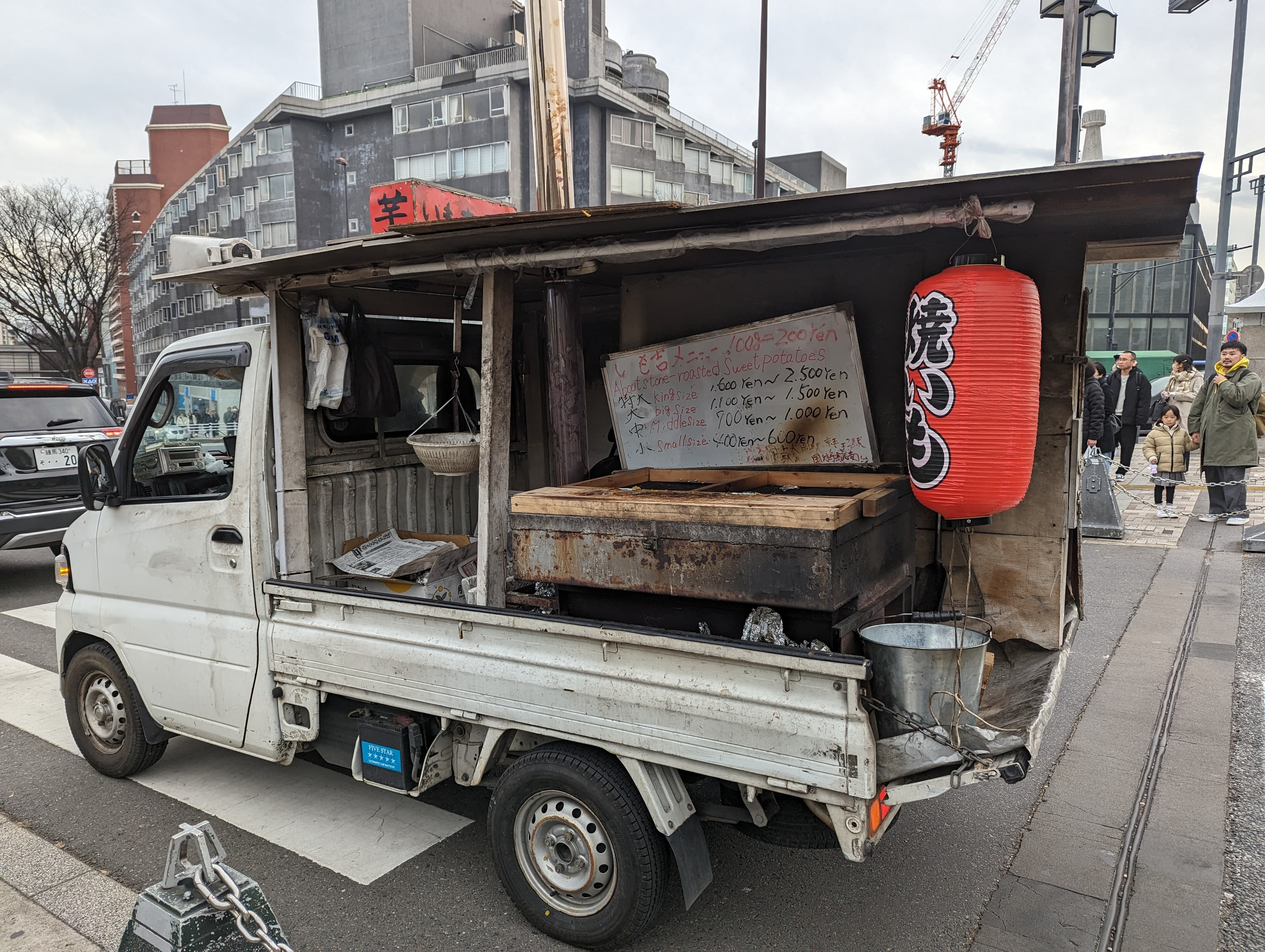
You hear it before you understand it. You've just dropped Samu-chan into reverse in the Fred Meyer parking lot — my '94 Sambar Van, the one with the ceramic mugs rattling in the back — and a small, bright melody floats up from somewhere beneath you. Three ascending notes, tinkling and precise, like a wind-up jewelry box your grandmother kept on her dresser. The woman loading groceries into her Subaru Outback two spaces over stops mid-bag and stares. Not alarmed. Enchanted.
"Is that... your truck?"
That's it. That's the moment. Every kei truck owner in America has had some version of it — the first time their vehicle sang to them, and the first time a stranger heard it too.
Japanese kei trucks are full of sounds that American vehicles simply don't make. Not the engine note or the rattle of a thirty-year-old cab — those are universal. I mean the designed sounds, the intentional ones, the ones someone at Suzuki or Daihatsu or Subaru sat down and composed — or at least carefully selected — for a 660cc work truck that costs less than a used couch.
There's the reverse chime, the most famous one, the one that stops people in parking lots. But there are others. The turn signal on a Suzuki Carry doesn't just click — it tocks, a warm mechanical pulse that sounds like a metronome in a quiet room. The door-ajar warning on a Hijet is a gentle, repeating two-tone phrase, not the angry sustained buzz of an American sedan but something closer to a polite tap on the shoulder. The seatbelt reminder chimes softly, then pauses, then chimes again — patient, unhurried, as if to say whenever you're ready. Leave your headlights on in a Sambar and a small melody plays when you open the door, just long enough to catch your attention, never long enough to annoy.
These are not accidents. These are not afterthoughts.
There's a word for this in Japanese — omotenashi, the art of wholehearted hospitality, of anticipating needs before they're spoken. It's the reason a Tokyo convenience store clerk hands you your change with both hands, the reason a ryokan innkeeper places slippers at the exact angle your feet will find them, and it's the reason a Daihatsu engineer decided that a kei truck's reverse warning should be a melody instead of a beep.
In Japanese design philosophy, every interaction between a person and an object is an opportunity for kimochi ii — that feeling of something being just right. A sound that grates is a failure of consideration. A sound that delights is a gift. The history of kei trucks is a history of constraints — 660cc engines, 3.4-meter bodies, weight limits that would make an American engineer laugh — but within those constraints, Japanese manufacturers poured extraordinary care into the details that most people would never notice. The sounds were part of that care. Safety regulations required audible reverse warnings. The law said beep. The engineers heard music.
This is the part nobody talks about — each manufacturer, each model, each generation has a distinct sonic identity, and owners learn to recognize them the way you learn to recognize a friend's laugh.
The Suzuki Carry plays a crisp, bright melody — four notes ascending, almost cheerful, like a bicycle bell turned into a song. The Daihatsu Hijet's chime is lower, warmer, with a rounded tone that Dave Russo once described as "a doorbell for a really nice hobbit house" — and honestly, he's not wrong. The Subaru Sambar — my Samu-chan — has what I can only call a lullaby: three notes, a pause, three notes again. It sounds like something you'd hear in a Miyazaki film, drifting through a forest clearing. I've had it for four years and it still makes me smile every single time.
The vans tend to have slightly different chimes than the trucks, even within the same manufacturer — a Mitsubishi Minicab truck and a Minicab Van from the same year will play different melodies, siblings with different singing voices. Some early '90s models used actual mechanical music box mechanisms bolted near the rear axle, tiny brass cylinders with pins that pluck metal tines. Later models switched to electronic modules, but the philosophy remained: make it musical, make it human, make it kind.
A few weeks ago, a thread blew up on the kei truck subreddits — "Anyone else have a music box?" — and the comments were pure joy. Two hundred and forty-six upvotes, people sharing videos of their reverse chimes, comparing melodies, one person admitting they reverse unnecessarily just to hear the tune. Someone wrote: "I've owned twelve trucks in my life and this is the first one that ever made me happy to back up."
There's something happening in that reaction that goes deeper than novelty. Americans are used to vehicles that communicate through warnings — angry buzzers, harsh chimes, flashing red lights that say you did something wrong. The sonic vocabulary of an American car is the vocabulary of a scolding parent. Kei trucks speak a different language entirely — their sounds say I'm here to help you and please be careful and don't forget your lights, and they say it gently, melodically, with the quiet confidence of someone who respects you enough not to shout. It's the same quality that draws people to the kei truck aesthetic more broadly — the feeling that every element was considered, that even the most utilitarian vehicle in Japan was designed with a kind of tenderness. You feel it in the sounds, but you also feel it in the way the dome light dims slowly instead of cutting out, in the way the window crank has just the right resistance, in the way the heater knob clicks into each position with a satisfying detent.
Some owners disconnect the reverse chime. I understand the impulse — it's loud in a quiet neighborhood at 6 AM, or maybe it feels too precious for a farm truck caked in mud. Dave has a great guide on electrical modifications, and yes, it's usually just a single wire or a small module you can unplug. But most people keep it. In every forum thread, every Reddit post, every conversation I've had at kei truck meets from Portland to Boise, the consensus is the same — the sounds stay. They're part of the character, part of the contract you made when you chose a vehicle from a country that believes a work truck deserves a lullaby.
Jake Mori told me once that the reverse chime on his '97 Carry is the single feature he mentions most when people ask about the truck. Not the 4WD. Not the dump bed. The melody. "It's the thing that makes people realize this isn't just a small truck," he said. "It's a small truck from a culture that cares about different things than we do."
I think about this a lot — sitting in Samu-chan outside my ceramics studio in the early morning, coffee in the cupholder, Nori the cat sleeping on the passenger seat, the engine ticking as it cools. There's a word in Japanese for the bittersweet awareness of passing things — mono no aware, the gentle sadness of impermanence. These trucks are thirty years old now. Their music boxes are aging. Some have gone silent. Some play their melodies a half-step flat, the way a music box does when its spring is winding down.
But they're still singing. In parking lots across America, in driveways in Idaho and Vermont and Texas, these tiny trucks are playing their tiny songs for people who never expected to hear them — people who bought a cheap work truck and found, hidden under the seat or tucked behind the tail light, a small act of grace from an engineer in Hamamatsu who believed that even a beep could be beautiful.
And something shifts. Not just in the parking lot. In you.