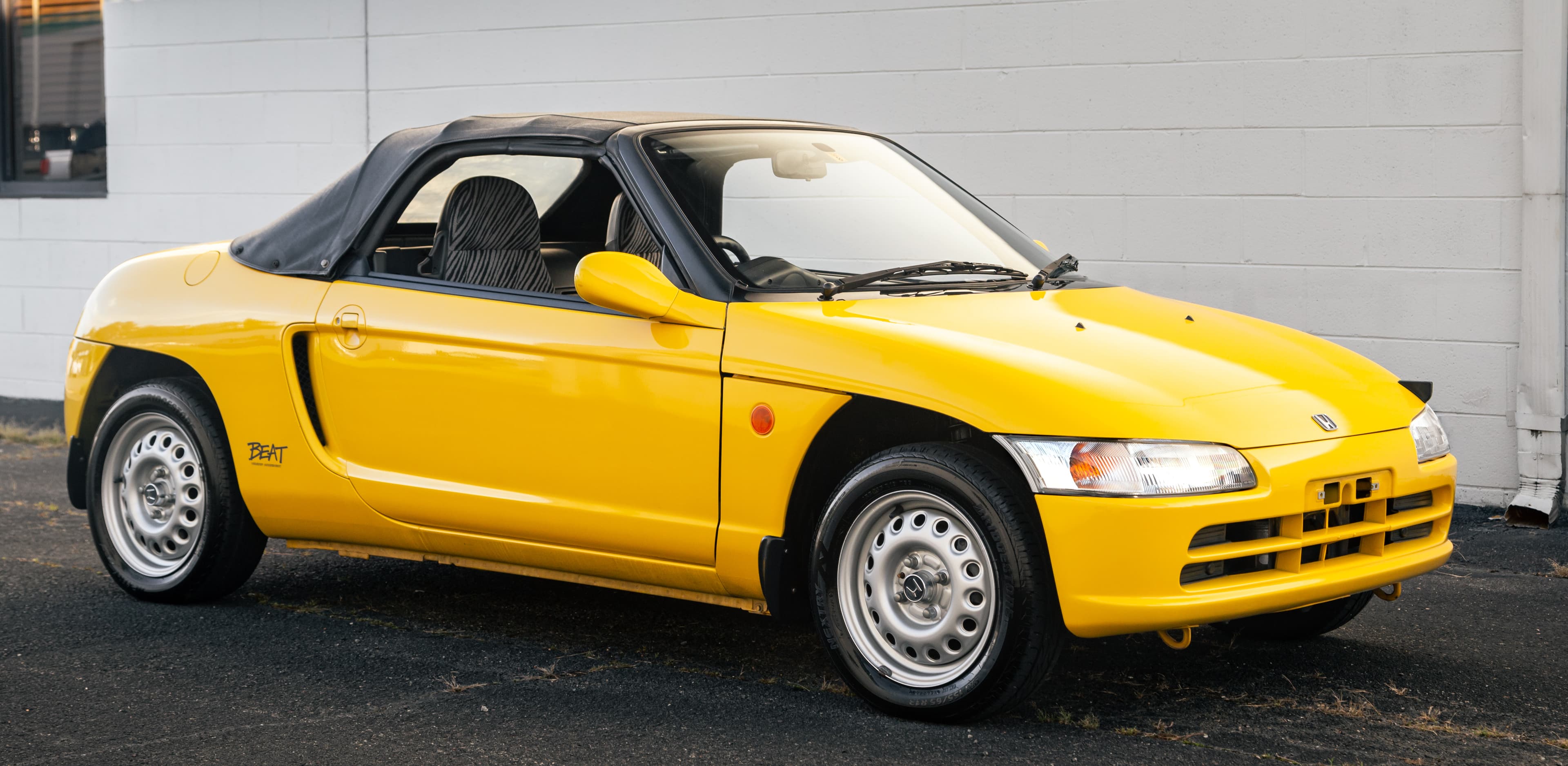
The Honda Beat is the kei car enthusiasts talk about with the same reverence they reserve for the NSX and the S2000. A mid-engine layout like the NSX. A high-revving naturally aspirated soul like the S2000. A chassis tuned by people who understood what makes a sports car feel alive. Honda built a pocket supercar, sold it for the price of a commuter car, and three decades later it's still one of the purest driving experiences available at any price.
Origin & History
The Beat arrived in May 1991, at the front of the golden era of kei sports cars alongside the Suzuki Cappuccino and the Autozam AZ-1 — the legendary "ABC" trio. Japan's bubble was still inflating, regulations had just allowed kei cars to make a full 64 horsepower, and every major manufacturer wanted to prove they could build a driver's car in the tightest possible package.
The exterior design is credited to Pininfarina — yes, that Pininfarina. The Beat was the last car personally approved by Soichiro Honda before he passed away in August 1991, just months after the car launched. Over roughly 33,000 were built across five years — not ultra-rare, but not common either in clean condition.
Generation Breakdown
There's only one generation, the PP1, produced from 1991 to 1996, and every example is now eligible for US import under the 25-year rule. But there are meaningful variants to know about:
- Early cars (1991-1993) — Version C and base trims. Mostly stock, usually higher miles.
- Version F (1992-1995) — minor trim and color updates, often in the more collectible red and yellow colors.
- Version Z (1995-1996) — the last-run special edition with unique wheels and interior trim. Rare and commanding a premium.
Mechanically, all Beats are essentially identical — same E07A engine, same 5-speed manual, same chassis. The decision is really about condition, color, and mileage, not trim level.
Engine & Drivetrain
The E07A is where the magic lives. It's a 656cc naturally aspirated SOHC three-cylinder — small even by kei standards — and it makes the class-maximum 64 hp at 8,100 rpm. What makes it special is Honda's MTREC system (Multi Throttle Responsive Engine Control), which gives each cylinder its own individual throttle body. Three cylinders, three throttle bodies. On any other 660cc engine this would be insane. On a Honda, it's normal.
The result is an engine that wants to be revved to redline on every shift. Peak power is basically at the redline, peak torque is at 7,000 rpm, and below 5,000 rpm it feels lazy. This isn't a flaw — it's the point. The Beat rewards you for driving it like you mean it. The 5-speed manual is one of the best Honda ever built, with short throws and a perfect gate. There was no automatic option. Ever. Good.
The mid-engine rear-drive layout gives the Beat a 44/56 weight distribution and handling that feels uncannily balanced. At 1,675 lbs with a low center of gravity, it carves corners in a way that makes faster cars feel clumsy.
What It Does Well
The Beat does exactly one thing brilliantly: make the act of driving feel like an event. On a back road, with the top down, at 6,500 rpm in second gear, there is nothing else on Earth that feels like a Beat. It's small enough to make every corner feel like a canyon run. It's underpowered enough that you can actually use all of it on public roads without losing your license. And the mid-engine soundtrack sitting six inches behind your head is addictive.
It's also a surprisingly good car to own and show. The design has aged remarkably well — those pop-up headlights and clean lines still look modern, and Beats draw attention at every cars and coffee.
Known Weaknesses
The Beat has its quirks. Going in with open eyes saves money:
- Timing belt — interference engine. Must be replaced on schedule. Budget for it the moment you buy the car if service history is unclear.
- Cam chain tensioner rattle — some cars develop top-end noise. Usually manageable but can become expensive.
- Rear main seal leaks — common on higher-mileage cars.
- Original electric top motor — fails. Many cars now use manual operation.
- Rust — check the frame rails, the area under the soft top latch, and the rear fender lips. Japanese coastal cars can be hiding serious rot.
- Dashboards crack — the original dash material is notorious for UV damage. A cracked dash is standard, a perfect dash is a reason to pay more.
Buying Advice
Here's the reality of the 2026 Beat market:
- $8,000-$11,000: high-mileage project cars, cracked dashes, faded paint, possibly some rust.
- $12,000-$16,000: solid drivers. Clean body, running well, minor cosmetic issues. This is the sweet spot.
- $17,000-$22,000: low-mileage, well-preserved examples. Museum-quality cars push higher.
Prefer a car with documented service history over a lower-mileage car with unknowns. A 120,000 km Beat with a fresh timing belt and clean frame is a better buy than an 80,000 km Beat with no records. Use the kei cars buyers guide for pre-purchase inspection specifics, and run the total cost through the import calculator before you bid — Beats aren't cheap to land in the US.
Alternatives & Comparisons — The ABC Trio
Versus Suzuki Cappuccino: Cappuccino is front-engine, turbocharged, and more conventional. It has broader torque, more power down low, and a removable hardtop. The Beat is more analog, more involving, and has a better engine note at the top end. If you want a traditional sports car feel, Cappuccino. If you want a miniature supercar experience, Beat.
Versus Autozam AZ-1: AZ-1 is rarer, crazier, and more expensive. Gull-wing doors, mid-engine turbo, fiberglass body. It's the visual showstopper. The Beat is more usable day-to-day and a lot more affordable.
The Beat is the driver's choice of the three. Cappuccino is the best all-rounder, AZ-1 is the collector's piece, Beat is what you buy if you just want the most fun.
Owner Experience
Owning a Beat is an emotional experience, not a practical one. The cabin is tiny — six-footers fit, but barely. Cargo space is a joke. There's no cup holder. But you don't buy a Beat to cup-hold. You buy a Beat to drive, and when you do, you remember why you love cars. The steering is communicative in a way modern electric-assist cars can't replicate. The pedals are perfectly placed for heel-toe downshifts. Every input matters, and 45 minutes on a good road turns into a full grin.
Should You Buy One?
If you've ever loved a sports car, yes. The Honda Beat is one of the last analog driver's cars ever built, and it happens to fit the kei definition, which means it's legal to import and own. Prices are climbing and they're not stopping. Buy the best one you can afford, drive the wheels off it, and it will still be worth more in five years than you paid. If the ABC trio calls to you, the Beat is where most enthusiasts should start.