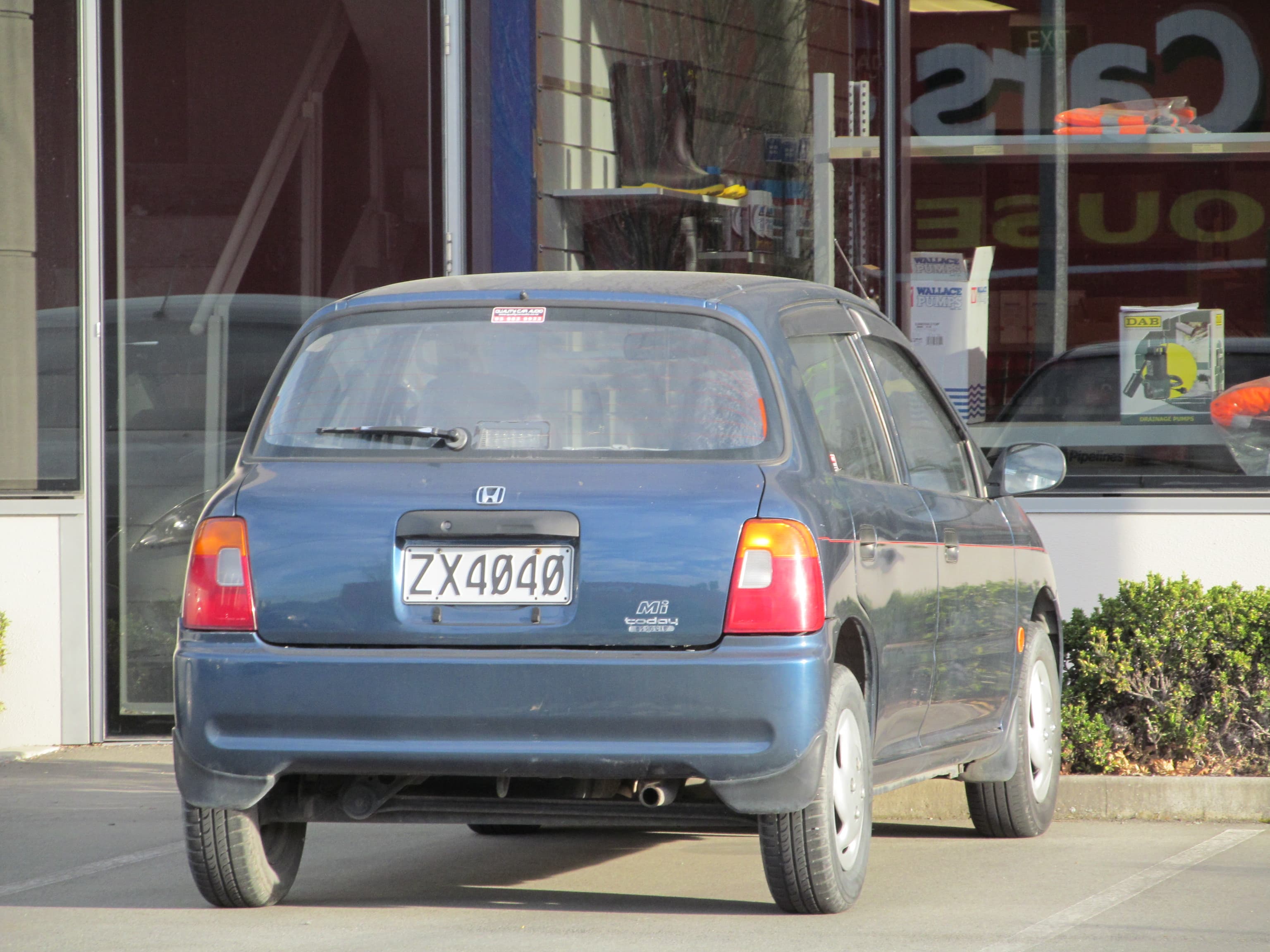
Let's be honest about what the Honda Today is: it's not a collector car, it's not a performance car, it's not a lifestyle car. It's a cheap, reliable, stupidly efficient city commuter that happens to be Japanese, tiny, and eligible for 25-year import. And for the right buyer, that's exactly the point. The Today is the kei car for people who want to spend as little money as possible on transportation without owning a vehicle they're embarrassed by.
Origin & history
Honda launched the original Today in 1985 as a competitor to the Suzuki Alto and Daihatsu Mira in the cutthroat entry-level kei car segment. The original was a tiny, basic, rear-hatchback economy car — literally the cheapest new Honda you could buy in Japan. The JA4/JA5 generation we care about today arrived in 1993 as a significantly improved version: more refined, better built, and fitted with the well-proven E07A engine from the Acty truck line.
The design philosophy has always been "cheap but not a penalty box." Honda wanted the Today to feel like a scaled-down Civic rather than a bargain-bin kei car, and they mostly succeeded. The interior ergonomics, build quality, and driving feel are noticeably a step above what the price point implied when new.
Generation breakdown
The JA4/JA5 generation (1993-1998) is the one most US importers focus on. JA4 is the standard front-wheel-drive model; JA5 is the 4WD variant, which is rarer and more valuable in snowy climates. Trims ranged from stripped-out base models with crank windows and no radio up to the "Mi" and "Rs" trims with nicer seats, better trim, and in some cases alloy wheels.
Both 5-speed manual and 3-speed automatic transmissions were offered. The manual is more fun, more efficient, and what I'd pick if I were buying one. The automatic is perfectly fine for pure city work.
Engine & drivetrain
The E07A 656cc three-cylinder is the same engine family that powers the Acty truck and the JA-series Honda Today. It's a SOHC 6-valve unit making 48hp — nothing special on paper, but it's smooth, willing to rev, and almost unkillable with basic maintenance. Timing belt at the interval, regular oil changes, periodic valve adjustments, and this engine will run essentially forever. Fuel injection is standard on all JA4/JA5 examples, which means no carburetor quirks to deal with.
Front-wheel drive on the JA4 is simple, transverse, and serviceable with basic tools. The 4WD system on the JA5 is a lightweight viscous-coupling setup that engages the rear wheels when the fronts slip — it's useful in snow but it's not meant for off-road work. Don't confuse this with the proper part-time 4WD you'd find in a Jimny.
What it does well
Commuting. This is the entire reason to own a Today. It's 45+ mpg city, it's tiny enough to park anywhere, it's cheap to insure (most US insurers rate it as an imported economy car, not a sports car), and the maintenance costs are negligible. If you live in a dense city and want a second car that costs almost nothing to operate, the Today is hard to beat.
It's also surprisingly pleasant to drive. The Honda chassis DNA is there — the steering is direct, the ride isn't punishing, and the E07A feels eager when you wring it out. It's not fast, but it's not unpleasant, which is more than I can say for most base-model economy cars from the '90s.
Known weaknesses
Rust is the biggest one. These were cheap cars built to a price point, and Honda didn't use the best undercoating. Rust-belt imports need a very thorough inspection of the rocker panels, the rear wheel arches, and the battery tray. CV boots tear and need replacement. Radiator caps weep on high-mileage examples. The automatic transmission is reliable but the fluid should be changed on a strict schedule — skipping it is how they fail.
Interior plastics are brittle. Expect broken dashboard bits, cracked steering wheels, and door handles that have given up. These are easy fixes but they add up. Air conditioning on early examples is often tired and may need a recharge or a compressor.
Buying advice
The Today is the cheapest Honda kei car you can realistically buy in the US, and that's a feature, not a bug. A clean JA4 manual in the $3,500-$5,500 range is doing great. A JA5 4WD example commands a premium and tends to land in the $5,500-$7,500 range. Anything under $3,000 almost always has rust issues or a mechanical problem you're going to inherit.
Avoid examples with aftermarket modifications that don't belong on a commuter — lowered Today cars with body kits exist in Japan and they've usually been thrashed. Pure, unmolested base-model Todays are actually the ones you want for reliability. Our complete buying guide walks through the inspection process, and the maintenance and parts guide covers parts sourcing — which is worth reading because Today-specific parts are rarer than Acty parts.
Alternatives & comparisons
The direct competitors in the "cheap kei commuter" category are the Suzuki Alto, the Daihatsu Mira, and the Mitsuoka Ray. The Alto and Mira are typically cheaper still, but the Today has the best engine and the best build quality of the group. If you're cross-shopping and you care about long-term reliability, the Today is the pick. If you care about absolute lowest cost of entry, the Mira wins.
The Today is not a substitute for a kei truck or van. If you need cargo capacity, look at the Acty, the Carry, or the Every. The Today is purely a passenger commuter.
Living with it
Fuel economy is 45-50 mpg in mixed driving, which is genuinely excellent and competitive with modern hybrids on city-only routes. Top speed is around 70-75 mph — it'll do the interstate if you have to, but it's buzzy and tiring over long distances. Interior room is decent for two adults, tight for four. Heat is good, A/C is okay when it works, visibility is excellent. My colleague Rina — who covers our regulations content — has been trying to buy one for her city runabout forever, and she's right that it's one of the best pure value propositions in the entire kei world.
Should you buy one?
Only if you know what you're buying. The Today is not exciting, it's not a collector, and it's not going to turn heads at a meet. What it is, is the cheapest possible entry into kei car ownership, powered by one of the most reliable small engines ever built, in a package that costs almost nothing to run. If you want a second car that'll handle the boring daily-driving duty while your fun car stays clean in the garage, the Today is a hard vehicle to argue against. Run the numbers in our import cost calculator — you'll be shocked how little a clean one actually costs to land.