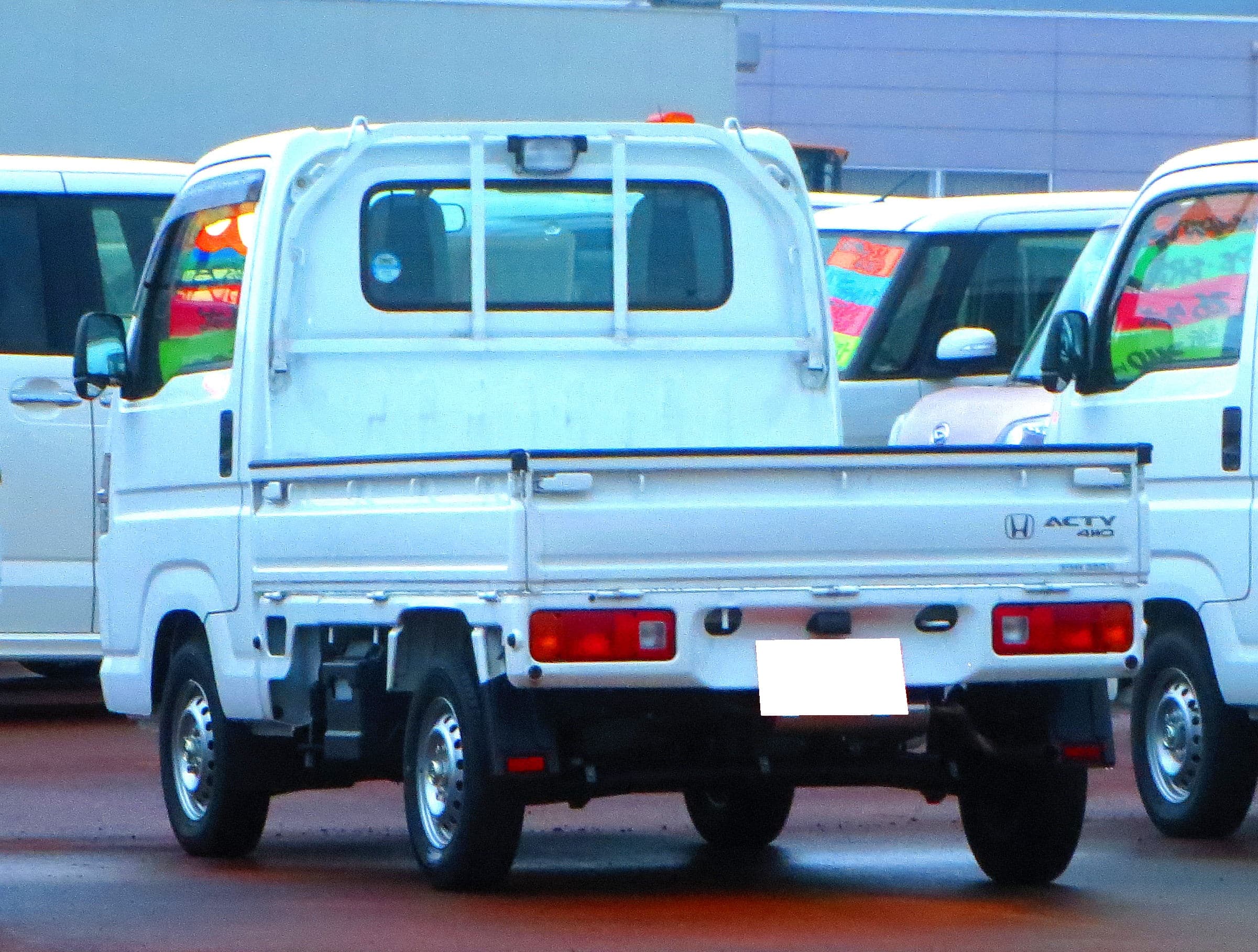
My second kei is a '98 Acty Van, and here's what I've learned: the Acty is the enthusiast's kei truck. It's the one people fall in love with after they already own one of the others. It's not the cheapest, it's not the easiest to service, and the resale value is strong because people who own them don't want to sell them. The Acty has the best chassis dynamics of any kei truck, period, and once you figure out why, it's hard to go back to a front-engine design.
Origin & history
Honda launched the Acty in 1977 as a replacement for the ancient TN360, and from day one Honda did what Honda does: they looked at what everyone else was building, decided it was boring, and put the engine behind the cab under the bed. The "mid-engine" layout isn't a marketing gimmick — it genuinely changes the way the truck drives, steers, and handles loads. Honda has always been the engineering-first kei truck, and the Acty is the clearest expression of that.
US importers focus on two generations: the HA3/HA4 (1990-1999) and the HA6/HA7 (1999-2009). Both are now importable, and the later HA6/HA7 is continuing to roll across the 25-year line each year. There's also the HA8/HA9 starting in 2009, which is still too new for most buyers but will become relevant in a few years.
Generation breakdown
HA3/HA4 (1990-1999) — The classic Acty. HA3 is 2WD, HA4 is 4WD. The E07A engine is carbureted on the very earliest examples and fuel-injected on most. Real-time 4WD is standard on HA4 — meaning the front wheels engage automatically when the rear slips, no button or lever required. Analog gauges, simple interior, plenty of character. This is the generation you chase if you want a mechanically-pure Acty.
HA6/HA7 (1999-2009) — Redesigned body, more interior room, updated E07Z engine. HA6 is 2WD, HA7 is 4WD. Crucially, the HA7 can be optioned with a dual-range (sub transmission) that gives the Acty a proper crawler gear for off-road work — this is the single best off-road kei truck feature most people don't know about. The 3-speed automatic became a real option on this generation and is fine for in-town work.
The HA8/HA9 (2009-2021) brought more refinement and the SDX trim, which is commonly seen in current import listings as it ages in.
Engine & drivetrain
The E07A and E07Z are both 656cc three-cylinder engines, both SOHC 6-valve, and both classic Honda in the way they feel: they love to rev. Where the Suzuki F6A makes peak torque down low and runs out of breath at 5,000 RPM, the Honda engines pull happily to 7,000 and sound good doing it. Horsepower is competitive — 45hp on E07A, 48hp on E07Z — but the character is totally different.
Real-time 4WD is Honda's take on AWD: a viscous coupling between the front and rear driveshafts engages the front wheels when rear slip is detected. It's fully automatic, you can't turn it off, and it works well in snow and mud. It's not a substitute for a locking diff or low range if you're doing serious off-road work — that's what the dual-range option on the HA7 is for.
Reliability is exactly what you'd expect from a 660cc Honda engine: stupid good if you service it. Timing belt at the interval. Valve adjustments. Regular oil changes. These engines routinely clear 150,000+ miles with nothing dramatic. Valve adjustments are a real thing on these, though — don't skip them like you would on a modern car.
What it does well
Handling. The mid-engine layout puts roughly 50/50 weight distribution on a truck that weighs about 1,600 lbs empty, and that matters more than it sounds. The Acty feels planted in corners, tracks straight at speed, and doesn't get nervous when you load the bed up. On hilly terrain, the weight over the drive wheels means the Acty claws up grades that make a front-engine Carry squirm.
It also runs quieter at highway speed than most kei trucks because the engine isn't sitting under your seat. The HA7 with dual-range is one of the most capable off-road kei trucks ever made — I'd argue it's the best all-around choice if you're splitting time between on-road and trail use.
Known weaknesses
Access. Maintenance that takes five minutes on a Carry takes twenty on an Acty because you have to pull a bed panel to reach the engine. Spark plugs, belts, fluids — all doable, but all more involved. The bed floor panels rust, especially around the access hatch seals. Timing belt tensioners have been known to seize on high-mileage trucks that sat. E07Z engines are sensitive to oil starvation if you let them run low. Real-time 4WD viscous couplings can fail on neglected trucks — symptom is loss of automatic front engagement.
Parts are slightly more expensive than Suzuki or Daihatsu equivalents because Honda parts just cost more, full stop. Not scary money — just a bit more.
Buying advice
For an HA4 4WD in clean condition with the E07A and the 5-speed, $7,500-$10,000 is the fair zone. For an HA7 4WD with dual-range, you'll pay $10,000-$14,000 and you should, because that dual-range gearing is worth the premium if you'll use it. Avoid HA3/HA6 2WD variants unless you live somewhere flat and dry — the 4WD trucks hold value better and are more useful.
Watch for oil leaks around the engine bay, check the bed access panels for rust, and listen carefully for timing belt noise at idle. Our complete buying guide covers the inspection process in detail.
Acty vs Carry vs Hijet
This is the question I get most often. Short version: pick the Carry or Hijet if you prioritize cheap, easy maintenance and the lowest possible buy-in. Pick the Acty if you care about how the truck drives and you're willing to pay slightly more for a better chassis and a revvier engine. The Acty is also the best choice if you'll spend meaningful time on hilly roads or loaded up — the weight distribution matters. Our hijet vs carry guide covers the Suzuki/Daihatsu side of the decision; the Acty sits above both of them in price and driving satisfaction.
Living with it
Daily-drivable for short commutes and errands. Top speed is an honest 65-70 mph — slightly better than the Carry thanks to the revvier engine and better aero. Fuel economy lands around 35-42 mpg. Heat and A/C are both good because the engine isn't cooking you from below. The cabin is marginally larger than a Carry's, which matters if you're taller than 6 feet. It's fun to drive — genuinely fun, not "fun for a kei truck" — and that's the Acty's hidden superpower. Run the numbers in our import calculator to see what a clean one lands for.
Should you buy one?
If you're a second-time kei buyer, or a first-time buyer who already knows they want the enthusiast's pick, yes. The Acty rewards the extra attention you have to pay it with a driving experience no other kei truck matches. If you just need the cheapest, simplest work truck, buy a Carry and save the difference. But if you want to grin every time you drive home from the hardware store, the Acty is the answer.