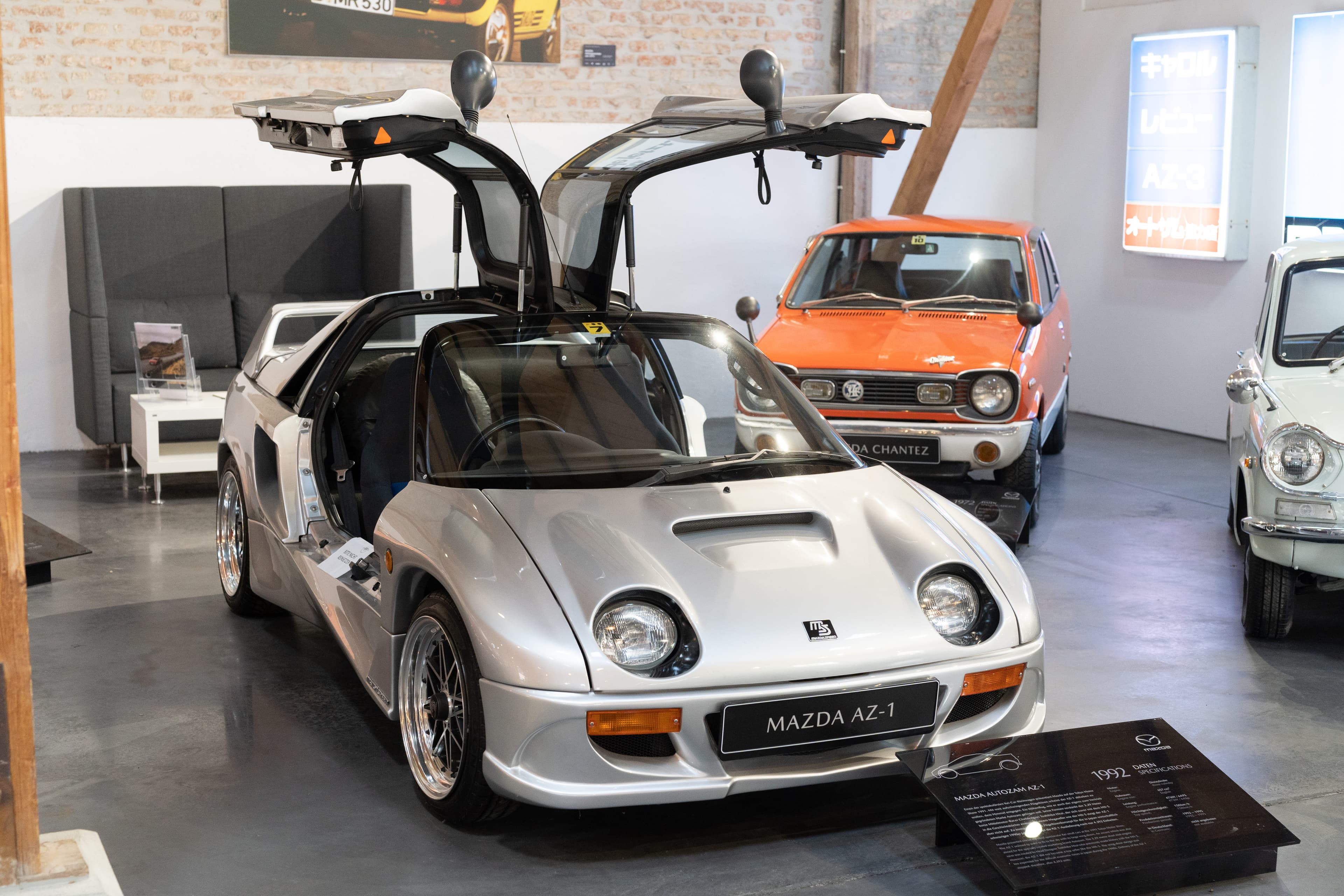
The Autozam AZ-1 doesn't make sense. It never did. Mazda sold a mid-engine, turbocharged, gull-wing-doored micro supercar during the final gasps of Japan's bubble economy, priced it like a normal kei car, sold almost none of them, and discontinued it after three years. The result is one of the most extraordinary vehicles ever produced by a major manufacturer — and now, three decades later, the rarest and most collectible kei car in existence. It's the crown jewel of the ABC trio.
Origin & History
The AZ-1 was born from a concept Suzuki originally developed and then handed to Mazda. Suzuki built the engine and running gear; Mazda, selling through its short-lived youth-oriented "Autozam" sub-brand, designed the dramatic body and took it to production. It launched in October 1992 — exactly the wrong moment to sell an expensive, impractical sports car, in the middle of Japan's bubble collapse.
Production lasted just three years. Mazda built approximately 4,392 units total, making it by far the rarest of the ABC trio — the Beat moved over 33,000 and the Cappuccino around 28,000. The AZ-1 is roughly eight times rarer than its competitors. That rarity, combined with the design, is the foundation of its collector status. It's the most extreme entry in the legendary "ABC" trio (Autozam AZ-1, Honda Beat, Suzuki Cappuccino). If the Beat is the driver's car and the Cappuccino is the all-rounder, the AZ-1 is the showpiece.
Generation & Variants
There's only one generation, the PG6SA, produced 1992-1995. Within that run, Mazda offered a few variants:
- Standard AZ-1 — the base car, available in red, yellow, silver, and blue. This is what most people think of.
- M2 1015 — an extremely rare performance variant with unique styling and body kit (estimated around 300 units). Commands enormous premiums when examples surface.
There's also a Suzuki-badged sibling called the Suzuki Cara — the same car under a different nameplate, with fewer than 600 built.
Engine & Drivetrain
Underneath the exotic bodywork, the AZ-1 uses the same F6A 657cc turbocharged 3-cylinder that powered the first-generation Cappuccino. It makes the class-maximum 64 horsepower and enough torque to make the 1,587-lb car feel genuinely quick. There's meaningful turbo lag, and then the boost hits and the car comes alive.
What makes the AZ-1 special isn't the engine by itself — it's where Mazda put it. The F6A sits transversely behind the driver, ahead of the rear axle, giving a true mid-engine layout with roughly 45/55 weight distribution. Combined with fiberglass body panels over a steel space frame, the result handles in a way nothing else at this price point does. The 5-speed manual is the only transmission — there was no automatic.
What Makes It Special
The gull-wing doors are the headline feature and what separates the AZ-1 from every other kei car ever built. They hinge at the roof and swing upward, exactly like a Mercedes 300SL or a DeLorean. In the context of a 10-foot kei car this is absurd in the best possible way.
The body is fiber-reinforced plastic panels over a steel monocoque, which is part of why it's so light. The glass area is enormous for a car this size, giving excellent outward visibility despite the wedge shape. The interior is surprisingly functional for how exotic the outside looks — two seats, simple dash, minimal cargo space. You're not buying this car to haul anything.
Known Weaknesses
The AZ-1's rarity makes it expensive to fix when things go wrong, and things do go wrong:
- Fiberglass body panel damage — cracks from impacts or aging resin; repair requires specialized work.
- Gull-wing door struts and seals — struts fail with age and seals leak, letting water into the interior.
- F6A turbo wear — same concerns as the early Cappuccino. Check boost behavior and oil condition.
- Timing belt (F6A) — interference engine, must be serviced on schedule.
- Electrical gremlins — Autozam was a budget sub-brand, and some of the switchgear reflects that.
- Body and paint — finding someone who can properly repair fiberglass bodywork on an AZ-1 is not easy.
Buying Advice
The AZ-1 market is a collector's market, not a driver's market. Expect to pay:
- $15,000-$22,000: higher-mileage cars or cars needing cosmetic work. Often have damage history or aging paint.
- $23,000-$30,000: honest drivers with clean bodies and documented mechanical condition. The realistic entry point for a good car.
- $30,000-$40,000+: low-mileage, well-preserved examples. Collector-grade cars.
- $45,000+: museum-grade examples, M2 1015 variants, and pristine one-owner cars.
Prices have risen sharply since the AZ-1 became importable in 2020 and will almost certainly continue rising. This is one of the kei vehicles where buying the best example you can afford is better than chasing the cheapest listing — repairs are specialized and expensive.
Do not buy an AZ-1 without a thorough pre-purchase inspection by someone who knows Japanese cars. Check the fiberglass body for cracks and prior repairs, the frame rails for rust, the gull-wing seals for leaks, and the turbo for health. See the kei cars buyers guide for inspection specifics, the importing step-by-step guide for the import workflow, and run the total through the import calculator — AZ-1s are expensive to land.
Alternatives & Comparisons — The ABC Trio
Versus Honda Beat: Beat is roughly half the price, more usable, and easier to live with. AZ-1 is rarer and more visually dramatic. If you want to drive it, Beat. If you want to own it as a collector piece, AZ-1.
Versus Suzuki Cappuccino: Cappuccino shares the engine and costs significantly less. Cappuccino is the better driver's car in real-world scenarios thanks to FR layout and better ergonomics. AZ-1 is the show car with greater rarity and appreciation potential.
As an investment: the AZ-1 is the only ABC car that functions as a genuine collectible. Good examples have roughly doubled in price over the last five years.
Owner Experience
Driving an AZ-1 is unlike anything else. The mid-engine layout means the car reacts to inputs instantly. Steering is sharp — arguably too sharp for casual driving. The turbo lag is noticeable, then the boost hits and the car surges forward. The gull-wing doors turn every arrival into a spectacle. This is not a daily driver. It's a weekend car, a cars-and-coffee car, and a collector's piece that happens to be street-legal.
Should You Buy One?
Only if you love it for what it is and can afford to own it properly. The Autozam AZ-1 is the rarest member of the ABC trio and one of the most visually extraordinary vehicles of the 1990s. It's not the practical choice or even the driver's choice — it's the passion choice, the car you buy because nothing else feels the way it does when the gull-wing doors swing up and everyone stops to stare. If you have the budget, garage space, and a good relationship with a Japanese car specialist, the AZ-1 is one of the most special vehicles you can own. If you want to actually drive regularly, buy a Cappuccino or a Beat and save yourself the heartache.