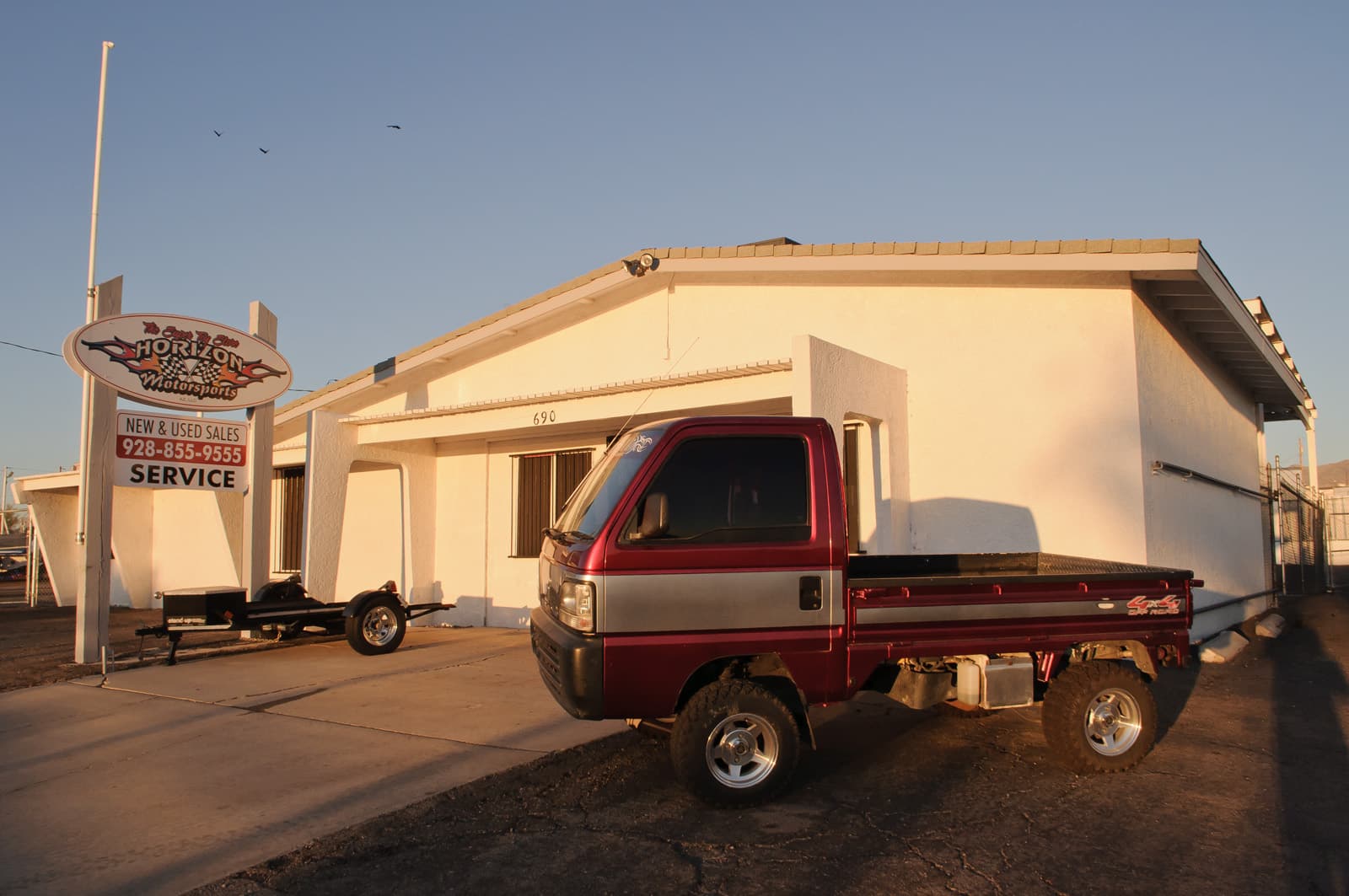
It's never dramatic. You're scrolling Reddit at midnight, or you're in a parking lot somewhere in Oregon, or a friend texts you a photo with no caption — just a tiny white truck parked next to a Dodge Ram, looking like its offspring.
And something shifts.
You open a new tab. Then another. Then another. You learn words like "keitora" and "660cc" and "25-year rule." You watch a man in rural Tennessee load a full cord of firewood into a bed that shouldn't physically hold it. You see a Suzuki Carry navigate a trail that would make a Jeep owner nervous. You text your partner: "So, hypothetically..."
If you're reading this, you know the feeling. That specific gravity of obsession where a vehicle you'd never heard of three weeks ago now occupies a permanent room in your brain. The Reddit post that inspired this article had 546 upvotes and 163 comments. The title was five words: "Someone please talk me out of this."
Nobody did. Nobody ever does.
But let's try anyway.
I love these trucks. I've built a whole corner of my life around them. Which is exactly why I owe you the truth.
They are slow. Not kind-of-slow, not slow-compared-to-a-sports-car slow — actually slow. A 660cc engine making 40-50 horsepower means 45-50 mph is where you'll top out comfortably on the highway, and even that feels like you're asking a lot. Merging onto an interstate is a prayer with a clutch pedal. If your commute involves a 65 mph highway, this is not your vehicle. Parts can be a puzzle, too — you will not walk into AutoZone and find a fuel filter for a 1994 Honda Acty. Some parts cross-reference with domestic equivalents; many don't. You'll learn to navigate Japanese parts websites, befriend importers, and develop a deeply personal relationship with your mechanic. This is part of the charm — until it's a Wednesday and your truck won't start and the part you need is on a boat somewhere in the Pacific.
There are no crash safety ratings. None. These vehicles were designed for 30 mph Japanese city streets, not American roads shared with 6,000-pound SUVs. The cab-over design puts your feet roughly where a crumple zone would be if there were one. This is not something to dismiss with enthusiasm. They're right-hand drive, which means you will misjudge drive-throughs, you will reach for a shifter that isn't there, and passing on two-lane roads requires a level of trust in your passenger — or your instincts — that takes time to build. Most people adapt within a week. But that week is humbling.
Your state might not want you to have one. Regulations vary wildly — some states welcome kei vehicles with open arms, others restrict them to off-road use only, or require inspections that seem designed to fail them, or exist in a gray area that your local DMV clerk has never navigated before. Check your state's rules before you fall any deeper. You probably won't, but I had to say it. And if you need to carry your family of five, haul a boat, or cruise at 80 mph across Texas, a kei vehicle will fail you. Spectacularly, adorably, but fail you nonetheless.
That's the case against. I've been fair. Now let me be honest about the other side.
They are the most fun per dollar in the automotive world. For $5,000 to $15,000, you get a vehicle that makes you grin every single time you turn the key — not some of the time, every time. Name another purchase under $15,000 that delivers daily joy for years. I'll wait. The fuel economy is absurd: 35-50 miles per gallon depending on the model and how heavy your right foot is. Fill the tank for $25, drive for two weeks. In an era of $4 gas and climate guilt, a kei vehicle is the closest thing to guilt-free driving that still involves combustion.
You will never be invisible again. Park a kei truck anywhere in America and count the seconds before someone walks up. Grocery stores, gas stations, parking lots, stoplights — people smile, point, ask questions. Children wave like you're driving a parade float. Your vehicle becomes a conversation, a community, a tiny rolling block party. And they are surprisingly, almost stubbornly capable — Japanese farmers use these trucks to navigate mountain terraces in conditions that would strand a full-size pickup. The four-wheel-drive models with low-range gearing will climb, haul, and work in ways that seem impossible given their size. The payload capacity — often 750-800 pounds — makes no visual sense. You'll load something heavy, look at the bed, look at the truck, and shake your head.
The turning radius is a superpower. You can U-turn on a residential street, parallel park in a space a MINI Cooper would skip, navigate tight trails and crowded parking lots and narrow alleys like they were designed for you — because in Japan, they were. The community will change your life, too — and this one surprises people. Kei vehicle owners wave at each other on the road like motorcycle riders. Reddit threads turn into friendships. Facebook groups turn into weekend meetups. You will know your neighbors better because of a truck, and you will meet strangers who feel like old friends because you both chose the same strange, wonderful thing.
They make you smile. I keep coming back to this because it's the truest thing I can say. In a world that's complicated and heavy and exhausting, these trucks are simple and light and joyful. There's a physics to it — something about the proportions, the mechanical honesty, the absurdity of driving something this small on American roads. It recalibrates your relationship with driving. It makes the ordinary commute feel like a small adventure.
Here's what the spec sheets and comparison charts will never capture: in a world of identical crossovers — silver, gray, white, beige, each one a forgettable appliance designed by committee to offend no one — a kei vehicle is protest art. It's a deliberate choice to be different, to be smaller, to be noticed for something other than aggression or status. Every kei truck on an American road is a small rebellion against the idea that bigger is better, that more is more, that a vehicle's worth is measured in towing capacity and curb weight. You don't drive a kei truck because it's the most practical choice. You drive one because it's the most honest choice.
There's a moment that will happen to you about two weeks after you buy your kei vehicle. You'll be driving on a back road, or through a small town, and you'll see another kei truck coming the other direction. And the driver will wave. Not a polite nod — a real wave, arm out the window, full grin, the kind of acknowledgment that says I see you. You're one of us now.
And you'll wave back, and something in your chest will shift, and you'll understand that you didn't just buy a truck. You joined a community that didn't exist five years ago and now spans every state in the country — a community built not on horsepower or wealth, but on the shared recognition that these ridiculous, wonderful, tiny vehicles are worth caring about. The parking lot conversations alone are worth the price of admission. The stories people tell you — about their grandfather's farm truck in Nagano, about seeing one on YouTube, about their kid drawing kei trucks in school — those stories become yours.
There's a Japanese concept that doesn't translate cleanly into English: 足るを知る (taru wo shiru) — "to know what is enough." It's related to wabi-sabi, the appreciation of imperfection and impermanence, but it's more active than that. It's a choice — a decision to stop reaching for more and recognize that what you have is sufficient.
Kei vehicles are taru wo shiru on wheels. 660cc is enough engine. A six-foot bed is enough bed. Forty-five miles per hour is enough speed. In a culture that tells you to supersize everything — your truck, your house, your ambitions, your appetites — a kei vehicle whispers that maybe the small life is the good life. This isn't deprivation. It's liberation. When your truck costs less than most people's down payment, when you can fix half of it with a basic socket set, when a full tank costs less than dinner out — you've freed yourself from something. Not from driving, but from the anxiety of driving. From the payments and the premiums and the paranoia of parking a $60,000 truck at the grocery store.
A kei vehicle costs less. It weighs less. It takes up less space, burns less fuel, demands less attention. And somehow — impossibly, illogically — it gives you more.
Go back to that Reddit post. 546 upvotes, 163 comments. "Someone please talk me out of this."
Not a single person did.
Oh, they tried. They mentioned the speed, the parts, the safety, the regulations. All real, all valid, all things I've listed here. And then they said: "But I bought mine anyway, and I've never been happier."
Comment after comment. The same confession, the same sheepish joy. People who bought the truck they couldn't justify, and found that justification was never the point.
If you're reading this article — if you've made it this far, past the warnings and the caveats and the honest downsides — then you already know what you're going to do. You've known since that first photo, that first Reddit thread, that first moment when a tiny truck from 1990s Japan lodged itself in your imagination and refused to leave.
You don't need more research. You don't need more pros-and-cons lists. You don't need another YouTube video or another forum thread or another spreadsheet comparing landed costs.
You need permission.
Here it is.
Ready to figure out which kei vehicle is right for you? Take the Which Kei Vehicle? Quiz, read the Complete Buying Guide, or start with our guide to the Best First Kei Vehicle.