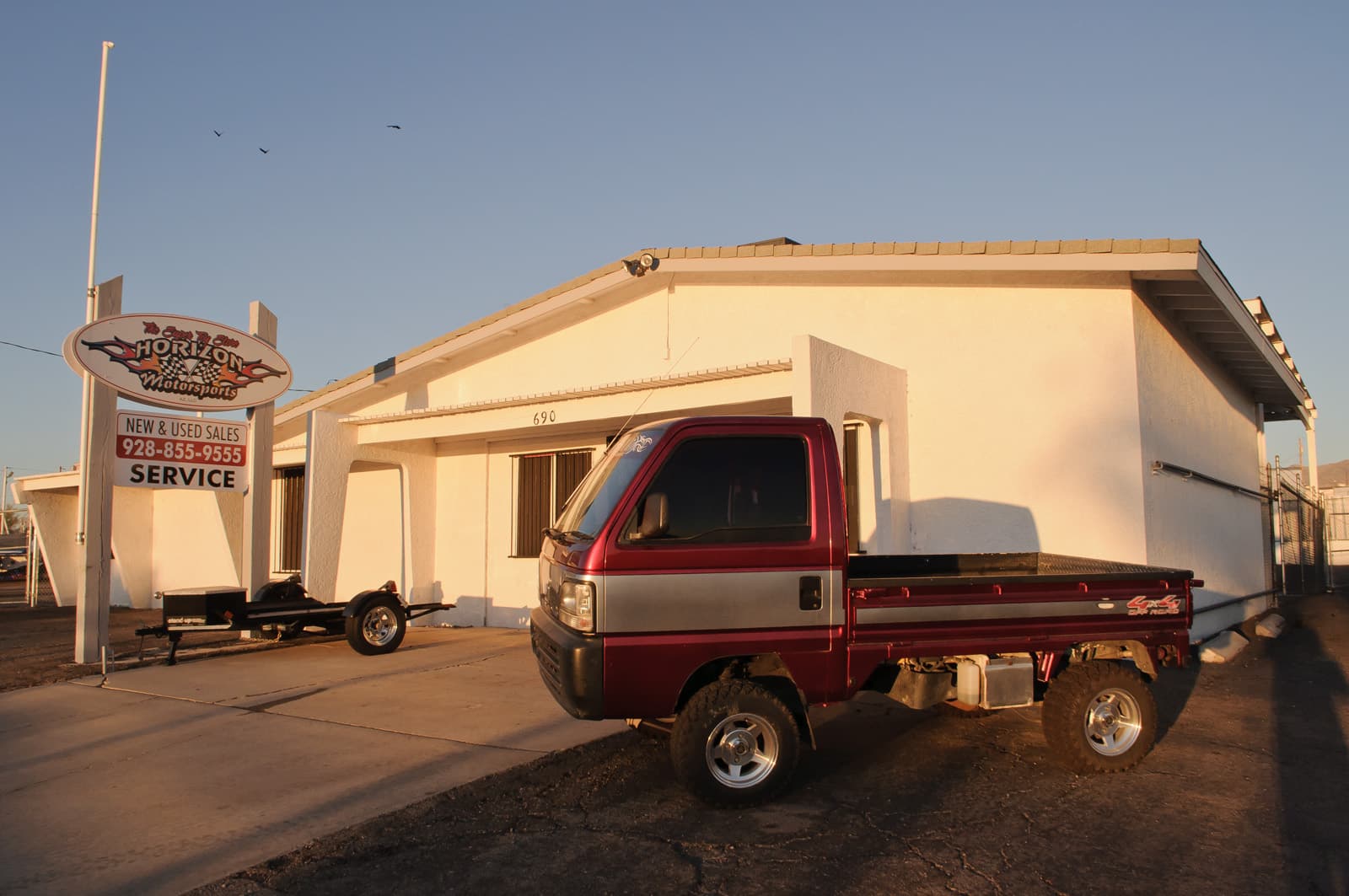
This is the question every kei buyer eventually gets from a spouse, a parent, or themselves at 2 a.m.: is this little thing going to get me killed?
I'm going to give you the honest answer, not the enthusiast answer or the hater answer. Both of those exist online and both are useless to someone actually deciding whether to buy.
The fair criticism
Start with what the critics get right, because they get a lot right. As NPR and OPB have both noted, a kei truck's cab-over design "provides no protective crumple zone, meaning knees take the hit directly in crashes." That's accurate. In a frontal collision there is very little vehicle ahead of your legs to absorb the impact.
Layer on the rest: importable kei trucks are at least 25 years old. That means no modern airbags, no electronic stability control, no side-impact protection, a body built to 1990s kei standards, and a curb weight a fraction of the F-150 that might hit it. In a crash against modern full-size traffic, physics is not on your side. None of that is fearmongering — it's just true.
Why "it's antiquated" isn't the whole story
Here's where the conversation usually goes off the rails: people treat "less safe than a 2026 SUV" as if it means "a death trap." Those aren't the same claim.
The kei community's counterpoint, which is also fair, is one of consistency. Enthusiasts point out that motorcycles — not known for occupant protection — are legal on every highway in the country, and that a Ford Model T with mechanical brakes and no seatbelts is road-legal as a classic. As one Portland owner put it to OPB, it's frustrating to be barred from registering a kei vehicle when far older and arguably less safe vehicles are waved through. The point isn't "kei trucks are safe." It's "we already let people make this risk tradeoff for other vehicles."
The variable that actually matters: speed and use
Crash energy scales with the square of speed. A collision at 30 mph carries roughly a quarter of the energy of the same collision at 60 mph. This is the single most important fact in the entire safety conversation, and it's the one that gets lost.
A kei truck used the way it was designed — local roads, farms, campgrounds, job sites, neighborhood errands, off-highway property — is operating in a speed range where its safety deficit matters far less. A kei truck used as a 70-mph interstate commuter, sharing lanes with semis, is operating exactly where its deficit matters most.
So "are kei trucks safe?" is the wrong question. The right question is "safe for what?" The same truck is a sensible low-speed utility vehicle and a genuinely risky freeway daily driver. You get to choose which one you're buying.
How to own one responsibly
If you buy a kei truck, you can meaningfully lower your risk without spending much:
- Drive it for its purpose — low speeds, local roads, off-highway and property use. This is the big one. Stay off interstates and high-speed arterials.
- Keep the safety systems honest — fresh brakes, good tires, working seatbelts. A 25-year-old truck with neglected brakes is the actual danger, more than the design.
- Be visible — upgraded lighting, a flag or beacon for slow off-highway use, bright colors. Most kei crashes that matter involve someone not seeing you.
- Increase following distance and assume you're invisible. Defensive, low-speed driving is the biggest lever you control.
- Don't overload the bed. It changes braking and handling on a vehicle that doesn't have margin to spare.
The bottom line
Kei trucks are less crash-protective than modern vehicles. That's not a controversial claim and you shouldn't buy one believing otherwise. But "less protective than a new truck" and "irresponsible to own" are different statements. Driven for what it's built for — slow, local, light-duty — a kei truck is a reasonable risk that millions of people in Japan have taken for decades. Driven as a highway commuter against US traffic, it's a real gamble.
Buy it for the right use, maintain it honestly, drive it defensively, and you've addressed most of the risk you actually control. Then go check whether it's even legal in your state — and run the numbers before you fall in love with one.