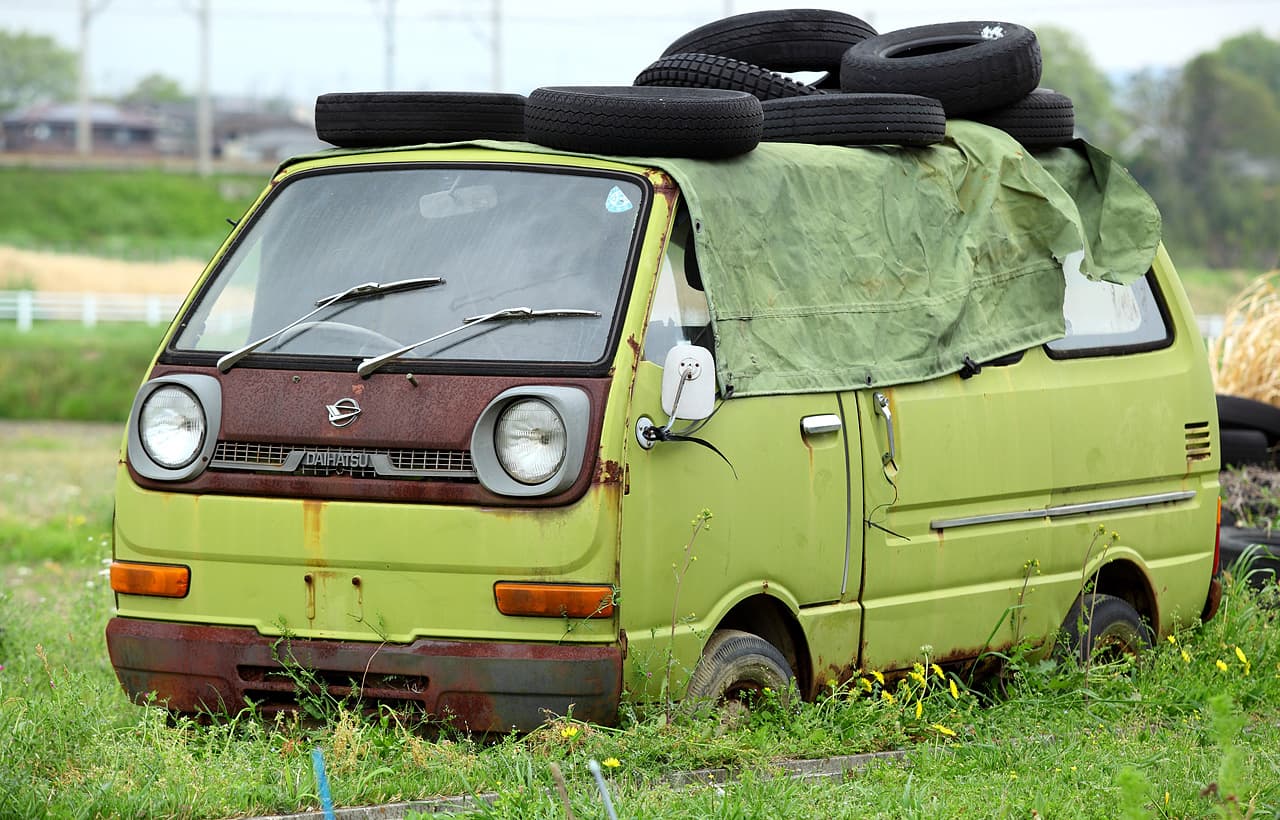
The Eternal Runner-Up (That Might Actually Be Better)
The Suzuki Carry gets all the love in the US kei truck scene. It's the default recommendation, the one with the biggest aftermarket, the truck most people buy first. Old Faithful is a Carry, and I recommend the Carry to first-time buyers constantly.
But here's the thing I don't say often enough — a lot of experienced kei truck owners end up with a Hijet. I've watched this pattern play out in forums for years. Someone buys a Carry, loves it, then picks up a Hijet as a second truck and quietly starts driving the Hijet more. Dave Russo's daily driver is a '96 Hijet — not his Minicab, not any of the other trucks in his rotation. The Hijet.
The Daihatsu Hijet has been in production since 1960. That's over six decades of continuous refinement. No other kei truck nameplate comes close to that kind of history. And while it might not have the Carry's Instagram following, it has something arguably more valuable: a massive global parts network and the kind of reliability that comes from a manufacturer obsessing over the same platform for generations.
So should you buy one? Let me walk you through everything.
Generations: Which Hijet Should You Buy?
Not all Hijets are created equal. Here are the two generations you'll actually find on the US market, plus the Jumbo variant that deserves its own conversation.
S83P/S110P (1990–1998): The Classic
This is the generation most people picture when they think "kei truck." Boxy, honest, no pretensions. These run the 660cc EF engine — a three-cylinder that's been proven in millions of Daihatsu vehicles across Asia and beyond.
Why buy this generation:
- Cheapest Hijets on the market ($5,500–$8,000)
- The EF engine is dead simple — your local mechanic can figure it out
- 4WD models are common and the system is robust
- Available in dump bed configurations, which are incredibly useful
Watch out for:
- Rust. These are 28–36 years old now, and Japanese trucks from this era lived through salted roads
- The cab is spartan — no power steering on earlier models, minimal creature comforts
- Some S83P models had the older 550cc engine (pre-1990 regulation change) — make sure you're getting the 660cc
The S83P (1990–1994) and S110P (1994–1998) share most parts and are mechanically very similar. The S110P got a refreshed interior and some minor improvements, but don't overthink the distinction.
S200P/S210P (1999–2014): The Refined One
This is the sweet spot for most buyers. The S200P/S210P generation brought genuine improvements to daily usability while keeping the mechanical simplicity that makes kei trucks great.
The EF-SE engine in these trucks is a more refined version of the EF — better fuel economy, slightly smoother, and just as reliable. The cab got meaningfully better too: more legroom, better dash layout, available power steering and air conditioning that actually works.
Why buy this generation:
- The best balance of modern comfort and kei truck simplicity
- EF-SE engine is the most parts-available Hijet powerplant
- Many were used as light commercial vehicles in Japan with meticulous service records
- S210P (4WD) models have a proper part-time 4WD system with low range
Watch out for:
- Higher prices ($8,000–$14,000) reflecting the newer years and better condition
- Some automatic transmission models from 2002–2006 had weaker torque converters — manuals are preferred
- Only trucks from 2001 and earlier are currently importable under the 25-year rule
As of 2026, the 25-year rule means S200P models from 2001 are the newest you can legally import. The S210P 4WD variants from this year are highly sought after — expect to pay a premium.
The Hijet Jumbo: Extended Cab Luxury
The Hijet Jumbo takes the standard Hijet platform and extends the cab backward, giving you roughly 4 extra inches of legroom behind the seats. It doesn't sound like much on paper. In practice, it's the difference between tolerating the cab and actually enjoying it.
The trade-off is real though — that extra cab space comes directly out of the bed. You lose about 8 inches of bed length compared to the standard Hijet. For a truck with a ~6-foot bed, that's meaningful.
More on whether the Jumbo is worth it below.
What Makes the Hijet Great
The parts network is massive. Here's something most US buyers don't realize: Daihatsu sold the Hijet in way more countries than Suzuki sold the Carry. Southeast Asia, South America, Europe, India — the Hijet platform is everywhere. That means the global parts supply chain is enormous. Japanese parts suppliers like Amayama and Megazip carry virtually every component, and because so many Hijets are still working daily in Indonesia, Thailand, and India, aftermarket manufacturers keep making parts for older generations. You might wait a couple weeks for shipping, but the part exists. That's more than you can say for some American trucks from the same era.
Dump beds are common — and they're a game-changer. If you need a dump bed, the Hijet is your best bet, and it's not even close. Daihatsu offered factory dump bed configurations across multiple generations, and they show up at Japanese auctions regularly. A Carry with a dump bed exists but is much rarer. A dump bed Hijet is genuinely one of the most useful property vehicles you can own. Mulch, gravel, firewood, soil — load it up and dump it where you need it. No shoveling. I used to shovel mulch out of Old Faithful's flatbed during my landscaping days in Boise, and every time I did, I thought about how a Hijet dump would've saved my back.
Daihatsu reliability is legendary. Daihatsu has been building small engines since 1951. The EF-series three-cylinder in the Hijet is one of the most produced small engines in automotive history. These aren't exotic — they're workhorses built to be maintained by rural mechanics across developing countries. Oil changes, timing belts on schedule, and basic care will keep an EF engine running to 200,000+ km without drama.
What Are the Honest Weaknesses?
The US aftermarket is thinner. The Carry dominates the US kei truck aftermarket. Lift kits, bumpers, bed racks, LED conversions — most US-based suppliers design for the Carry first and the Hijet second, if at all. You'll find what you need, but you might wait longer or pay more for Hijet-specific parts. Dave Russo has had good luck sourcing Hijet mod parts from Australian suppliers, where the Hijet is more popular than the Carry.
Parts sourcing takes patience. While the global parts network is huge, getting those parts to the US takes time. Common maintenance items like filters, belts, brake pads, and spark plugs are readily available from US-based kei truck suppliers. But anything specific — a door handle, window regulator, or dashboard component — is probably coming from Japan with a 2-3 week shipping window. That's not a dealbreaker, but you need to plan ahead instead of fixing things same-day.
Some automatic transmissions are weaker. This is the one area where the Hijet genuinely falls behind the Carry. Certain automatic Hijets from the early 2000s had torque converter issues that could lead to premature failure. The manual transmission is rock solid, but if you're buying an automatic S200P, have the transmission inspected thoroughly. My strong opinion: buy the manual. It's more reliable, more efficient, and more fun.
The manual 5-speed is the better choice for almost every Hijet buyer. It's more reliable, more efficient, and — honestly — more fun. The only reason to go automatic is if you physically cannot drive a manual.
Hijet vs. Carry: The Quick Comparison
This is the comparison everyone wants, so let's lay it out honestly.
| Category | Daihatsu Hijet | Suzuki Carry |
|---|---|---|
| Heritage | In production since 1960 | In production since 1961 |
| US popularity | #2 | #1 |
| US aftermarket | Good | Excellent |
| Global parts availability | Excellent | Very good |
| Dump bed availability | Common | Rare |
| Extended cab option | Hijet Jumbo | None (standard only) |
| Engine simplicity | EF 3-cylinder | F6A/K6A 3-cylinder |
| Manual transmission | Excellent | Excellent |
| Auto transmission | Some weak years | Consistently solid |
| Typical price range | $5,500–$14,000 | $6,000–$15,000 |
The honest take: If you want the easiest ownership experience with the most US-based support, buy a Carry. If you want a dump bed, an extended cab, or you appreciate the deeper parts network and don't mind ordering from Japan occasionally, buy the Hijet. Neither is the wrong choice.
What to Check When Buying
Every used kei truck needs inspection, but the Hijet has a few specific things to look for.
Frame rust is the number one concern — specifically the rear crossmember. That's the structural piece that ties the rear frame rails together behind the rear axle, and it's the most rust-prone area on the truck. Japanese road salt eats at it from above, and mud and moisture trap against it from below. Get under the truck and tap the rear crossmember with a screwdriver. If it's solid, you're fine. If the screwdriver goes through, walk away. This is a structural repair that costs more than most Hijets are worth. Also check cab corners where the floor meets the firewall, the bed floor under the rubber mat, fuel tank mounting straps, and brake line routing along the frame.
The timing belt is non-negotiable. The EF engine uses a timing belt, not a chain, and if the belt breaks, the engine is toast — it's an interference design. Ask when the belt was last replaced. If nobody knows, budget $300-$500 for a timing belt job immediately after purchase. Don't negotiate on this one. Just do it.
Test the AC compressor. Hijet AC compressors are known to seize, especially on trucks that sat for a while before export. Turn the AC on during your test drive and verify it blows cold. A replacement compressor is $200-$400 for the part, but labor adds up fast on a kei truck where everything is tightly packaged.
Beyond those Hijet-specific items, do the standard checks: shift into 4WD on gravel and make sure it engages smoothly, check that the clutch grabs in the middle of pedal travel rather than at the very top, watch for blue smoke on startup (valve stem seals) or white smoke (head gasket), and test every switch, light, and gauge. Japanese wiring harnesses are reliable, but 25+ years is 25+ years.
Pricing: What You Should Expect to Pay
The Hijet market is more predictable than you'd think. Here's what you'll see in 2026:
| Condition | Price Range | What You Get |
|---|---|---|
| Project / rough | $5,500–$7,000 | Running but needs work. Rust, worn interior, high km. Good if you're handy. |
| Driver quality | $7,000–$10,000 | Solid truck, some cosmetic wear, everything works. The sweet spot. |
| Clean / low km | $10,000–$12,000 | Under 50,000 km, well-maintained, good cosmetics. |
| Jumbo / dump / pristine | $12,000–$14,000 | Premium variants or exceptional condition. Collectors and daily drivers. |
Dump bed models command a $1,000–$2,000 premium over equivalent flatbed trucks. The Hijet Jumbo adds $500–$1,500 over a standard cab depending on condition.
Pricing includes purchase and basic import costs. Your total landed cost will be higher once you factor in shipping, customs, and registration. Use our Import Cost Calculator to estimate your all-in number.
Should You Spend More for the Jumbo?
I get this question constantly, and my answer depends entirely on how you plan to use the truck.
If you're over 5'8" and plan to drive it regularly, get the Jumbo. If it's your daily driver, get the Jumbo. If you value comfort and don't need maximum bed space, get the Jumbo. If you carry passengers — even just occasionally — the extra space behind the seats fits bags, a dog, or just gives your passenger room to breathe.
Stick with the standard if maximum hauling capacity is the priority, if it's a farm or property vehicle that only does short trips, if you want the cheapest possible Hijet, or if you're building it out with a bed rack or camper shell where every inch of bed length counts.
The Jumbo isn't just about legroom though — the extended cab also gives you a small storage area behind the seats that's genuinely useful for keeping tools, bags, and valuables out of the open bed. For daily driving, that alone is worth the premium. If I were buying a Hijet today as a daily driver, I'd get the Jumbo without hesitation. The bed space trade-off is worth it for the comfort.
The Verdict
The Daihatsu Hijet doesn't need to beat the Suzuki Carry. It needs to be the right truck for you, and for a lot of people, it absolutely is.
If you want a dump bed, the Hijet wins by default. If you want an extended cab, the Jumbo has no equivalent from Suzuki. If you appreciate a manufacturer that's been refining the same truck for 60+ years and has a global parts network to prove it, the Hijet delivers.
Buy the manual. Check the rear crossmember for rust. Change the timing belt. And enjoy owning a piece of the longest-running kei truck lineage in the world.
Ready to dig deeper? Check out the full Daihatsu Hijet profile and the Hijet Jumbo profile for detailed specs. If you're still deciding between models, our Truck Comparison Tool lets you put the Hijet head-to-head with any other kei truck. And if you're new to all this, start with the Complete Buying Guide for the full picture.