
The most-watched kei truck content of the last month was not a build, a review or a legalization story. It was a video asking how much a brand-new mini truck costs — 116,000 views, and a comments section full of Americans asking where they can buy one.
They cannot. Suzuki and Daihatsu are building kei trucks right now, today, and you cannot buy one new in the United States at any price. I get asked why constantly, and the answers online usually name one reason. There are three, they are independent of each other, and only one of them ever goes away.
Barrier one: it was never certified for this market
Every new vehicle sold in the US must be certified by its manufacturer as compliant with Federal Motor Vehicle Safety Standards — crash performance, lighting, mirrors, restraints, glazing, a long list. Certification is not a form you file. It is engineering work and destructive crash testing, done per model, for the market you intend to sell into.
A kei truck has never had it, because it was never intended for this market. Japanese manufacturers certify kei vehicles to Japanese standards, sell them in Japan and a handful of similar markets, and that is the end of the business case.
This is the barrier people mistake for a ban. There is no law saying "kei trucks are illegal in America." There is a law saying an uncertified vehicle cannot be imported for road use, and no kei truck has ever been certified. The effect is the same and the distinction matters, because it explains why the 25-year rule works the way it does.
Barrier two: the 25-year rule is an exemption, and exemptions need age
The rule everyone knows: a vehicle 25 years old or more can be imported without meeting FMVSS. That is what puts a 1997 Hijet on a US road legally.
Read it as what it is — an exemption from barrier one, granted on the grounds that a quarter-century-old vehicle is a collector item rather than mass transport. It does not certify the vehicle. It excuses it.
Which means the rule can never apply to a new vehicle, by construction. It is not a queue that new trucks join; it is a rolling release of old ones:
| Model year | Federally importable from |
|---|---|
| 1999 | 2024 |
| 2001 | 2026 |
| 2005 | 2030 |
| 2026 | 2051 |
The kei truck in that 116K-view video becomes importable when today's toddlers are in their late twenties. Our 25-year rule explainer covers the mechanics, and the import eligibility status on each vehicle page tells you where a given model sits.
Barrier three: the Chicken Tax
Even if a manufacturer wanted to certify one, there is a 25% import duty on light trucks waiting — a 1964 retaliatory tariff that never went away. On a vehicle whose entire appeal is being cheap, a quarter added to the landed cost is not a rounding error.
This one catches people out because it is genuinely separate from the safety rules. The 25-year rule waives FMVSS. It does not waive the duty. Our Chicken Tax guide untangles the three things people routinely conflate — the duty, the 25-year rule, and the 2025 tariff — and the import calculator has a 2.5% / 25% toggle because which one applies depends on how the vehicle is classified.
"So why not just build a US version?"
The honest answer is that it would stop being a kei truck.
The category is defined by Japanese regulation: 3.4m long, 1.48m wide, 660cc. Those limits exist because kei vehicles get tax and insurance advantages in Japan, and the dimensions are the price of admission. Meeting US crash standards at that size means adding structure, and adding structure means exceeding the box.
At which point you have designed a small pickup, not a kei truck — and small pickups are a market US manufacturers have repeatedly tried and mostly abandoned. The thing that makes a kei truck appealing here is precisely the thing that makes it uncertifiable here.
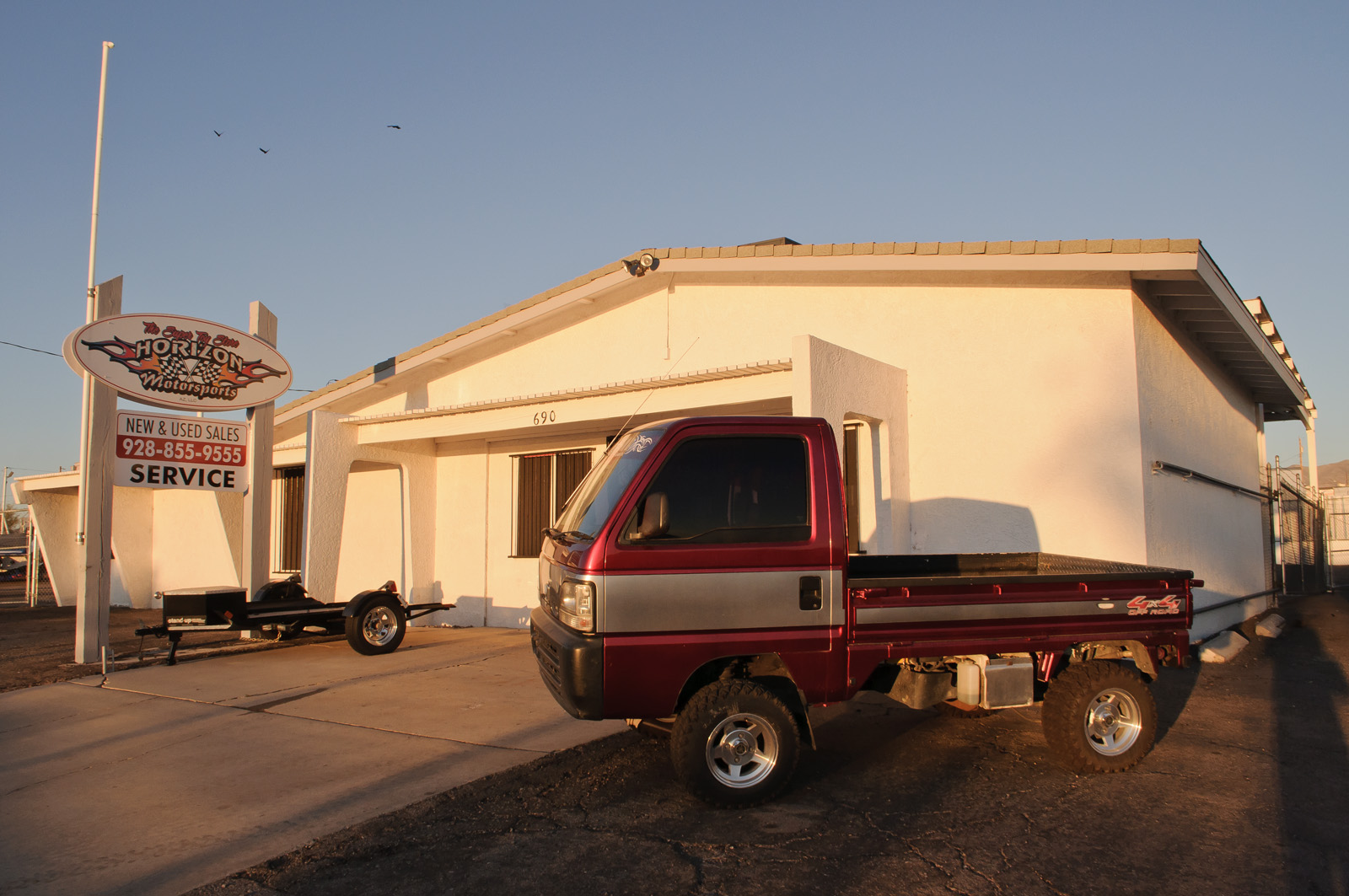
Except that dealers are selling new ones right now
Here is the part that makes people think the rest of this article is wrong, and it deserves a straight answer: you can buy a brand-new 2026 Daihatsu Hijet in America today. Not a 25-year-old one. A new one, with delivery mileage, from a US dealer, this week.
We read forty-seven US mini truck sellers' own websites in September 2026. Eight of them stock current-model vehicles — 2024, 2025 and 2026 Hijets — and fifteen more carry them alongside the old imports. Prices run roughly $21,500 to $39,900, against $7,000 to $15,000 for a typical 25-year import.
This does not contradict the three barriers. It goes around them, and the way it does that is the thing worth understanding.
The trick is that it is not a road vehicle
FMVSS applies to vehicles manufactured for use on public roads. A machine brought in as off-highway equipment is not making that claim, so it never has to meet the standard — the same doorway a utility side-by-side walks through. That is why the dealers who are most explicit about it put the condition in writing. One states it as "sold for off-road use only per Federal law"; another as "Nonpublic Road Use Only — Speed limited to 25 mph"; a third as "All vehicles are sold for off-road use only... electronically speed limited to not exceed 19 mph."
Note that those numbers disagree, and a fourth seller quotes a different one again: across the sites we read, published figures were 19 mph, 25 mph and 30 mph, the last described as following "the same laws as golf carts". We are not going to print one of them as though the question were settled. The limit is real and it is low — ask your specific seller which figure applies to the specific truck, and get it in writing.
What you are actually buying
- It is speed-limited. Not "capable of 55 but restricted on paper" — electronically limited, at a speed that makes it a yard and jobsite machine. Every figure we found was between 19 and 30 mph.
- There is no ordinary route to a road-legal title. It was never FMVSS certified, and it is decades short of the 25-year exemption, so neither door is open. A handful of states run a separate low-speed class that can cover a vehicle like this — Florida defines a "mini truck" in statute and registers one for streets posted at 35 mph or below — but that is a state question with a different answer in every state. Check the regulations tracker for yours, and confirm with your own DMV before you buy rather than after.
- The 25-year rule will never rescue it. This is the detail people get wrong most often. A 2026 Hijet imported as off-road equipment does not become street legal in 2051. The exemption governs importation, and this vehicle is already here.
- It costs three to five times a used import, for a vehicle you can legally drive in fewer places.
- Not every seller says any of this. Of the sellers we checked stocking new vehicles, several published no off-road notice at all on the pages we read. The restriction comes from how the vehicle entered the country, not from whether the dealer mentions it.
So which one do you want?
If you want a work vehicle for a farm, a ranch, a warehouse or a large property and you were otherwise pricing a UTV, the new one is a real option and the comparison you should be running is against a side-by-side, not against a used import. Heat, air conditioning and a proper cab for UTV money is a genuine argument.
If you want something you can register and drive to town, the new one cannot do it and no amount of waiting changes that. That is the 25-year truck, and everything below still applies.
What this means for you
You are not waiting for anything — if what you want is a new kei truck you can register and drive. There is no pending rule change that puts a road-legal new kei truck in a US dealership. State-level legalization — the tracker follows it — is about whether you can register an imported 25-year-old truck. It has nothing to do with new vehicles, and no amount of it will change that.
The road-legal vehicle you can buy is a 25-year-old one, and it is genuinely good. These are simple, repairable machines that were built to work. Our buying guide and vehicle profiles cover what is actually available.
The newest thing you can get gets newer every year. That is the one real piece of good news in this article. Each January, another model year clears. If you want the most modern kei truck legally available, the answer changes annually — check the import year on any vehicle page.
The short version
Three barriers, and people usually only know about one:
- No FMVSS certification — never built for this market, never tested for it.
- The 25-year rule is the exemption from that, and by definition it only releases old vehicles.
- A 25% duty sits on top, independent of both.
Only the first ever clears, and only by the vehicle getting old enough. The reason nobody sells you a road-legal new one is not that America dislikes small trucks — it is that the rules for selling a new vehicle here and the rules that define a kei truck cannot both be satisfied at once.
And there is a fourth thing, which is not a barrier but a doorway: a new kei truck can be sold here as off-road equipment, speed-limited and with no ordinary path to a licence plate. That is a different vehicle for a different job, at three to five times the price. Knowing which of the two you actually want is the whole decision.