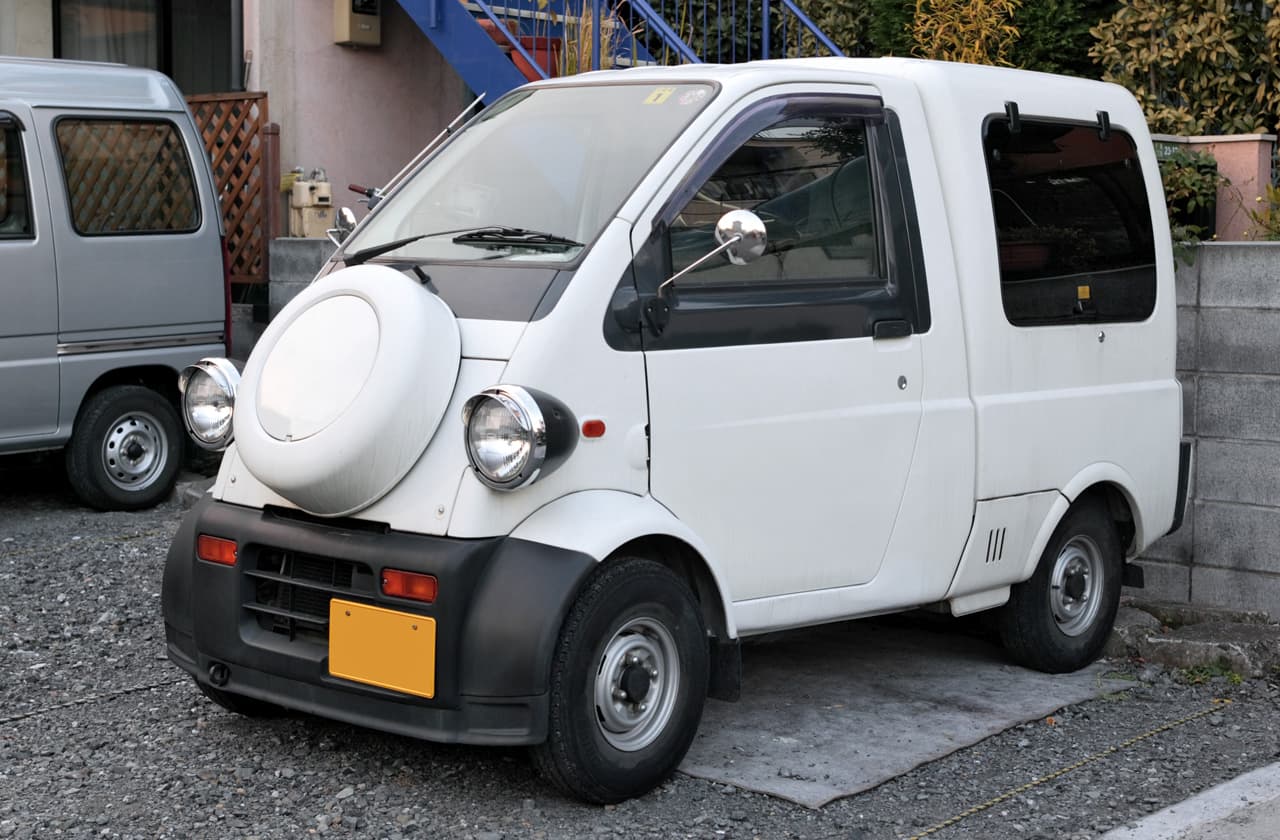
A love letter to a 1957 three-wheeler
To understand the Midget II, you have to understand the original Midget. In 1957, post-war Japan was rebuilding, and what it needed most was cheap, simple transportation for the millions of small shopkeepers, fishmongers, farmers, and deliverymen who couldn't afford a proper truck. Daihatsu's answer was a tiny three-wheeled delivery vehicle called the Midget — a single headlight up front, a handlebar instead of a steering wheel, a 250cc engine, and a bed just large enough for a few crates of produce. It was absurd. It was also exactly what Japan needed, and over 336,000 were sold in a decade. The Midget became a character. A symbol. The scrappy little face of post-war economic recovery.
Fast forward to 1996. Japan was in the middle of its "bubble economy" nostalgia era, and Daihatsu's engineers decided to pay tribute to their own history. The result was the Midget II — a modern kei truck that deliberately evoked the charm of its ancestor while meeting every current safety and emissions regulation. Round headlights. Stubby proportions. A single-seat cab that made no apologies. A body the length of a refrigerator.
It wasn't designed to be practical. It was designed to be loved.
Just how small is it?
The Midget II is 2,790mm long — that's 9 feet 2 inches, roughly two feet shorter than a standard Suzuki Carry. It's narrower too, at just 1,335mm wide. The cargo bed is 3.5 feet long. The payload is 440 lbs, about half of a normal kei truck. You can park it inside a standard American garage and still have room for a motorcycle. You can turn it around in a one-lane alley. You can, in a pinch, fit it through a standard double-door opening and into a warehouse.
Most Midget IIs came from the factory as single-seaters — just the driver, with the passenger space replaced by an extended cargo shelf accessible from inside the cab. Daihatsu later offered a two-seat "D-Type" with a passenger seat and a tiny jump shelf behind. The two-seat versions are rarer and command a premium.
The EF-GL engine and drivetrain
Under the tiny hood sits the EF-GL, a 659cc 3-cylinder naturally-aspirated engine making around 40 horsepower. It's a detuned version of the engine you'd find in a contemporary Hijet. Because the Midget II weighs almost nothing (about 1,400 lbs), 40 horses is actually adequate for city driving. Top speed is around 70 mph, but you don't really want to go that fast in something this small — it feels like piloting a go-kart into a headwind.
Transmissions were a 4-speed automatic or a 5-speed manual. Drivetrain is 2WD only — no 4WD option was ever offered. The Midget II was never meant to leave pavement.
Mechanically, most parts are shared with the S100-era Hijet, which makes maintenance straightforward. See the parts and maintenance guide for sourcing tips. The exceptions are body panels and trim — those are Midget-specific and nearly impossible to replace. Wreck the hood and you may never find another.
What it does well
Exactly one thing: making people smile. The Midget II is not a work truck. It's not a daily driver. It's not a camper platform. It is a four-wheeled love object. Owners report that every single trip to the grocery store becomes a 20-minute conversation with strangers. Kids scream. Adults ask to take photos. Cafe owners let you park on the sidewalk just to have it out front. It is the single most charismatic vehicle per dollar in the entire kei category.
There are some real use cases. Small urban deliveries — florists, bakeries, bike shops — use them as rolling advertisements. Resort properties and theme parks use them as utility vehicles that also function as decor. Collectors buy them as automotive sculpture and drive them to car shows. Dave — our mods editor — has talked about building one as a mobile tool cart for event demos, and honestly I think he's onto something.
Known weaknesses
Rarity is the big issue. Only about 10,000 Midget IIs were ever built (some sources say closer to 8,500), and a meaningful number were scrapped in Japan before the export window opened. That means body parts, trim, badges, and interior bits are effectively unobtanium. If something breaks and it's Midget-specific, you're fabricating a replacement or scouring Yahoo Auctions Japan for months.
Mechanical weaknesses are minor — the EF-GL engine is bulletproof, the transmissions are durable, and the brakes are simple. But the body is thin-gauge steel and rusts easily, the single-seat cab has poor sound insulation, and the ride on Japanese-market tires is harsh. The ventilation system is also weak — these things get hot in summer.
Buying advice
Prices are all over the place because the market is small and driven by collectors. Expect to pay $10,000 to $16,000 for a clean, running Midget II in reasonable condition, and up to $20,000+ for a pristine low-mileage example or a rare color. Two-seaters cost more than single-seaters. Manuals cost more than automatics. The cargo version (with a hard canopy over the bed) is rarer than the flat-bed version.
When buying, prioritize body condition and completeness over mechanical condition. You can fix the engine. You cannot fix a missing grille badge. Demand photos of every panel, every trim piece, and the underside. If the seller hesitates, walk away. The complete buying guide has a general checklist, but for a Midget II I'd add: "Is every piece of original trim present?"
Alternatives
There are no real alternatives. Nothing else in the kei world looks like this. If you want weird-and-charming but more practical, the Suzuki Mighty Boy (a kei pickup based on a hatchback) has a similar vibe but more utility. The Honda N360 truck or original Subaru 360 pickup are older and more expensive. But if you specifically want the Midget II aesthetic, only the Midget II delivers.
Should you buy one?
Only if you know exactly what you're getting. The Midget II is not transportation. It is a rolling mood. Buy one because you love how it looks, because you want to bring joy to strangers, because you want a garage ornament that occasionally goes to get donuts. Do not buy one to haul firewood, do not buy one for snowy winters, and do not buy one as your only vehicle. But if you're a collector, a shop owner, a cafe proprietor, or just someone who believes cars should be more than appliances — the Midget II might be the most soulful $14,000 you ever spend.