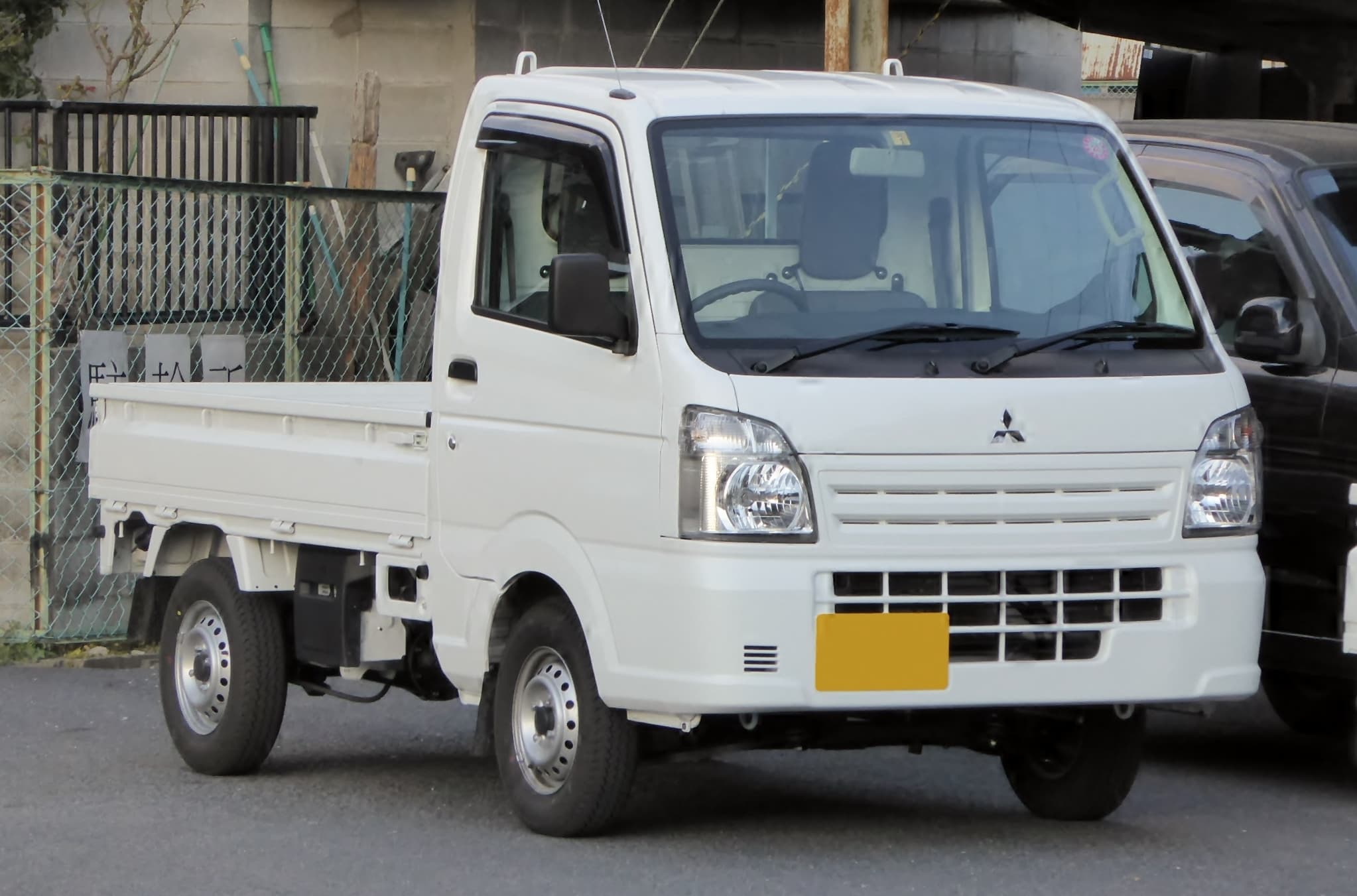
Let me say this upfront: the Mitsubishi Minicab is the most underrated kei truck in America. Everybody talks about the Suzuki Carry and the Daihatsu Hijet, and for good reason — they're great trucks. But the Minicab quietly does everything they do, often for a thousand bucks less, and nobody seems to notice. That's a problem for Mitsubishi marketing. It's an opportunity for you.
Origin & History
Mitsubishi has been building tiny trucks since 1966, when the original Minicab rolled out as part of the first wave of Japanese kei commercial vehicles. By the time the U40 generation arrived in 1991, Mitsubishi had almost 25 years of refinement in small commercial chassis design, and it shows. The Minicab was built to do one thing: work, cheaply, forever. No supercharger marketing gimmicks, no funky suspension experiments, just a proven layout Mitsubishi had already validated across generations.
The reason it never caught on in the same way as the Carry comes down to branding. Mitsubishi's commercial vehicle division sold mostly to businesses — farms, utilities, municipal fleets — so the Minicab never had the consumer glow-up that Suzuki cultivated. That's bad for nameplate prestige and great for used prices.
Generation Breakdown
The U40 (1991-1999) is the one you'll find at the lowest prices. It's the honest, stripped-down version — vinyl seats, manual windows, no power steering on base trims. The 3G83 engine in this era makes 45hp, which is plenty for hauling dirt around a property but feels strained on a long hill.
The U60 (1999-2014) is the generation I'd actually recommend to most buyers. Mitsubishi bumped output to 50hp, added real sound insulation, and offered power steering on most trims. Crucially, the U60 finally got an automatic option that wasn't embarrassing. If you live somewhere with actual traffic, spend the extra money on a U60 auto.
Engine & Drivetrain
The 3G83 is a 657cc SOHC inline-three, and it's one of the most underrated engines in the kei world. Mitsubishi designed it for commercial use from day one, which means long service intervals, forgiving tolerances, and a bottom end that shrugs off abuse. I've talked to Japanese mechanics who say the 3G83 is the engine they'd pick if they had to drive one for 300,000 km without touching it.
The part-time 4WD is the classic kei truck setup: floor-mounted shifter, 2H/4H/4L positions, locking hubs on early models. It's simple, it's mechanical, and there's nothing on it to break. For a guide to how these systems actually work in the field, Dave's mod guides cover the 4WD lever and transfer case in detail.
What It Does Well
The Minicab shines in exactly the scenarios kei trucks are supposed to shine: low-speed work on uneven terrain, short-haul property runs, orchard and vineyard duty, and basically anything where a Ranger or Tacoma would be overkill. The low horsepower doesn't matter when you're hauling mulch at 8mph.
It's also the best kei truck for first-time buyers who aren't sure they'll love the lifestyle. Because Minicabs sell for less, the cost of finding out is lower. If you bail after a year, you lose less money.
Known Weaknesses
Nothing on a Minicab is catastrophically bad, but there are things to watch:
- Rust on the bed floor and rear frame rails — Japan's coastal climate is brutal and Minicabs were often used by fisheries. Check under the bed with a magnet.
- Timing belt — the 3G83 is an interference engine. If the seller can't document a timing belt service in the last 60k miles, budget for it immediately.
- Clutch hydraulics — the slave cylinder on U40s is a known weak point. If the clutch pedal feels spongy, plan to replace it.
- Heater cores — a PITA job, and U40s are notorious for them leaking around year 20. Smell the cabin for coolant on your test drive.
Buying Advice
A clean U40 with under 80,000 km should land between $4,500 and $6,500 delivered. A U60 automatic in similar condition runs $7,000 to $9,500. Anything above $10,000 for a standard Minicab is dealer markup territory — walk away unless it's a factory dump bed or crane-equipped unit.
Prefer the U60 for daily driving, the U40 if you just need a cheap farm rig. Avoid any truck with rust that extends past the bed — the frame rails are thin and expensive to repair. For the complete pre-purchase checklist, see the buying guide and run the landed cost through the import calculator before committing.
Alternatives & Comparisons
Versus the Carry: Minicab is 10-20% cheaper, mechanically just as reliable, but has a smaller aftermarket. If you want lift kits, camper conversions, or bolt-on mods, Carry wins. If you just want a truck, Minicab wins.
Versus the Hijet: Hijet has a slightly nicer interior and better parts availability in the US. Minicab has lower purchase prices. Tie, pick whichever is in better shape at your budget.
Versus the Sambar: different animal. Sambar is rear-engine, more fun to drive. Minicab is front-engine, more conventional, less quirky.
Owner Experience
Driving a Minicab feels like driving exactly what it is — an honest little work truck with no pretensions. The seating position is upright and commanding, visibility is excellent, and the shifter is vague but forgiving. On the highway it tops out around 65 mph and won't love it, which is fine because this isn't a highway truck.
Take the Which Kei Truck quiz if you're still deciding whether a Minicab fits your use case.
Should You Buy One?
Yes, if you want maximum kei truck for minimum money and don't care about the badge. The Minicab is the value buy of the kei truck world — no romance, no hype, just a reliable little workhorse that costs less than the competition. First-time buyer on a tight budget? This is your truck. Enthusiast chasing a specific model? Look elsewhere. Everyone else? Don't overlook it.