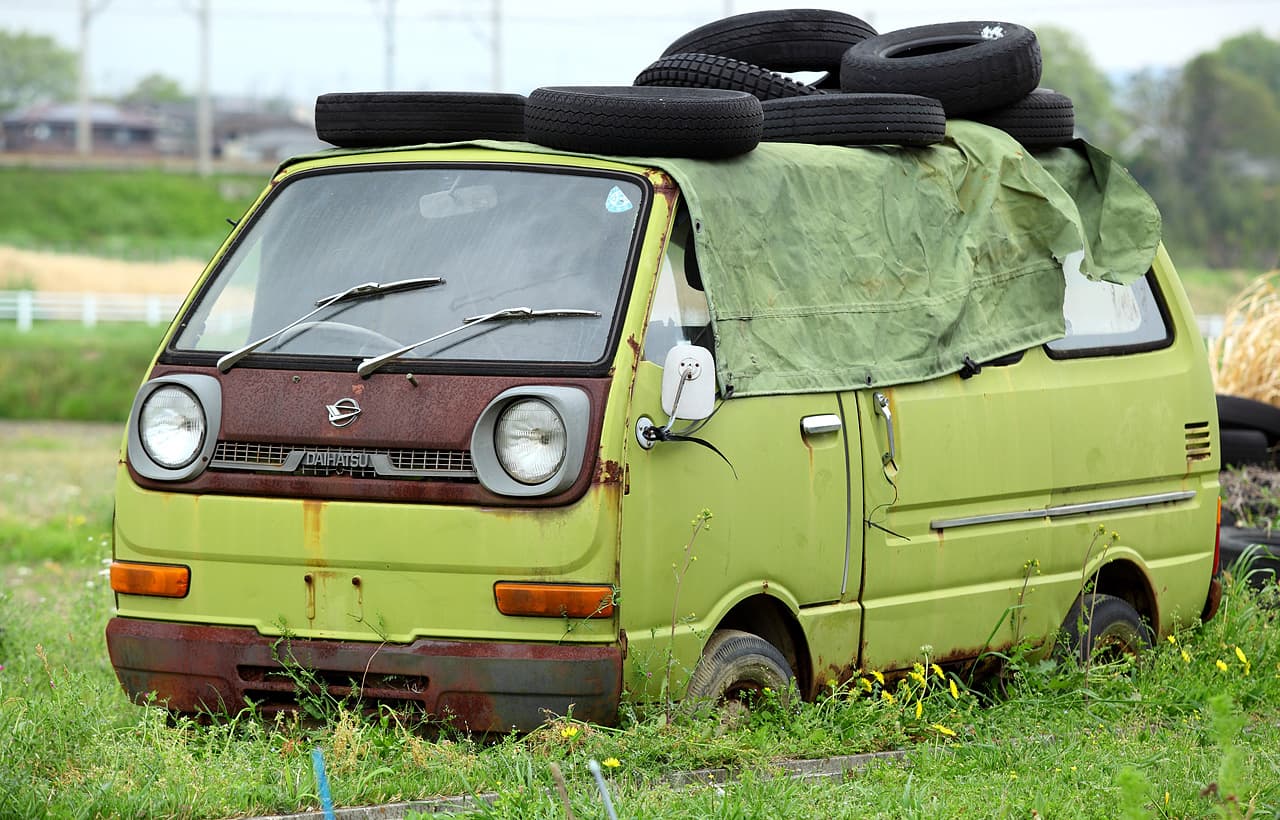
The granddaddy of kei trucks
Here's a number that should put things in perspective: the Hijet has been in continuous production since 1960. That's older than the Ford Mustang, the Porsche 911, and every other kei truck on the market. When Suzuki was still figuring out the Carry formula, Daihatsu was already on their second Hijet generation. The badge on the tailgate of your 2002 Hijet is the same one that rolled out of the Ikeda plant when Kennedy was president.
That kind of institutional experience shows up in weird little places. The door hinges are properly engineered. The gear shift has a mechanical honesty to it. The bed sides fold down with a satisfying thunk that tells you Daihatsu has been tweaking this design for six decades. It's not flashy, but it's the kei truck equivalent of a Leatherman — refined by being used by millions of people for a very long time.
Generation breakdown
The two generations you'll actually see for sale in the US are the S80/S81 (1981-1994) and the S200/S210 (1999-2014). There was an S110 in between, but they're rare and not worth hunting down unless you're a collector.
The S80/S81 is the budget play. Early models came with the tiny 547cc EB 2-cylinder, which makes about 27 horsepower and sounds like a lawnmower arguing with a chainsaw. These are dirt cheap and charming in a "why did I buy this" way. From 1990 onward, the 3-cylinder EF replaced the EB and suddenly the Hijet actually kept up with traffic. If you want an S80, get a 3-cylinder.
The S200/S210 is the real sweet spot. Power steering became standard. Air conditioning and power windows were available. The EF-SE 3-cylinder makes a respectable 50 horsepower, and for the first time you could order a proper 4-speed automatic instead of fighting a column-shift. The cab was modernized, the ergonomics improved, and the part-time 4WD system got a more usable shift-on-the-fly mechanism.
The EF-SE engine
The Hijet's EF-SE 659cc 3-cylinder is one of the most bulletproof little engines ever built. It's all-aluminum, SOHC, fuel-injected, and has a timing chain (not belt) — meaning you don't have to worry about a snapped belt stranding you. Oil changes every 3,000 miles and a periodic valve adjustment and these things routinely go 200,000+ km without a major rebuild.
Common weak points: the alternator bracket cracks on high-mileage trucks, the exhaust manifold studs love to seize (penetrating oil is your friend), and the idle air control valve gets gummy from old gas and causes stalling. All are cheap, easy fixes. See the maintenance and parts guide for walk-throughs.
What it does well
The Hijet's superpower is cheapness. Not just the purchase price, which is the lowest in the kei truck world, but everything downstream. Daihatsu has a massive presence in Southeast Asia and Latin America, where the Hijet is sold new as the Gran Max. That means aftermarket parts are everywhere, prices are low, and you can source obscure bits like door seals and window regulators from Indonesia for pocket change.
It's also the obvious choice for farm work, orchards, campgrounds, and rural property maintenance. The part-time 4WD with low range will pull you out of mud that would eat a side-by-side, and the 770 lb payload handles firewood, fencing, feed bags, and everything else a small property throws at it. Owners on 20-acre hobby farms swear by them.
Known weaknesses
Two main things to watch. First, rust on the bed floor and rear crossmember — especially on trucks that lived in snowy prefectures like Hokkaido. Always crawl under before buying and poke at the frame rails with a screwdriver. Second, the S80 manual transmission synchros get tired, particularly second gear. If it grinds going into second on a cold start, walk away or negotiate hard.
Interior plastics on the S80 are also famously crumbly — sun-baked dashes crack, and the door cards warp. The S200 fixed most of this.
Buying advice
For a daily-driveable Hijet, target an S210 with the EF-SE, 5-speed manual, and under 100,000 km. Expect to pay $7,500 to $9,500 for a clean one, more if it has AC that actually works and a rust-free frame. Automatics are easier to sell later but less fun to drive. Avoid anything with a sketchy Carfax-equivalent export document — Japanese auction sheets (called nyusatsu-hyo) are the gold standard and any reputable importer will provide one. The complete buying guide covers what to look for in detail.
How it compares
The Hijet sits between the Suzuki Carry and the Honda Acty in the kei truck hierarchy. The Carry has better aftermarket support in the US and a huge owner community. The Acty drives better thanks to its mid-engine layout. The Hijet wins on price and long-term parts availability. If you want the cheapest kei truck that'll still be running in 2040, this is it. Not sure which one fits you? Try the vehicle quiz.
Should you buy one?
Yes, if you want a kei truck to actually work and don't care about badge prestige. The Hijet is the unglamorous, dependable choice — the Toyota Corolla of kei trucks. It won't make you look cool on Instagram the way a supercharged Sambar will, but it'll start every morning, haul what you ask it to, and cost you almost nothing to keep running. I've got a '97 Carry I call Old Faithful, but if a clean S210 Hijet showed up for $6,500 tomorrow I'd have a hard time saying no.