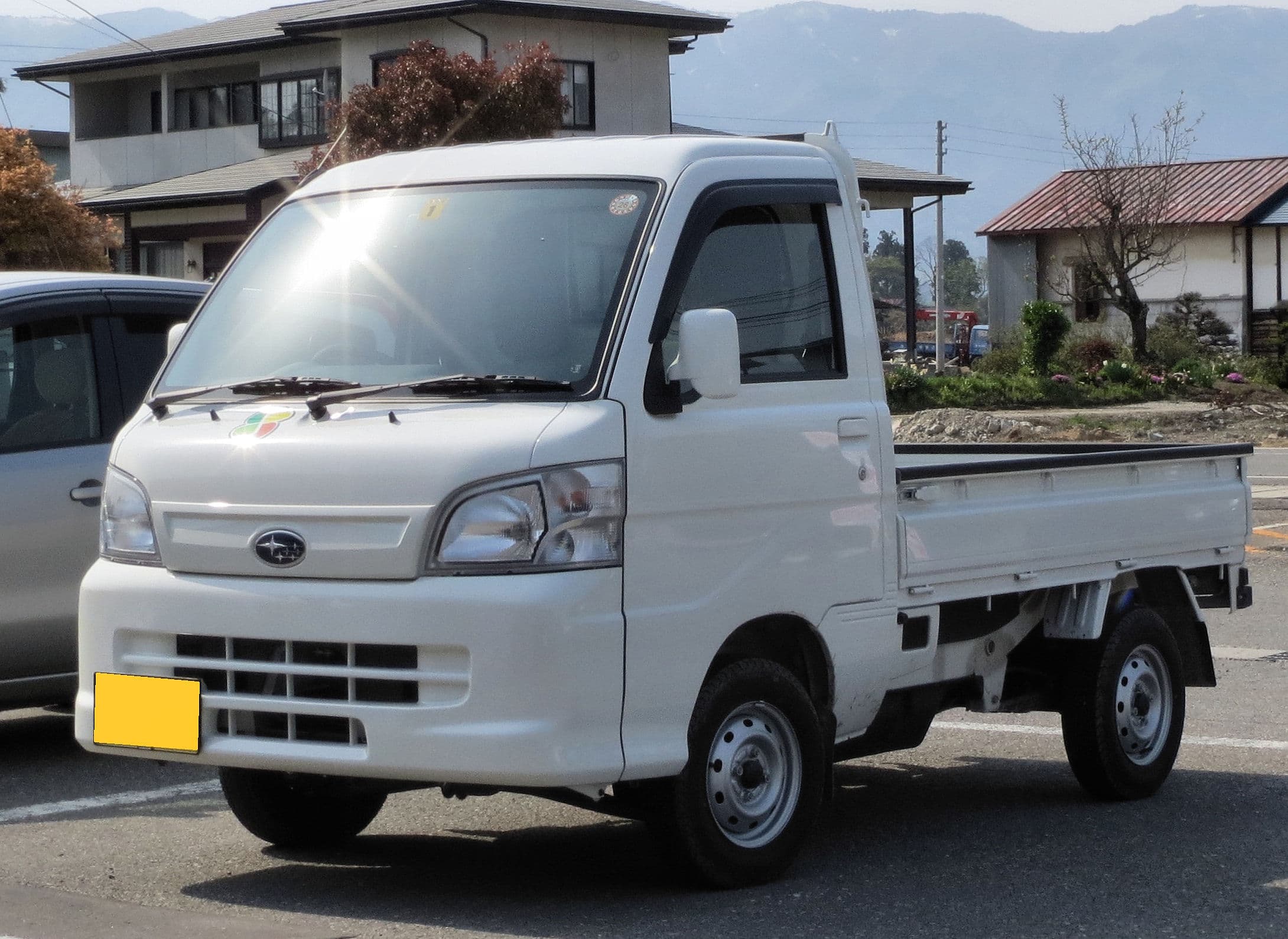
The enthusiast's kei truck
Ask ten kei truck owners which mini truck is the most fun to drive and at least seven of them will say the Subaru Sambar. There's a reason for that, and it's not just badge loyalty. The Sambar is the only kei truck ever built with a rear-mounted, 4-cylinder engine and fully independent suspension on all four corners. It was Subaru's weird engineering flex — the Porsche 911 of kei trucks, if the 911 hauled firewood and cost $8,000. When Subaru finally killed off in-house Sambar production in 2012 and started rebadging Daihatsu Hijets instead, kei truck enthusiasts treated it like a funeral. And they were right to.
A brief history
Subaru started building the Sambar in 1961, making it the second kei truck ever (after the Suzuki Carry, which beat it by a few months). From the very beginning, Subaru committed to a rear-engine, rear-wheel-drive layout inherited from the Subaru 360 kei car. This was unusual — every other manufacturer eventually moved to front- or mid-engine layouts — but Subaru stuck with it for 50 years, through seven generations, all the way until the final in-house Sambar rolled off the Gunma line in 2012.
Why rear-engine? Two reasons. First, it freed up the entire front of the truck for cargo and crumple zone. Second, putting the engine over the driven rear wheels gave the Sambar remarkable traction — particularly important in Japanese mountain villages where snow and steep grades made front-engine 2WD trucks useless. The rear-engine Sambar could climb in conditions that stranded its competitors.
The generations you'll actually see
Two generations are currently importable and worth knowing:
KS3/KS4 (1990-1999) — The fifth generation. This is the classic square-body Sambar, the one most enthusiasts picture when they hear the name. Rear-mounted EN07 658cc 4-cylinder, naturally-aspirated, 48 horsepower. Available as 2WD or part-time 4WD. 5-speed manual was by far the most common. This generation is legally importable right now and commands reasonable prices. Look for the SDX and TC trims, which add a little extra chrome and nicer seats.
TT1/TT2 (1999-2012) — The sixth generation, and the one most Americans are currently chasing. Bigger cab, better ergonomics, and — crucially — an available supercharged version of the EN07 producing 55 horsepower. Also available as full-time 4WD (rather than the earlier part-time system) and with Subaru's quirky E-CVT automatic, which was a continuously variable transmission years before CVTs hit the mainstream US market. The 2003 facelift improved the interior significantly. TT2 supercharged 4WD manuals are the holy grail.
The EN07 — kei's only 4-cylinder
This is the Sambar's technical secret weapon. Every other kei truck uses a 3-cylinder engine because three cylinders are cheaper, lighter, and simpler. Subaru's EN07 is a 4-cylinder 658cc all-aluminum DOHC engine, shared with the Vivio and Pleo kei cars. It has two main advantages over the 3-cylinder competition: smoother power delivery (no weird firing-order vibration) and higher revability. The Sambar happily revs past 7,000 RPM, whereas most 3-cylinder kei trucks start protesting at 6,000.
Then there's the supercharger. The supercharged EN07 uses a small Roots-type blower mounted on top of the engine, feeding an air-to-air intercooler. It's not a huge boost increase — maybe 7 psi — but it transforms the Sambar's character. Low-end torque jumps dramatically, highway cruising becomes relaxed instead of manic, and climbing grades stops feeling like a religious experience. Supercharged 4WD Sambars are legitimately quick by kei truck standards.
Common EN07 issues: the head gasket is a known weak point on high-mileage, hard-driven examples (sound familiar, Subaru fans?). The supercharger snout bearing can wear and start whining — replacement is straightforward but parts are specific. Oil leaks from the valve cover are universal and easy to fix. Overall the engine is reliable if maintained, but it's more finicky than a Daihatsu EF-SE. See the parts and maintenance guide for specifics.
What it does well
The Sambar is the kei truck you buy when you actually want to enjoy driving it. The independent rear suspension makes it handle corners in a way no leaf-sprung Hijet or Carry can match. The 4-cylinder smoothness means highway driving doesn't give you a headache. The rear-engine weight distribution (roughly 45/55 front/rear) plants it on the road rather than wandering. And the supercharged version genuinely keeps up with US traffic — 70 mph cruising is drama-free.
It's also excellent in snow and mud. The rear-biased weight helps the driven wheels dig in, and the full-time 4WD on TT-generation trucks splits power seamlessly. Mountain property owners and ski-country users love Sambars for this reason.
Known weaknesses
Three things to check hard before buying:
- Head gasket history. Ask for service records. If the head gasket has been done, that's a good sign. If it hasn't and the truck has 120,000+ km, factor it into your price.
- Supercharger condition (on TT1/TT2 SC models). Listen for whining or rattling from the blower. A failing supercharger is expensive.
- Rust on the rear subframe and engine cradle. The rear-engine layout means the cradle is exposed to road salt and debris. Inspect carefully.
The E-CVT automatic is also a known weak point. When it works it's smooth and pleasant, but when it fails it's basically unfixable in the US. Buy a manual if you can.
Buying advice
Expect to pay a premium over other kei trucks. A clean KS4 4WD manual runs $8,000 to $11,000 landed. A TT2 supercharged 4WD manual with low miles can hit $13,000 to $15,000+. Non-supercharged TT trucks are the value play, sitting in the $9,000-$12,000 range. Always demand the Japanese auction sheet and crawl under the truck (or have your importer do it) before committing. The complete buying guide covers inspection points in depth.
Sambar vs. the others
Against the competition: the Hijet is cheaper and simpler, the Carry has better aftermarket support, and the Acty has a similarly playful character thanks to its mid-engine layout. What the Sambar offers that nothing else does is the 4-cylinder + independent suspension + supercharger combination. If you want a kei truck that drives more like a car and less like a farm implement, this is the only answer. Still comparing? Try the vehicle quiz or check the Hijet vs Carry comparison.
Should you buy one?
Yes, if you care about driving dynamics and you're willing to pay for them. The Sambar is the kei truck for people who would otherwise buy a Subaru Forester — practical, capable, a little weird, and secretly fun. It costs more than a Hijet, demands a little more maintenance attention than a Carry, and has a smaller aftermarket than either. But when you're carving through mountain roads in a supercharged rear-engine 4WD mini truck, you'll understand exactly why Subaru fans get misty about these things. I've driven a lot of kei trucks, and the Sambar is the one I find myself thinking about when I'm not in it.