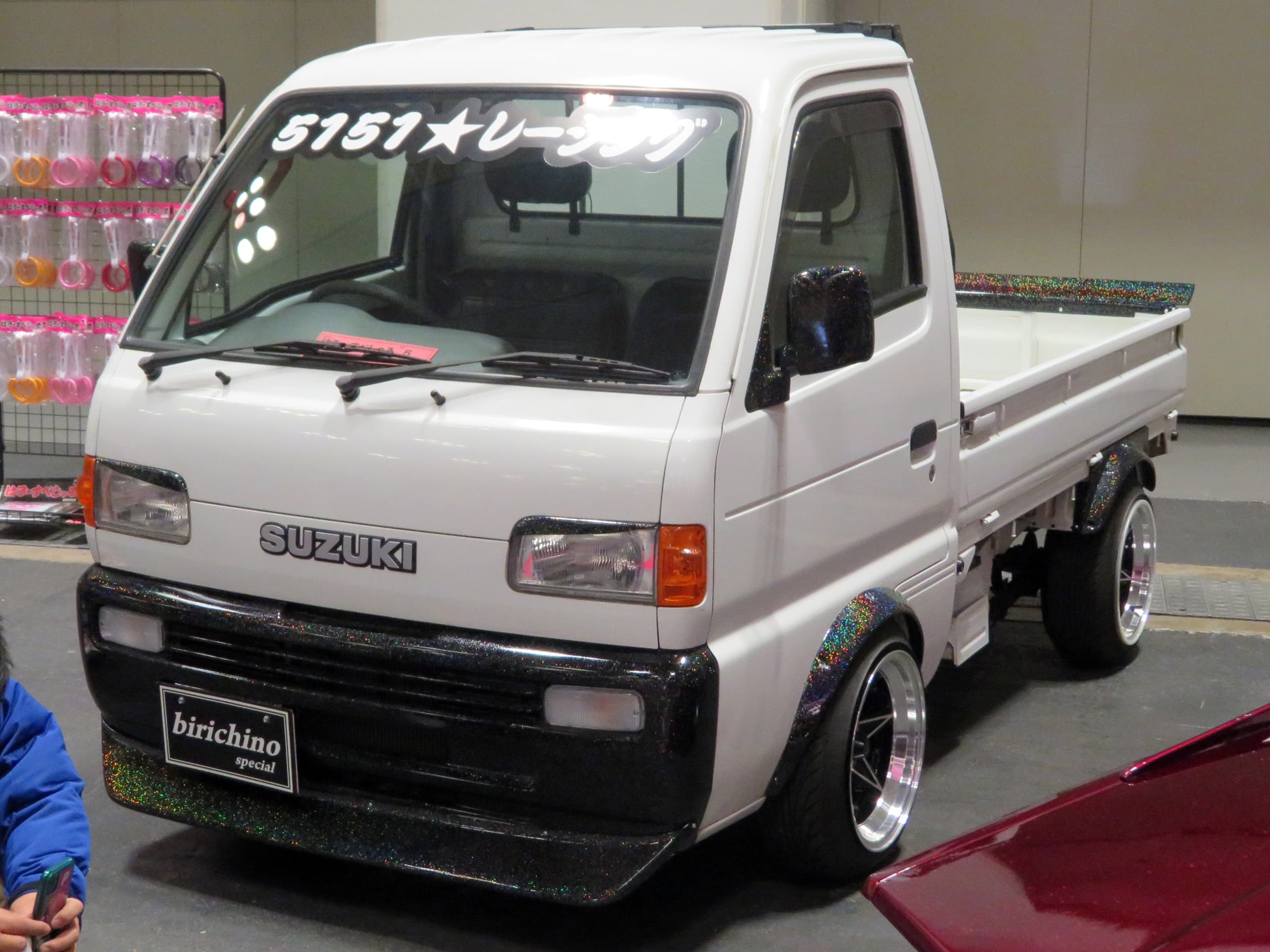
The Stat That Breaks Brains
I track kei truck conversations on Reddit. (Yes, I have a spreadsheet.) Last year, a post pointing out that kei trucks have the same bed length as a Ram hit 3,000+ upvotes. It's the most viral kei truck fact on the internet because it's true — and it made me pull out a tape measure at my dad's farm in Chesapeake to verify it on his '95 Carry. Six feet, two inches. Same as the Ram parked next to it at the feed store.
The data is the data. Let's break down the real comparison.
Bed Size: The Headline
| Truck | Bed Length | Bed Width | Bed Area |
|---|---|---|---|
| Suzuki Carry (DA63T) | 6.2 ft | 4.5 ft | ~28 sq ft |
| Ram 1500 Crew Cab | 5.6 ft | 5.3 ft | ~30 sq ft |
| Ford F-150 SuperCrew | 5.5 ft | 5.0 ft | ~28 sq ft |
| Toyota Tacoma Double Cab | 5.0 ft | 4.7 ft | ~24 sq ft |
| Honda Acty (HA7) | 6.1 ft | 4.5 ft | ~27 sq ft |
The kei truck bed is longer than a Tacoma and essentially tied with an F-150 SuperCrew. It's narrower, but the usable area is remarkably close.
And here's the kicker: kei truck beds have flat, low sides with drop-down gates on three sides. Loading and unloading is dramatically easier than reaching over the tall sides of a modern full-size.
The Full Comparison
| Category | Kei Truck | Full-Size Pickup |
|---|---|---|
| Purchase price | $5,000–$15,000 | $35,000–$70,000 |
| Fuel economy | 35–45 mpg | 15–22 mpg |
| Insurance | $200–$600/year | $1,500–$3,000/year |
| Registration | $50–$300/year | $100–$500/year |
| Bed length | 6.0–6.2 ft | 5.5–6.5 ft |
| Payload | 770 lbs | 1,500–3,000 lbs |
| Towing | Not recommended | 6,000–13,000 lbs |
| Top speed | 60–70 mph | 100+ mph |
| Turning radius | ~14 ft | ~22–24 ft |
| Parking | Fits anywhere | Full-size parking only |
| Engine | 660cc, 45–55 hp | 3,500–6,200cc, 275–400 hp |
| 4WD | Available | Available |
| Length overall | ~10 ft | 18–20 ft |
| Curb weight | ~1,600 lbs | 4,500–5,500 lbs |
Where Kei Trucks Win
1. Cost — Not Even Close
A kei truck costs $5,000–$15,000 total landed. A new F-150 starts at $36,000 and an average transaction price is over $55,000. Even a used full-size with 100k miles runs $20,000+.
Over 5 years of ownership, factoring fuel, insurance, and maintenance:
| Kei Truck | Full-Size | |
|---|---|---|
| Purchase | $8,000 | $45,000 |
| Fuel (10k mi/yr) | $3,500 | $10,000 |
| Insurance | $2,000 | $10,000 |
| Maintenance | $2,500 | $5,000 |
| 5-year total | $16,000 | $70,000 |
That's a $54,000 difference. You could buy 4-5 kei trucks for the price of one full-size pickup.
2. Maneuverability
A kei truck is under 11 feet long with a turning radius of about 14 feet. It can:
- Navigate tight barn aisles
- U-turn on a two-lane road
- Park in a compact car spot
- Drive down narrow forest trails
Try doing any of that in a Crew Cab F-150 that's 20 feet long.
3. Fuel Economy
35–45 mpg vs. 15–22 mpg. At current gas prices, you're saving $1,000+ per year in fuel alone. And kei trucks run fine on regular 87 octane.
4. Simplicity
660cc engines with carburetors or basic fuel injection. No turbochargers, no computer-controlled 10-speed transmissions, no DEF fluid, no 47 sensors to fail. Most maintenance can be done in a driveway with basic tools.
5. Fun Factor
This is subjective, but there's something genuinely joyful about driving a kei truck. They're light, responsive, and they turn heads everywhere you go. Nobody has ever pointed and smiled at an F-150 in a parking lot.
Where Full-Size Pickups Win
1. Payload and Towing
This is the big one. A kei truck maxes out at 770 lbs of payload. A full-size handles 1,500–3,000 lbs in the bed and can tow 6,000–13,000 lbs. If you're hauling a loaded trailer, heavy equipment, or construction materials regularly, a kei truck can't do the job.
2. Highway Comfort
Kei trucks top out at 60–70 mph and they're working hard to get there. Highway driving is loud, windy, and tiring. Full-size pickups cruise at 80 mph in air-conditioned silence. For long-distance driving, there's no comparison.
3. Crash Safety
A 1,600 lb kei truck vs. a 5,000 lb F-150 in a collision is not a fair fight. Modern full-size trucks have crumple zones, airbags, stability control, and reinforced cabs. Kei trucks have seatbelts and a thin steel cab. For highway driving in heavy traffic, the safety gap is real.
4. Creature Comforts
Modern full-sizes have heated/cooled seats, 12-inch touchscreens, adaptive cruise control, and a cabin the size of a living room. Kei trucks have a heater (sometimes), an AM/FM radio (maybe), and manual everything. They're charming, not comfortable.
5. Availability and Support
You can buy an F-150 at any of 3,000+ Ford dealers and get it serviced anywhere. Kei trucks require specialized importers, and finding a mechanic who's worked on one can be a challenge in some areas.
The Real Answer: They're Different Tools
The comparison isn't really "which is better" — it's "which is right for the job."
Get a kei truck if you need:
- A farm/property runabout
- A light-duty hauler for mulch, firewood, feed
- A fun weekend vehicle
- A second truck that costs almost nothing to own
- Something that fits where a full-size can't
Get a full-size if you need:
- Heavy towing (trailers, boats, equipment)
- Highway commuting
- Regular heavy payload (construction, landscaping business)
- Maximum crash safety in mixed traffic
- A primary family vehicle
The smartest move? Many kei truck owners have both. The kei truck handles 80% of "truck tasks" at a fraction of the cost, and the full-size comes out for the 20% that actually requires it. My dad does exactly this — the Carry handles daily farm chores, and his neighbor's F-250 gets borrowed for the twice-a-year trips to the lumber yard. The 5-year cost difference of $54,000 isn't theoretical. I ran the numbers. I have a spreadsheet. (I always have a spreadsheet.)
Next Steps
- Browse the truck database to find the right kei truck model
- Take the quiz to get a personalized recommendation
- Calculate your import cost
- Check your state's regulations