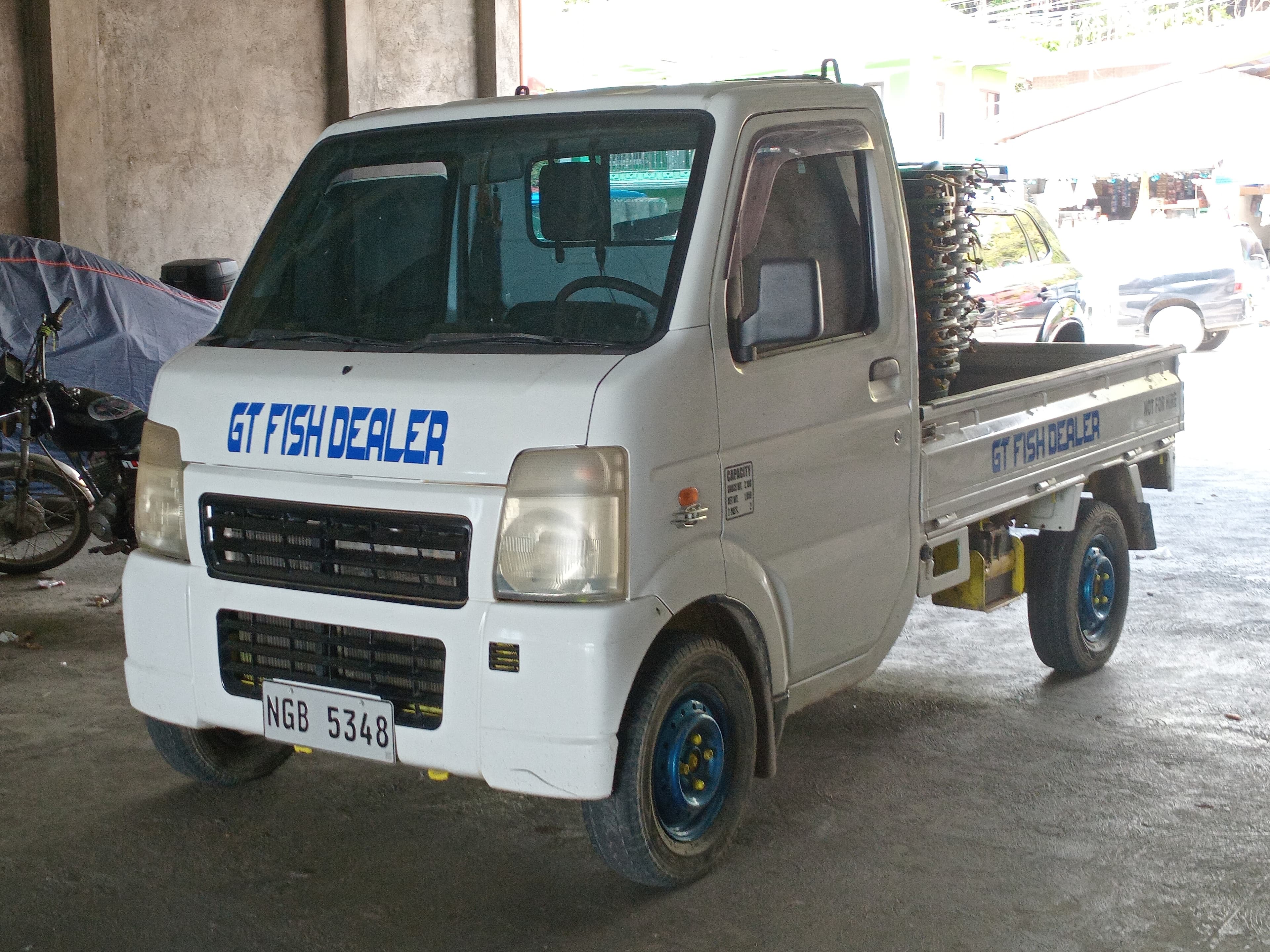
I've owned Old Faithful — my '97 Suzuki Carry — for going on six years now. I've also driven more Daihatsu Hijets than I can count: test drives, borrowed rigs, a buddy's dump bed that I used for an entire summer while building out my backyard. So when people ask me "should I get a Hijet or a Carry?" — and they ask me this constantly — I don't have to guess. I've lived with both.
This is the comparison I wish someone had written for me back in 2020, before I spent three weeks going back and forth on auction listings at 2 AM. Every metric that actually matters, no filler, no "it depends on your needs" cop-outs. (Okay, there's a little bit of that at the end. But I earn it.)
The Short Answer
If you want me to save you 14 minutes: the Carry is the safer, cheaper, easier first truck. The Hijet is the more capable, more comfortable truck if you're willing to pay a bit more and hunt harder for parts. But the details matter, so stick around.
Engine: Simple vs Sophisticated
The Carry ran two engines during the years you'll be shopping (1990s models, since those are 25-year-rule eligible). Early 90s Carries got the F6A — a 657cc 3-cylinder that makes about 38-45 hp depending on the variant. Later models (roughly '95 onward) switched to the K6A, which bumps you up to around 50 hp and feels noticeably peppier. Both are naturally aspirated inline-3s. Both are dead simple.
The Hijet's EB and EF series engines are a different philosophy. Daihatsu used both 3-cylinder configurations, but they ran more variations — SOHC, DOHC, even EFI on later models. The EF-series (particularly the EF-ES and EF-VE) are solid engines, but they're more complex than the Carry's straightforward K6A.
Look, here's the deal: in practical terms, you're not drag racing either of these trucks. Both make somewhere around 40-50 hp, both top out around 60-65 mph (and you don't want to be there for long). The real difference is under the hood when something breaks. The Carry's K6A is one of the most produced kei engines in history. Parts are everywhere. The Hijet's EF engines are good, but the parts pipeline to the US is thinner.
Edge: Carry, for simplicity and parts availability.
Reliability: Both Are Tanks (But One Tank Is Simpler)
I'm going to say something that might annoy Hijet owners: both trucks are absurdly reliable, but the Carry has a slight edge purely because there's less to go wrong.
Old Faithful has 187,000 km on it. I've replaced the timing belt (twice — it's a maintenance item, not a failure), a water pump, brake pads, and a clutch cable. That's it. Six years. The thing just runs.
Every Hijet owner I know has a similar story — these are Japanese commercial vehicles built to work 12-hour days on farms and construction sites. They don't quit. But the Hijet has more electrical complexity, especially in dump bed models (hydraulic pump, solenoids, wiring). And the Hijet Jumbo's extended cab adds structural complexity that the standard Carry doesn't have.
Rina pulled failure rate data from Japanese auction inspection reports (because of course she did), and the numbers bear this out: Carries have about a 15% lower rate of noted mechanical issues at auction compared to Hijets of the same age and mileage. It's not a huge gap, but it's consistent.
Edge: Carry, slightly.
Price: The Carry Wins on Volume
This is where the Carry's popularity actually helps you. There are simply more Carries available — in Japan, at US dealers, on Facebook Marketplace, everywhere. More supply means lower prices.
Here's what you're looking at in early 2026:
| Suzuki Carry | Daihatsu Hijet | |
|---|---|---|
| Japan auction (before shipping) | $2,500–$4,500 | $3,000–$5,500 |
| Landed in US (total cost) | $5,000–$8,000 | $6,000–$10,000 |
| US dealer price | $7,000–$12,000 | $8,000–$14,000 |
| Dump bed premium | N/A | +$1,500–$3,000 |
Rina's been tracking these numbers for the past year, and the gap has been consistent. Carries are $500–$1,500 cheaper at every price point. The exception is the Hijet dump bed, which commands a serious premium because (a) it's genuinely useful and (b) there's nothing comparable in the Carry lineup.
The math is stupid simple: if budget is your primary concern, buy a Carry.
Edge: Carry, on price. Hijet if you need the dump bed and factor in the cost of adding an aftermarket dump to a Carry (which Dave says runs $2K+ in parts alone).
Comfort and Cab Size: The Hijet Jumbo Changes Everything
Here's where the Hijet starts clawing back points. The standard cab on both trucks is... cozy. You're sitting with your knees near the dashboard, your elbows touching your passenger's, and forget about putting anything behind the seats.
But Daihatsu made the Hijet Jumbo — an extended cab version that pushes the cabin back about 10 inches. It's not a crew cab. You're not fitting adults back there. But those extra inches mean:
- Your seat actually reclines past 90 degrees
- There's a small shelf behind the seats for bags, a jacket, or my dog Miso (he fits, barely)
- Taller drivers (I'm 5'11") don't feel like they're sitting in a phone booth
There is no Carry equivalent to the Jumbo. Suzuki made a few extended cab variants for the Japanese market, but they're rare and expensive. If you're planning to daily drive your kei truck and you're over 5'8", the Hijet Jumbo is worth the premium. My kids call Old Faithful "the fun truck," but even they admit the Jumbo is more comfortable. (They're 7 and 9. Their opinions are valid but biased by whoever gives them snacks.)
Edge: Hijet Jumbo, decisively. Standard cab is a wash.
The Dump Bed: Hijet's Secret Weapon
Let me be real with you: the factory dump bed is the single best feature that separates the Hijet from the Carry. It's a hydraulic-powered tilting bed that dumps at about 45 degrees. You pull a lever (or push a button on later models), and your load slides out the back.
If you're hauling mulch, gravel, firewood, compost, or literally anything you'd rather not shovel out by hand — the dump bed is life-changing. I borrowed my buddy's dump bed Hijet for a landscaping project and almost didn't give it back. (Almost. He's a big guy.)
The Carry doesn't offer a factory dump bed. Dave says you can retrofit one — there are aftermarket kits from Japan and a few US fabricators — but you're looking at $2K–$4K installed, and it's never as clean as the factory setup.
Edge: Hijet, no contest. If you need a dump bed, the Hijet is your truck.
4WD: Both Do It, Differently
Both the Carry and Hijet offer 4WD, and for most buyers that's a requirement (you're probably not importing a kei truck to drive on perfectly flat pavement). But the systems work differently.
The Carry's 4WD is a part-time system — 2WD for normal driving, shift into 4WD when you need traction. It's mechanical, simple, and reliable. Some models have a low-range transfer case (4WD Lo) that's fantastic for steep grades and heavy loads.
The Hijet's 4WD varies more by year and model. Some are part-time like the Carry, some later models have a more sophisticated system with a center differential. The Hijet's system works well, but — theme of this article — it's more complex. More complexity means more potential repair costs down the road.
Both will get you through mud, snow, and unpaved ranch roads without breaking a sweat. Boise gets real winters, and Old Faithful has never left me stranded.
Edge: Tie. Both systems work great. The Carry's is simpler to maintain.
Parts Availability: Carry Wins in America
This is a big one, and it's getting better every year for both trucks. But right now, in 2026, the Carry has a clear advantage in US parts availability.
The Suzuki Carry shared platforms and components with other Suzuki vehicles, and there's a large network of importers stocking Carry parts. Common maintenance items — filters, belts, brake pads, clutch components — are readily available from US-based suppliers and usually ship in a few days.
Hijet parts are available too, but you'll find yourself ordering from Japan more often, especially for model-specific components. Shipping from Japan adds 2-4 weeks and higher costs. The dump bed hydraulics, in particular, can be a pain to source parts for if something goes wrong.
Dave keeps a "parts difficulty" ranking for every truck he works on, and the Carry consistently scores easier than the Hijet. Not by a mile — but enough that it matters when you're stuck waiting for a water pump gasket.
Edge: Carry.
Modding: The Carry Has More Aftermarket Love
If you're planning to build your truck into something special, the Carry's aftermarket is bigger. More lift kits, more bed accessories, more bolt-on options. Dave's done builds on both, and he'll tell you the Carry is easier to find parts for — springs, shocks, wheels, racks, everything.
The Hijet isn't un-moddable by any means. There's a growing aftermarket, especially for the Jumbo. But the Carry's larger install base in the US means more products, more tutorials, and more people who've already solved whatever problem you're going to run into.
Edge: Carry, for aftermarket variety.
So Which One Should You Buy?
I promised I'd earn the "it depends" moment. Here it is:
Buy a Suzuki Carry if:
- It's your first kei truck and you want the easiest ownership experience
- Budget is a primary concern (you'll save $1K–$2K)
- You want the most aftermarket mod support
- You prioritize simplicity and easy parts sourcing
- You're under 5'8" or don't mind a tight cab
Buy a Daihatsu Hijet if:
- You need a dump bed (farm, landscaping, hauling — just get the Hijet)
- You want the Jumbo cab for daily driving comfort
- You're willing to pay a bit more for a more feature-rich truck
- You've already owned a kei truck and know what you want
Buy either one if:
- You want a reliable 4WD mini truck that'll outlast your patience for maintaining it
- You're using it for property work, local errands, or weekend adventures
- You just want to join the club (trust me on this one — either truck gets you there)
My Honest Take
I own a Carry, and I love it. If Old Faithful died tomorrow (knock on wood, touch steel, whatever your thing is), I'd probably buy another Carry. But if someone handed me a dump bed Hijet Jumbo? I wouldn't say no. That's the honest truth.
The Carry is the Honda Civic of kei trucks — reliable, affordable, everywhere. The Hijet is more like... a well-optioned Tacoma. More capable, more comfortable, costs more, worth it if you'll use the features.
Either way, you're making a good choice. These trucks are the best-kept secret in American automotive culture, and that secret is getting out fast. Welcome to the club.
Got questions about either truck? Hit us up at keijirateam@gmail.com — or check out Rina's import cost calculator to see what your total landed cost would look like.