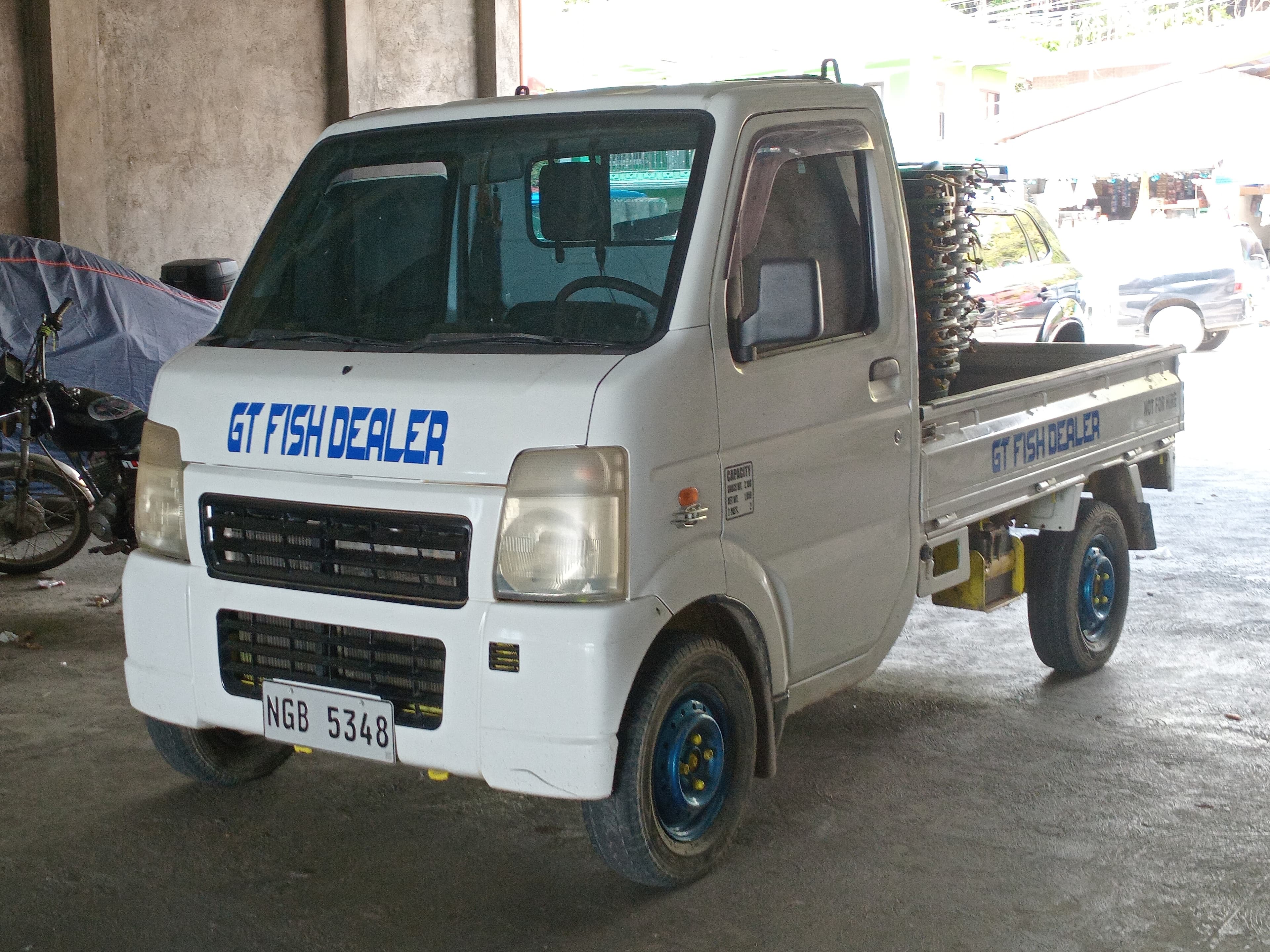
I'll be honest with you — I almost bought a Sambar instead of Old Faithful.
It was 2019, I was deep in the auction listings, and I kept coming back to this 1994 Sambar van with the supercharger. AWD, rear engine, independent suspension on all four corners. It drove like an actual car. I went with the '97 Carry instead (and I love that truck), but the Sambar never left my brain. There's something about it that just feels different from every other kei truck on the market.
And I'm not alone. Talk to anyone who's driven one, and they'll tell you the same thing. The Sambar is the Swiss Army knife of kei vehicles. It does everything, it does it well, and it does it with an engineering philosophy that makes you wonder why every kei truck isn't built this way.
Look, here's the deal. If you're considering a kei truck and you haven't looked at the Sambar, you're making a mistake. Let me walk you through everything.
What Makes the Sambar Special
Three words: rear-mounted engine.
Every other kei truck on the market — Carry, Hijet, Minicab — puts the engine under the front seats or somewhere in the cab. The Sambar puts it behind the rear axle. This changes everything. The bed floor is completely flat with no drivetrain tunnel. Weight distribution is better (more weight on the drive wheels). And the cab is quieter because the engine is, you know, not directly under your butt.
Then there's the supercharger. The Sambar is the only kei truck that came from the factory with forced induction. Not a turbo — a supercharger. Instant boost, no lag. On a 660cc engine making 58 horsepower (the kei car legal limit), that extra shove is the difference between merging onto the highway with confidence and merging with a prayer.
And the suspension. Independent rear suspension on a kei truck. Every other kei truck uses a solid rear axle (leaf springs on the Carry and Hijet, which is fine for hauling but rides like a covered wagon when empty). The Sambar has coil springs and independent geometry at all four corners. It actually handles.
Suki drives a '94 Sambar Van — she calls it "Samu-chan" — and she'll tell you it's the most livable kei vehicle she's owned. She hauls pottery to markets, camps on the Oregon coast, and daily drives it in Portland traffic. That's the Sambar's range. It just does everything.
Generations: What's Importable
For US import under the 25-year rule, you're looking at:
KS3 (1990-1994): The sweet spot right now. All of these are legal to import. Round headlights on early models, more angular on later ones. Available in truck and van (Dias for the upscale van trim). Supercharged option available from 1992 onward. This is the generation Suki's Samu-chan belongs to.
KS4 (1994-1998): The refined version. Same basic platform but with updated interior, better sound insulation, and improved supercharger tuning. The 1997 and 1998 models are just now becoming importable. If you can wait for a '98, you'll get the most developed version of this generation.
TT1/TT2 (1999-2012): Not importable yet (earliest eligible in 2024). Different platform, still rear-engine. Worth knowing about if you're planning ahead. The 2005+ models lost the supercharger option, which is a tragedy.
For right now, 1990-1998 is your window. My recommendation: aim for 1992-1996. Old enough to be fully legal, new enough to have the refined supercharger and better interior.
Engine Options: EN07 Naturally Aspirated vs. Supercharged
Both versions use Subaru's EN07 inline-4 (yes, a four-cylinder — while everyone else was using three-cylinder engines). It's a 660cc SOHC unit that revs freely and sounds legitimately good at high RPM.
Naturally aspirated (EN07C): 40-46 horsepower. Perfectly adequate for around-town use, farm work, and anything under 50 mph. Bulletproof reliability. Dave says these are the ones he almost never sees in the shop for engine problems. (He's a maintenance guide machine — check his troubleshooting guide if you want the full rundown on what breaks.) Oil changes and timing belts, that's basically it.
Supercharged (EN07Y / EN07F): 58 horsepower. Doesn't sound like much on paper, but on a truck that weighs 1,700 lbs, it's transformative. Highway merging, hill climbing, hauling a loaded bed — the supercharger makes the Sambar actually competent at speed. The trade-off: more maintenance. Oil changes every 3,000 km (not 5,000), timing belt at 60,000 km, and the supercharger itself needs its oil topped up periodically.
Trust me on this one: if you plan to drive on any roads with speed limits above 45 mph, get the supercharger. The naturally aspirated version works hard at highway speed, and "works hard" on a 660cc engine means noise, vibration, and wear. The supercharged version just cruises.
Truck vs. Van: Which One?
This is the most common question I get about the Sambar. Both share the same platform, same engine options, same drivetrain. The difference is the back half.
Sambar Truck: Open bed, lower weight, easier to load bulky items, more mod-friendly (bed racks, toolboxes, lift kits). If you're using it for hauling, farm work, landscaping, or just want the classic kei truck look — get the truck. Prices run $6,000-$9,000 imported.
Sambar Van (and Dias Van): Enclosed cargo area, weather-sealed, folds flat for sleeping, better for road trips. The Dias trim gets upgraded seats, carpet, and sometimes AC. If you want a micro-camper, a delivery vehicle, or a daily driver that keeps your stuff dry — get the van. Prices run $7,000-$11,000, with Dias trim and supercharger models at the top. Suki's Samu-chan is a Dias van with the supercharger and AWD, and she paid around $9,500 landed in 2021. That's probably $10,500-$11,000 today.
(Parenthetical confession: I sometimes regret not getting a van. Miso — my dog — would love a van. The Carry's bed works fine with his crate, but a van with the rear area set up for him? That's the dream.)
Known Issues
It's a Subaru. You know what's coming.
Head gaskets are the obvious concern. The EN07 is less prone to this than the EJ25 in Outbacks and Foresters, but it's not immune. High-mileage supercharged models are the most at risk. Look for milky oil, coolant loss with no visible leak, or white smoke from the exhaust. Budget $300-$500 for a head gasket job if needed. I've seen forum posts from guys who've had no issues at 200,000+ km, but I've also seen posts from guys who got hit at 80,000 km. It's a Subaru thing — accept it and inspect accordingly.
Supercharger maintenance is real. The supercharger has its own oil reservoir that needs checking every 10,000 km and topping up with specific supercharger oil. If previous owners neglected this, the supercharger bearings wear and you'll hear a whine that gets louder with RPM. Supercharger rebuild kits exist ($150-$250) but it's specialized work. Dave has done a few of these and says it's not hard if you're comfortable with the engine bay, but it's not a first-timer job either.
The timing belt is non-negotiable. This is an interference engine — if the belt snaps, valves meet pistons and you're looking at a rebuild. Replace at 60,000 km, no exceptions. If you're buying a Sambar with unknown timing belt history, budget for an immediate replacement ($100-$150 in parts, 3-4 hours of labor). Dave will tell you this is the most important maintenance item on the entire truck, and he's right.
Rust is the same story as every 25+ year old Japanese vehicle. Check the frame rails, bed floor (on trucks), and wheel arches. Southern Japanese trucks (Okinawa, Kyushu) are generally cleaner than northern ones (Hokkaido, Tohoku) because of road salt.
How Are Parts?
Better than you'd think. The Sambar shares a lot of components across its production run, and Subaru made millions of them. Engine parts, brake components, and suspension bits are readily available through Japanese parts suppliers.
Filters, belts, and brake pads are easy — multiple suppliers, ships in a week, budget $10-$30 per item. Engine internals and supercharger parts are available but sometimes slow to source through Megazip, Amayama, and Japan Parts Direct. Body panels are the hard part — fenders and doors are model-specific, and your best bet is a Japanese salvage yard or another Sambar donor vehicle.
The Sambar community is also solid. There's a dedicated Sambar owners group on Facebook with 4,000+ members who buy, sell, and trade parts regularly. Between that group and the broader kei truck forums, I've never seen a Sambar owner stuck without a solution for more than a few days.
Price Ranges (2026, US Landed)
| Variant | Price Range | Notes |
|---|---|---|
| Truck, naturally aspirated, 2WD | $6,000-$7,500 | Most affordable entry point |
| Truck, naturally aspirated, AWD | $7,000-$8,500 | AWD adds $800-$1,200 |
| Truck, supercharged, AWD | $8,000-$10,000 | The enthusiast's pick |
| Van, naturally aspirated | $7,000-$9,000 | Enclosed cargo premium |
| Van, supercharged, Dias trim | $9,000-$13,000 | Top spec, highest demand |
Low mileage (under 50,000 km) adds $1,000-$2,000 to any variant. Air conditioning adds $500-$1,000. Power steering adds a slight premium but is relatively rare.
Best Years to Buy
Best overall: 1994-1996 KS4. Fully refined platform, all the kinks worked out, every engine and drivetrain option available. 1994 is the first year of the KS4 update with improved interior and better NVH. Legal to import right now.
Best value: 1990-1992 KS3. Older, simpler, cheaper. Non-supercharged 2WD trucks in this range can be found for $5,000-$6,500 landed. Great farm truck or project truck.
Best future investment: 1997-1998 KS4. Just becoming eligible. Lower mileage examples are still available at auction in Japan. Prices will only go up as more people discover them.
How It Compares to the Carry and Hijet
I own a Carry. I love my Carry. But I'll be straight with you about how they compare.
vs. Suzuki Carry: The Carry is simpler, cheaper, and has the best parts availability of any kei truck. It's the Honda Civic of kei trucks — everywhere, cheap to fix, reliable. But it rides rougher (leaf springs), the engine is louder (mid-mounted three-cylinder), and there's no supercharger option. If you want the lowest cost of ownership, get the Carry. If you want the best driving experience, get the Sambar.
vs. Daihatsu Hijet: The Hijet splits the difference. Better parts availability than the Sambar, more refined than the Carry, and the Hijet Jumbo cab gives you usable rear space. But still no supercharger, still a solid rear axle, and the bed floor has a drivetrain hump. Dave loves his Hijet and it's treated him well, but he'll admit the Sambar drives better.
The Sambar costs more upfront and costs slightly more to maintain (especially supercharged models). That's the trade-off for a truck that feels like it was engineered by people who actually wanted to drive it, not just haul stuff with it.
Who Should Buy a Sambar?
Buy the Sambar if you'll drive on highways or roads above 45 mph regularly (get the supercharged), if you want the best ride quality of any kei truck, if you value a flat bed floor, if you want a van for camping or daily driving, or if you appreciate over-engineering and don't mind paying a slight premium for it.
Skip the Sambar if budget is your top priority (Old Faithful and the Carry lineup are cheaper to buy and maintain), if you need the absolute easiest parts sourcing (Carry wins again), if you're doing heavy farm work where suspension sophistication doesn't matter, or if you want the largest community and aftermarket support (Carry and Hijet have the numbers).
Look — every kei truck is a good kei truck. I say that owning a Carry and meaning it. But the Sambar is the best-driving kei truck on the market, and nothing else is close. It drives better than it has any right to, it's more versatile than anything else in the class, and that supercharged rear-engine layout is just cool. Suki drives Samu-chan everywhere — Portland traffic, Oregon coast camping trips, pottery market hauling — and she'll tell you the same thing.
If that speaks to you, go get one. You won't regret it.