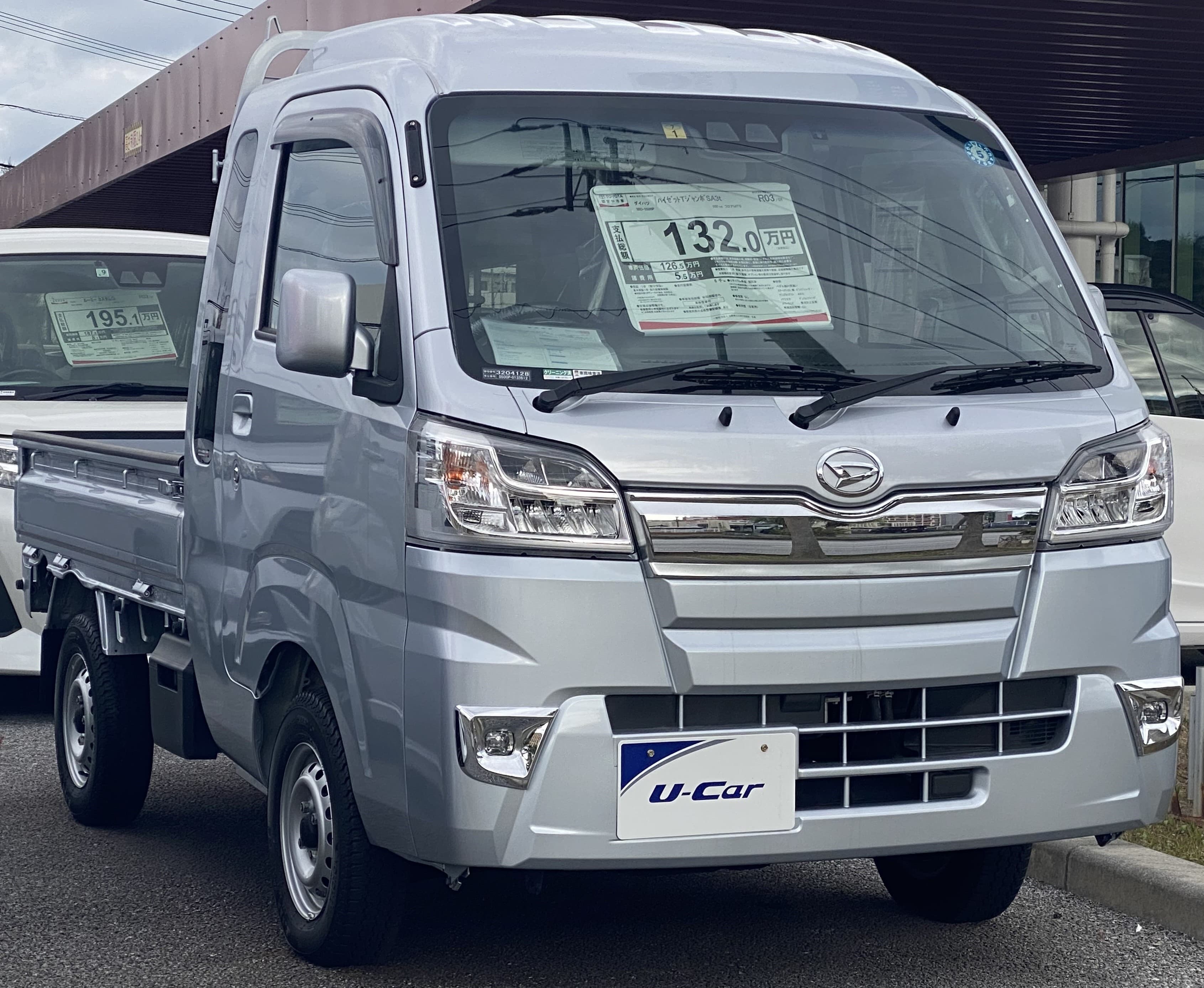
The kei truck for tall humans
I'm 5'11" and the first time I sat in a standard Hijet cab, my knees were touching the dashboard and my head was brushing the headliner. It was not a good first impression. Then I climbed into a Hijet Jumbo. Suddenly my legs had room to stretch, my hand wasn't resting on the shifter while I drove, and I could actually lean back in the seat instead of sitting at attention like a nervous passenger. That moment — that's why the Jumbo exists, and why it's become the fastest-growing segment of the US kei truck market.
Daihatsu introduced the Jumbo cab in 1999 as an answer to a complaint Japanese farmers had been making for years: the regular Hijet cab was too small for anyone over average height. Their solution was elegant — push the back wall of the cab rearward by about 4 inches (roughly 100mm), shortening the bed accordingly. The overall length of the truck stays within the kei class limit, but the cab becomes genuinely usable for taller drivers.
What 4 inches actually buys you
It sounds small. It isn't. Four inches of legroom in a vehicle this compact is the difference between "I can drive this for an hour" and "I can take this on a road trip." The seatback also reclines further in the Jumbo because there's finally room behind it. Most models gain a small parcel shelf or fold-down jump seat behind the main seats — big enough for a backpack, a laptop bag, a lunch cooler, or a small dog. Some owners rig it up as a tool tray for sockets and drill bits within arm's reach of the driver.
The door opening is also slightly larger on the Jumbo, which makes getting in and out noticeably easier. If you're over 6'0" or have a bad back, this matters every single time you use the truck.
The bed trade-off
You give up about half a foot of bed length — 5.6 ft on the Jumbo versus 6.1 ft on the standard Hijet. For most owners, this is a non-issue. A standard 40"x48" pallet still fits (diagonally). Four-foot lumber fits with the tailgate up. Eight-foot lumber sticks out the back, but it does on the regular Hijet too. Unless you're hauling full sheets of plywood flat (and you shouldn't be doing that in any kei truck), you probably won't notice the shorter bed.
The payload rating stays the same at 770 lbs. The axles, suspension, and frame are identical.
Mechanical identity
This is important: the Jumbo is mechanically 100% identical to the standard S200/S210 Hijet. Same EF-SE 659cc 3-cylinder with 50 horsepower, same 5-speed manual or 4-speed automatic, same part-time 4WD with low range, same everything. The only differences are the cab stampings, the bed length, and the rear window (the Jumbo has a larger one). Every wear part, brake component, suspension piece, and engine part is interchangeable with a regular Hijet.
That's great news for parts availability. You're not buying into an orphan — you're buying a Hijet with a bigger hat. See the maintenance and parts guide for sourcing.
What to look for when buying
All the usual S200/S210 Hijet inspection points apply: check the frame rails for rust, listen for clutch chatter, make sure the 4WD engages without grinding, and verify the AC blows cold. See the complete buying guide for a full inspection checklist.
Jumbo-specific things to watch: the rear cab wall can develop rust at the seam where the extended section was welded in, especially on trucks that lived near the coast. Pull back the cab trim if you can and look for bubbling. Also check the rear window seal — it's larger than the standard Hijet's and a common leak point on older, sun-baked trucks.
Buying advice and pricing
Jumbos command roughly a $1,500 to $2,500 premium over equivalent standard Hijets. For a clean, rust-free S210 Jumbo with AC, under 80,000 km, and a clean auction sheet, expect to pay $9,000 to $11,500 landed. Manuals are slightly cheaper than automatics. AWD automatics are the priciest configuration. The import cost calculator will get you a ballpark from different Japanese ports.
If you're on the fence between a Jumbo and a standard Hijet, here's my honest rule of thumb: if you're taller than 5'9", buy the Jumbo. The comfort difference is massive and you'll never regret it. If you're shorter, the standard Hijet saves you money and gives you a longer bed. Simple as that.
Alternatives
The only real alternative is the Suzuki Carry Super Cab (sometimes called the Carry Wide Cab), which Suzuki offered as a similar extended-cab option. It's rarer than the Hijet Jumbo in the US market and parts are harder to find, so unless you specifically want a Carry, the Jumbo is the easier buy. Honda never offered an extended-cab Acty. Subaru never offered a Jumbo-style Sambar.
Should you buy one?
Yes, if you're a taller driver planning to actually use the truck regularly. The Jumbo is the single best quality-of-life upgrade you can get on a kei truck, and the shorter bed genuinely doesn't matter for 95% of use cases. It's the kei truck I recommend to every American buyer who's 5'10" or taller — the regular Hijet cab is just not built for us. If you're short and cheap, get a standard Hijet and pocket the savings. If you're tall and want to actually enjoy ownership, the Jumbo is worth every extra dollar.