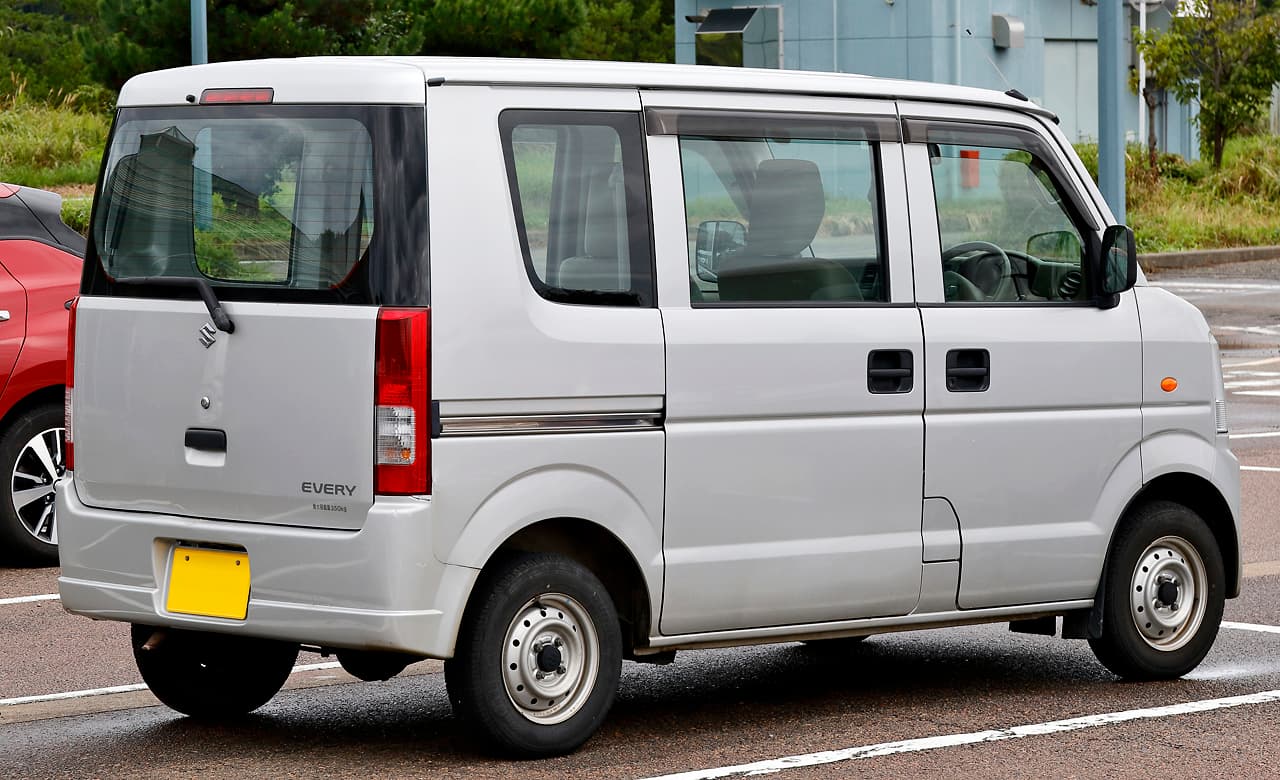
The Every is what happens when Suzuki looked at the Carry and said, "what if we put a roof on the whole thing?" It shares a chassis, drivetrain, suspension, and most of the hard parts with the Carry truck, which means it inherits all of the Carry's best traits — dead-simple mechanicals, cheap parts, and a reputation for running forever. What you gain is enclosed, weatherproof, standing-room-ish cargo space with sliding doors on both sides, and that turns out to be a massive deal for a lot of buyers.
Origin & history
Suzuki has built van variants of the Carry since the 1960s, but the Every nameplate took over in the '80s and has stuck ever since. In Japan, the Every is wallpaper — you see them doing deliveries, running as kei-class shuttles, towing little trailers behind ramen shops, and serving as the family second car in tight neighborhoods. It's meant to do everything the Carry does but without your cargo getting rained on.
For US importers, two generations matter: the DE51V/DF51V (1991-1999) and the DA64V (1999-2015, with the early years now import-legal).
Generation breakdown
DE51V/DF51V (1991-1999) — The classic boxy Every. F6A engine, part-time 4WD on the DF51V, manual or 3-speed auto. Simple, blocky, upright. Not a lot of trim variety, but you can find high-roof models if you hunt. This is where you shop if you want something you can fix yourself without a laptop.
DA64V (1999-2015) — This is the sweet spot for most buyers right now. Wider body, more interior room, K6A engine, the option of a 4-speed automatic that's actually pleasant in traffic, and — critically — factory high-roof models that give you nearly standing headroom inside. The Joinpop and Jointurbo trims added nicer seats and more glass. If you're converting to a camper, the DA64V high-roof is the one to chase.
Engine & drivetrain
Same story as the Carry. F6A in the early stuff, K6A in the DA64V. Both are 660cc three-cylinders, both are bulletproof with basic service, both are belt-driven so don't skip the timing belt interval. The K6A runs smoother at highway speeds and gets slightly better fuel economy, and with a fully enclosed body pushing more air around, you'll appreciate every bit of that.
The 4WD system is part-time with a button or lever — you're meant to run it in 2WD on pavement and switch to 4WD when things get slippery. Don't leave it engaged on dry asphalt or you'll bind up the transfer case. Low range is available on most 4WD trims.
What it does well
Camper conversions. This is where the Every shines in the US market. The flat floor, the tall roof, the sliding doors, the fold-flat or removable rear seats — it's as if Suzuki designed it for you to build a bed platform and throw a Dometic cooler in the corner. You can sleep two people comfortably (if the two people are short friends) and one person like a king. Parts interchange with the Carry means you're not paying van-specific prices for consumables.
It's also excellent for mobile businesses — coffee carts, flower delivery, mobile repair rigs, pet groomers. The sliding doors make loading from either side trivial, and at under 11 feet long, you can park it anywhere.
Known weaknesses
Rust around the rear wheel arches and the sliding door bottom rails — this is the single biggest thing to check on any Every. Water gets trapped in the door tracks and eats the metal from the inside. Sliding door rollers wear and get sticky; replacements are cheap but annoying to install. Rear hatch struts give up. The headliner on high-roof models can sag with age, especially trucks that sat in the Japanese sun. Seat motors on power-seat trims fail.
And honestly, these things are slow. Loaded down with camping gear on an incline, the F6A-powered DE51V will make you question your choices. The K6A helps but doesn't transform it. If you live somewhere flat, this is a non-issue; if you live in the Rockies, budget your expectations.
Buying advice
For a DA64V high-roof 4WD with the K6A and the automatic in reasonable condition, expect $9,000-$13,000 landed. The earlier DE51V/DF51V trucks are cheaper — sometimes dramatically so — but you're trading refinement for simplicity. I'd pay up for the DA64V if you plan to drive it as your daily; I'd save the money and grab an F6A Every if you just need a cheap weekend camper.
Watch out for Japan-market vans that had signage or graphics on the sides — the adhesive pulls paint when removed, and what you're seeing in photos may not be what lands in your driveway. Run the numbers in our import cost calculator before you commit.
Every vs Hijet Cargo vs Acty Van
The Hijet Cargo is the Every's direct rival and shares most of the same strengths. Parts availability tips slightly toward the Every in the US, but both are well-supported. The Acty Van is the mid-engine oddball — smoother ride, worse cargo access (engine under the rear floor eats a few inches of space). For a camper build, I'd pick the Every or Hijet Cargo over the Acty Van nine times out of ten because that flat, uninterrupted floor matters more than the Acty's handling advantage. For a daily driver, pick whichever one you find in the best condition.
Living with it
Fuel economy lands around 35-42 mpg depending on generation and driving style. Highway cruising is comfortable up to about 60-65 mph. The interior is genuinely spacious for what it is — my buddy Dave (he runs our mods section) built a sleeping platform, a small kitchen, and a gear rack in his and still has floor space. Heat and A/C are both better than the Carry truck because the engine isn't sitting under your feet cooking you.
Should you buy one?
If you want kei reliability plus enclosed cargo, yes — this is the default recommendation. The Every earns its place in the lineup by being genuinely useful in ways a truck bed can't match: weatherproof cargo, secure locking storage, and a platform that turns into a tiny camper with a weekend's work. Grab the DA64V high-roof if you can afford it, grab the DE51V if you can't, and enjoy one of the most practical little vehicles ever built.