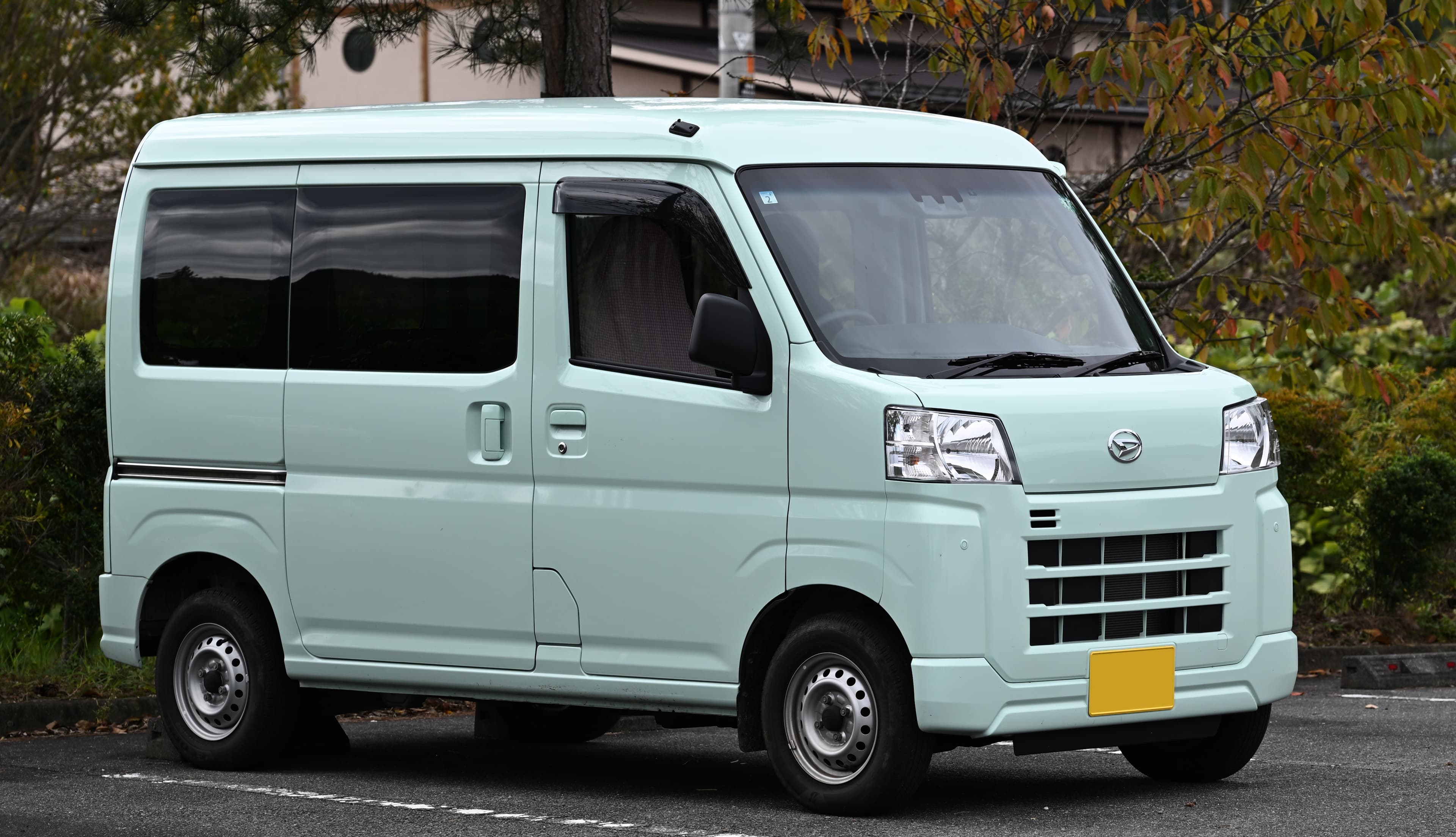
The refined cousin of the Hijet
If the Daihatsu Hijet is the work-boot of the kei world — practical, tough, unglamorous — then the Atrai is what happens when Daihatsu asked "what if we made one of these for people who don't want to feel like they're driving a farm implement?" The Atrai shares the Hijet's cab-over platform, suspension, and basic architecture, but everything else was reworked with passenger comfort in mind. Better seats, better sound insulation, more glass, turbo power, and the kind of interior trim that doesn't feel like it was designed to be hosed out.
It's the closest thing to a minivan experience in the kei class, and for daily drivers who want to actually enjoy the commute, it's one of the most underrated choices on the market.
Origin and lineup position
Daihatsu introduced the Atrai name in 1981 as the passenger-oriented trim of the Hijet Van. By the time the S220/S230 generation launched in 1999, Atrai had evolved into its own distinct model with unique front-end styling, upgraded interior, and exclusive powertrain options. It sat at the top of Daihatsu's kei van range, above the basic Hijet Cargo van and alongside the sportier Atrai 7 (a stretched seven-seater that didn't meet kei dimensions and isn't importable under the 25-year rule).
In Japan, Atrai buyers were typically small business owners who wanted a commercial vehicle that doubled as a family hauler, or retirees who wanted something easy to park but comfortable for weekend trips. That dual-use philosophy shaped every design decision.
The EF-DET turbo engine
This is the Atrai's headline feature. The EF-DET is a turbocharged 659cc 3-cylinder DOHC engine producing the kei-class maximum of 64 horsepower and around 77 lb-ft of torque. That doesn't sound like much until you remember the Atrai only weighs about 2,100 lbs. The power-to-weight ratio is genuinely competitive with a base Toyota Yaris, and in real-world driving the turbo makes a huge difference — you can merge onto highways, climb grades fully loaded, and cruise at 65 mph without the engine screaming in protest.
The turbo is a small Aisin unit with an air-to-air intercooler. It spools early (around 2,500 RPM) and makes the Atrai feel alert rather than wheezy. Paired with the 4-speed automatic, which is a proper torque-converter unit (not a CVT), it's one of the most relaxed driving experiences in the entire kei class.
Common EF-DET issues: the turbo oil feed line can coke up if oil changes are neglected, and the intercooler hoses get brittle with age. Both are cheap fixes. Otherwise the engine is as reliable as the naturally-aspirated EF-SE in the standard Hijet.
Interior and comfort
The Atrai's interior is where it really separates itself from the Hijet Cargo van. You get proper cloth seats with adjustable headrests, a column-mounted automatic shifter that frees up floor space, power windows and mirrors, a real dashboard with a tachometer, and on higher trims, rear air conditioning, tinted rear glass, and captain's-style front seats. Sound insulation is noticeably better — the engine cover has extra padding, and the door panels have actual felt backing rather than bare metal.
The rear seats fold and tumble to create a flat cargo floor, or slide forward to give rear passengers limo-like legroom. It's a genuinely clever packaging job.
What it does well
The Atrai is the kei vehicle you buy if you want to daily-drive one. Long highway stretches don't destroy you. The turbo means you don't have to plan passing maneuvers three minutes in advance. The interior stays quiet enough to hold a conversation. The automatic makes stop-and-go traffic tolerable. And because it's still under the 11-foot kei length limit, you can park it anywhere.
It's also an excellent small camper conversion platform. Flat floor, tall ceiling, rear-hinged hatch, and enough power to actually get you up a mountain pass with gear loaded.
Known weaknesses
Beyond the turbo-specific items, watch for: automatic transmission cooler lines leaking at the radiator fittings, rear wheel bearings on high-mileage examples (they're a weak point on the 4WD version), and sunroof drain tubes on sunroof-equipped trims — they clog and dump water into the headliner. Rust is less of an issue than on Hijet Cargo vans because Atrais were typically garage-kept by private owners, but still inspect the rear wheel wells and rocker panels.
Buying advice
Expect to pay $9,000 to $13,000 landed for a clean S220/S230 Atrai with the turbo and under 100,000 km. 4WD examples are worth the premium if you live somewhere with snow. Prioritize documentation and auction sheets — the importing step-by-step guide walks through what to look for. Low-spec non-turbo Atrais exist but defeat the purpose; if you want a non-turbo kei van, get a cheaper Hijet Cargo or Sambar Van.
Atrai vs. Every vs. Sambar Van
The three main kei van competitors each have a personality. The Suzuki Every has the biggest aftermarket and the most US presence. The Subaru Sambar Van has the rear-engine layout and supercharger option for enthusiasts. The Atrai is the most comfortable of the three for daily driving — the best seats, the smoothest powertrain, the quietest cabin. If comfort is your #1 priority, it wins. If you want cargo focus or performance, look elsewhere. The vehicle quiz can help you decide.
Should you buy one?
Yes, if you want a kei vehicle you can actually live with as a second car — commuting, errands, weekend camping, airport runs. The Atrai is the most car-like kei van ever made, and the turbo + automatic combo makes it genuinely pleasant rather than just tolerable. It's less common than the Every in the US, so parts support is a bit thinner, but the mechanical commonality with the Hijet means most wear items are easy to source. If you've been looking at the Every and finding it too basic, drive an Atrai and see what you think.