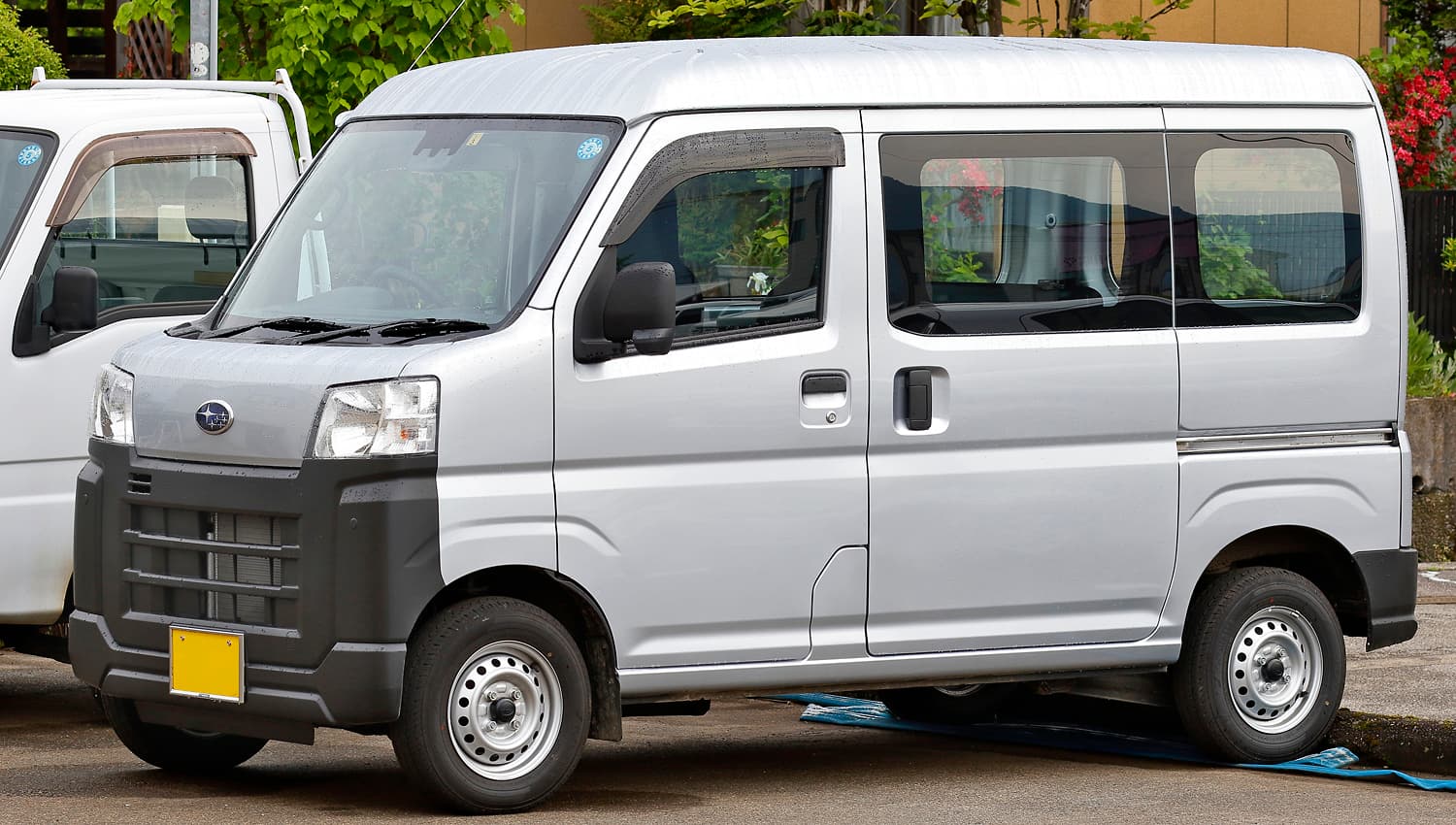
The enthusiast's kei van
Every quirk that makes the Subaru Sambar Truck the enthusiast's choice in the kei truck world carries directly over to the Sambar Van — and in many ways matters even more here. Rear-mounted EN07 4-cylinder engine. Independent suspension on all four corners. An available supercharger. And because this is a van, not a truck, it inherits one additional advantage that makes it arguably the best platform for van life, campers, and mobile workshops in the entire kei segment: an absolutely flat load floor.
If you've been researching kei van conversions on YouTube and Reddit and wondering why Sambar Vans keep showing up in the coolest builds, this is why.
Why the flat floor matters so much
Most kei vans have the engine mounted under the front seats, which creates a raised cab floor and a lowered cargo area behind it. You have to step down to get into the back. That step eats into the usable standing height and makes it really annoying to build a flat bed platform or a kitchen counter — you're always working around an awkward height change between the cab and cargo area.
The Sambar Van doesn't have this problem. Because the engine sits in the rear under the cargo floor (not under the seats), the entire cabin floor is flat from the back of the front seats all the way to the tailgate. This is enormous for conversions. You can drop in a plywood bed platform that runs the full length of the cargo area at one single height. Your camping mattress doesn't have a weird hump in it. Your kitchen counter sits level. Your pull-out drawers actually work.
For van-lifers, surfers, adventure-overland campers, and mobile tradespeople who want a tiny, maneuverable, fuel-efficient base for a build, the Sambar Van is close to unbeatable.
Generation breakdown
KV3/KV4 (1990-1999) — The square-body fifth generation. Rear-mounted EN07 4-cylinder, 48 horsepower naturally-aspirated. Available as 2WD or part-time 4WD. The Dias and Dias II trims were the passenger-focused variants with better seats, dual sliding doors, rear A/C, and upgraded interior — worth seeking out if you want comfort. The KV4 (4WD) is the value pick for conversions because they're reasonably priced and mechanically simple.
TV1/TV2 (1999-2012) — The sixth generation, bigger and more refined, with better crash protection and modernized electronics. This is where the supercharged EN07 (55 hp) joins the lineup and where Subaru switched the 4WD system to full-time instead of part-time. The TV2 is the 4WD version. Dias Classic and Dias Wagon trims added retro styling cues (chrome trim, round headlights, two-tone paint) that make them some of the most visually distinctive kei vans ever built. TV2 supercharged 4WD manuals are the holy grail — if you find a clean one, buy it.
The EN07 engine in van duty
Same engine as the Sambar Truck — the all-aluminum 659cc 4-cylinder DOHC, with or without a small Roots-type supercharger depending on trim. In the van, the 4-cylinder smoothness matters more than it does in the truck because you're spending more time cruising highways and less time hauling dirt on a farm road. Conversations in the cabin stay possible at 65 mph. The supercharged version brings the van to life on highway on-ramps and mountain grades — without it, a fully-loaded Sambar Van with camping gear struggles above 60 mph.
Maintenance considerations are identical to the Sambar Truck. Watch for head gasket history, supercharger bearing wear, and oil leaks from the valve cover. See the maintenance and parts guide for sourcing and service intervals.
What it does well
The Sambar Van's personality is "fun, capable, and easy to live with." It rides better than any Every or Hijet Cargo thanks to the independent rear suspension. It handles snow and mud better than any 2WD kei van thanks to the rear-engine weight bias. It's spacious enough inside to stand up in (with the roof raised on the high-roof variants). And it's quirky enough to feel special — you'll never get mistaken for the guy driving a Hijet Cargo around town.
Specific use cases where it shines:
- Van life and micro-campers — the flat floor is the killer feature here
- Mobile workshops — electricians, plumbers, locksmiths, and bike mechanics love the cargo space
- Dog transport — flat floor + low step-in = easy loading for older dogs
- Festival and event vehicles — small enough to park anywhere, unique enough to draw attention
- Ski and snowboard rigs — 4WD + rear-engine traction is excellent in winter
Known weaknesses
Beyond the general Sambar concerns (head gasket history, supercharger bearings, rear subframe rust), the van has two van-specific things to watch:
- Sliding door tracks wear out on high-mileage examples and can bind or derail. Replacements are available but not cheap.
- Rear hatch struts sag over time — minor issue, cheap fix.
- The E-CVT automatic is still a weak point. When it works, it's buttery smooth and perfect for the van's touring character. When it fails, it's effectively unfixable in North America. Buy a manual if you have the option.
Also: the rear-engine layout puts the radiator up front, meaning a long coolant run that can develop small leaks at connection points over time. Inspect the coolant lines and reservoir carefully.
Buying advice
Prices for Sambar Vans have climbed steadily since they became broadly importable. Expect:
- Clean KV4 4WD manual: $8,500 - $11,500 landed
- Clean TV2 4WD manual (naturally aspirated): $10,000 - $13,000 landed
- TV2 supercharged 4WD manual (the unicorn): $13,000 - $18,000 landed
- Dias Classic with retro styling: add $1,500-$3,000 to the above
Always insist on the Japanese auction sheet. Prioritize rust-free examples from dry prefectures (central and southern Japan) over cheap options from Hokkaido or northern Honshu. The import cost calculator will help you budget, and the importing step-by-step guide walks through the whole process.
Sambar Van vs. the competition
The Suzuki Every is the sensible, boring, high-volume choice — great aftermarket, widely available, well-understood. The Daihatsu Hijet Cargo is the cheapest option with the simplest mechanicals. The Daihatsu Atrai is the comfort-oriented passenger van with the smoothest automatic. The Sambar Van is the enthusiast's choice — the one with the flat floor, the 4-cylinder engine, the independent suspension, and the supercharger option. It's the most fun to drive and the best conversion platform, but it costs more and demands more attention to maintain. Still comparing? Try the vehicle quiz.
Should you buy one?
Yes, especially if you're planning a camper conversion or van life build. The flat floor alone makes it the easiest kei van to build out, and the rear-engine layout gives it a driving character none of its competitors can match. If you just need a cheap cargo van for daily errands, get an Every and save money. But if you want a kei van you'll actually look forward to driving — one that handles, pulls hard with the supercharger, and lays out perfectly for a bed build — the Sambar Van is the one. It's the kei van I keep recommending to anyone who says the word "conversion."