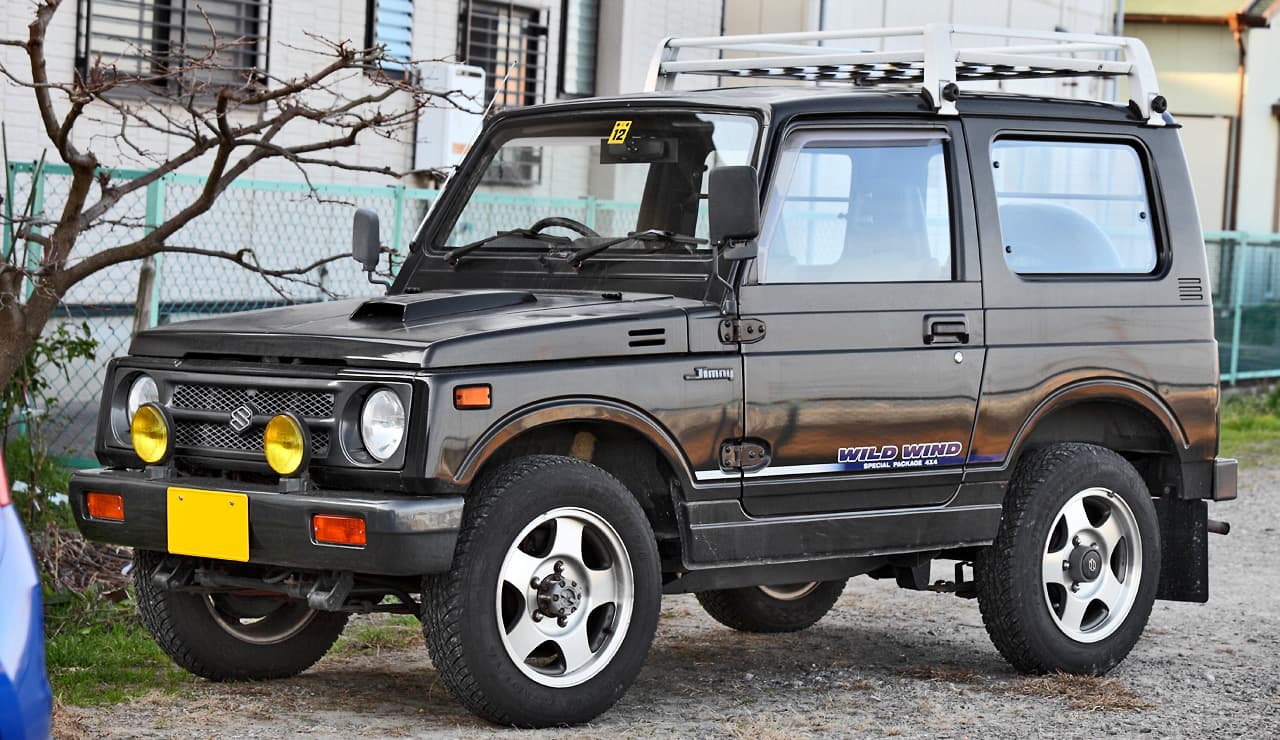
Before I start gushing about this thing, a disclaimer: the Jimny is not a kei truck. It's a kei SUV — a genuine, ladder-framed, live-axle, low-range-equipped 4x4 in a footprint the size of a Smart Car. I include it here because every person who gets into kei trucks eventually asks about it, and because it's one of the most absurdly capable vehicles ever built at any size, in any class, anywhere in the world. If a Carry is a farm mule, the Jimny is a mountain goat.
Origin & history
The Jimny has existed since 1970, which makes it one of the longest-running nameplates in Suzuki's history. It was born as the LJ10 to compete with the early kei-class off-roaders and quickly became the de facto mini 4x4 for Japanese forestry workers, rural delivery services, and mountain villages where roads turn into suggestions. The JA-series generations we care about in the US are the JA11 (1990-1995) and the JA12/JA22 (1995-1998). All of them are now import-eligible under the 25-year rule, with more JA22s crossing the threshold every month.
Suzuki's design philosophy with the Jimny has been unusually consistent: keep it small, keep it light, keep it mechanically simple, and never compromise the off-road hardware. Unlike virtually every other "off-road SUV" that's drifted into soft-roader territory over the decades, the Jimny has stubbornly kept its ladder frame and its solid axles through generation after generation.
Generation breakdown
JA11 (1990-1995) — The sweet spot for a lot of buyers. Turbocharged F6A making 55hp, 5-speed manual only, part-time 4WD with a proper lever-actuated transfer case and low range. Leaf springs front and rear on the earliest JA11s, coil-sprung live axles on the later "Panoramic Roof" variants. Honest, analog, mechanical. This is the Jimny that off-road purists chase.
JA12/JA22 (1995-1998) — Updated K6A turbo engine making the full kei-class maximum of 64hp, coil-sprung front and rear, improved interior, and the option of an automatic. The JA22 is noticeably more refined on the road than the JA11 without giving up any real off-road capability. If you plan to drive it to the trail instead of trailering it, the JA22 is the one I'd pick.
You'll also see the JB23 (1998+) which is the next generation — a few of the very earliest ones are just now hitting import eligibility. That's a separate animal and deserves its own page.
Engine & drivetrain
Both the F6A turbo and K6A turbo are legitimately punchy little engines. The turbos spool early — useful torque is available from around 2,500 RPM — which matters enormously off-road where you want power at low engine speed. On the highway, both engines will happily cruise at 65 mph, which is more than most kei vehicles can honestly claim.
The drivetrain is where the Jimny earns its reputation. Part-time 4WD with a real, lever-actuated transfer case. A proper low range that multiplies your crawl ratio by roughly 2:1. Live axles front and rear (leaf-sprung on early JA11, coil on JA22), which means huge articulation compared to independent suspension setups. Ground clearance is excellent for the size. Approach and departure angles are genuinely world-class.
What it does well
Trails. Narrow, twisty, rooty, rocky, wet trails that a Wrangler can't fit on. I've watched a stock JA11 climb a line that required my buddy's lifted 4Runner to take a detour. The weight advantage is enormous — these things are well under 1,800 lbs, which means they barely sink into mud, they don't tear up the environment, and if you get stuck, two friends can usually unstick you.
It's also great in snow. Lightweight, 4WD, low range, good ground clearance, and small enough to fit through the tracks left by bigger vehicles. Hunters love them for exactly this reason.
Known weaknesses
Turbo age is the first thing to worry about. Turbos from the early '90s don't love being neglected, and turbos on neglected JDM imports are often tired. Budget for a turbo refresh if one's on the horizon — it's not a catastrophe, but it's not nothing either. Also check the front wheel bearings and the birfield joints — these wear on any part-time 4WD that's been worked hard. Rust around the rear quarters and the tailgate is common on rust-belt imports. Interior trim is cheap and brittle.
Highway cruising is fine until you hit a headwind, at which point the tall, boxy body pushes air like a barn door and the turbo works overtime to keep you at speed. Don't plan cross-country road trips; plan trail weekends.
Buying advice
A clean, unmolested JA11 turbo 5-speed in the $10,000-$13,000 range is fair market right now. Clean JA22s go for more — $12,000-$17,000 is typical for one in good condition, and the prices are still climbing. Anything under $8,000 deserves a very hard look; it's usually rusty, wrecked, or the turbo's toast.
Prefer the JA22 if you'll drive it on the street, the JA11 if you want mechanical purity and the best trail weapon. Avoid automatics unless you need one — the 5-speed is more fun and more capable. If you're importing directly from Japan, follow our importing guide carefully — Jimnys have become popular enough that scams are a real concern.
Alternatives & comparisons
The Jimny's closest in-class rival is... nothing, really. There isn't another kei-class vehicle with ladder frame, live axles, and low range. The Mitsubishi Pajero Mini exists and is a fine vehicle, but it's independent-suspension and not in the same off-road league. If you want an enclosed kei 4x4 for off-roading, the Jimny is the answer. If you want something similarly capable but with a truck bed, look at a Hijet Jumbo 4WD with a locker or a Carry KC 4WD with the diff lock — both are detailed in our hijet vs carry comparison.
Living with it
Daily-driving a Jimny in the US is doable if your commute is short and slow. Highway stretches over 30-40 minutes get tiring — wind noise, small cabin, buzzy turbo engine. Fuel economy is mediocre by kei standards, around 28-35 mpg, because the turbo and the boxy body both hurt efficiency. Heat is good, A/C is adequate, the ride is stiff, and the steering is slow by modern standards. You'll love it or you'll hate it within 20 minutes behind the wheel. Most people love it.
Should you buy one?
If you want a trail rig that does what bigger SUVs can't, yes, absolutely, chase a clean one and don't look back. If you want a daily driver that's also cool, keep looking — the Jimny isn't the most comfortable kei car. It's a specialist tool, and as a specialist tool it has almost no peers. Prices are going up, not down, so waiting isn't going to save you money. Run the quiz if you're not sure whether the Jimny is the right call for you, and skim our complete buying guide before you commit.