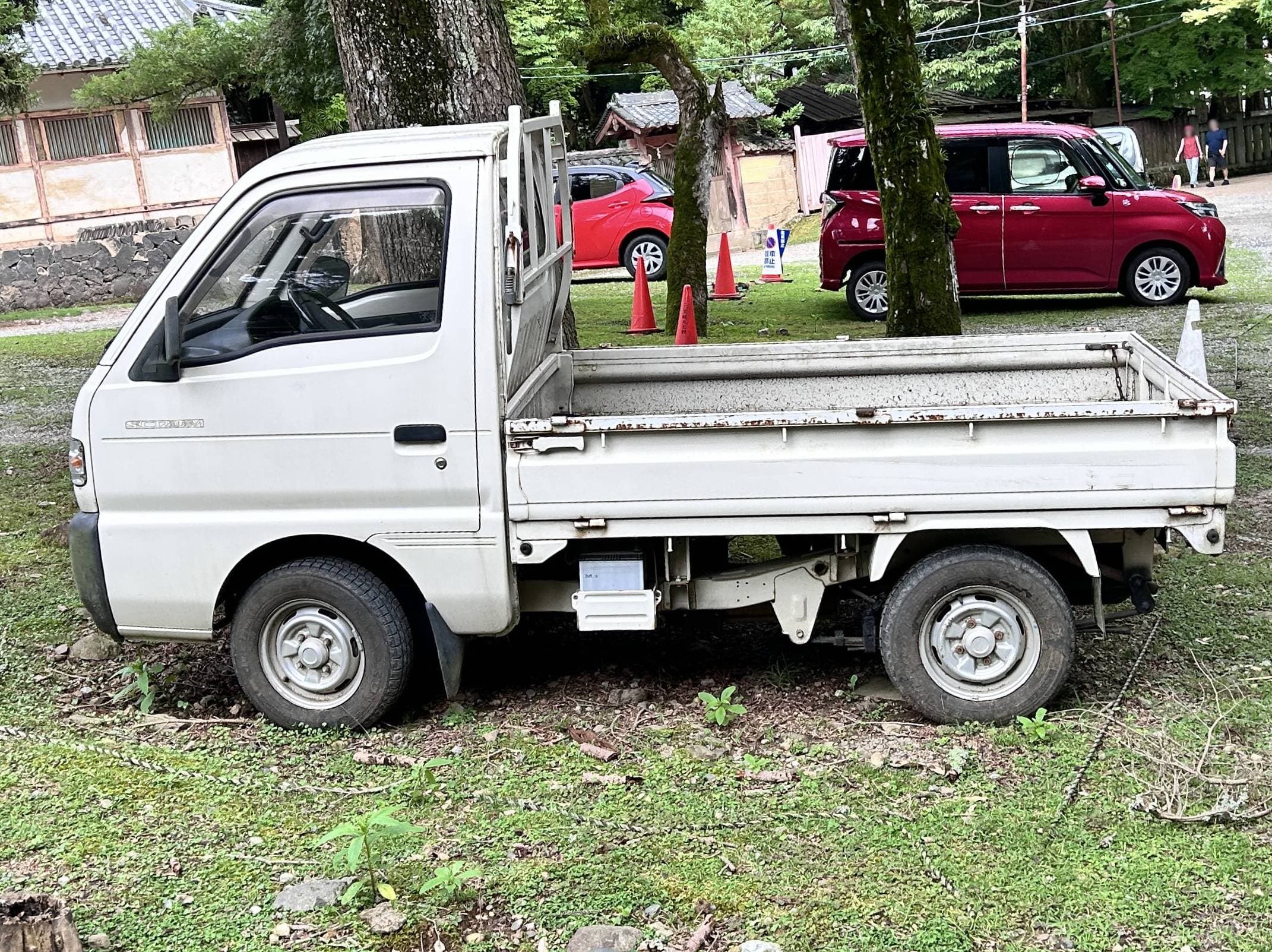
It starts innocently. You buy one kei truck for the farm. It's great. Then you see a Beat for sale and think "well, I need a weekend car." Then a van pops up at a good price and you "might as well" have something for camping. Then someone lists a Cappuccino and — look, at these prices, how can you NOT?
I own Old Faithful (the '97 Carry), The Van (the '98 Acty Van), and a '93 Cappuccino. Three kei vehicles. I did not plan this. Dave Russo calls it "kei creep" and he's the same guy who owns a Hijet, a Minicab, and is always looking at Sambars. We are not the people to ask about restraint.
Here's what I've learned about managing a tiny fleet.
The Economics Are Surprisingly Sane
Here's what most people don't realize: four kei vehicles cost less to own than one new truck.
| Expense | 4 Kei Vehicles | 1 New F-150 |
|---|---|---|
| Purchase | $30,000 total | $55,000 |
| Insurance/year | $1,200 | $2,500 |
| Registration/year | $400 | $300 |
| Fuel/year | $1,500 | $4,000 |
| Maintenance/year | $1,500 | $1,500 |
| Annual cost | $4,600 | $8,300 |
Read that again. Four vehicles, each specialized for a different purpose, for roughly half the annual cost of one F-150. When Emi asked me to justify the Cappuccino purchase, I showed her this spreadsheet. She still rolled her eyes, but at least the math was on my side.
How to Build a Smart Fleet
The smart way to collect isn't "buy everything you see." It's building a fleet where each vehicle serves a different role, so you're not just accumulating — you're diversifying.
The Worker is a Carry or Hijet for hauling, farm work, and utility. This is your daily beater, the one that gets dirty and doesn't matter. Old Faithful fills this role for me — she hauls mulch, moves furniture, and I don't flinch when she gets scratched.
The Adventure Rig is a Jimny for trails, or a Sambar Van for camping. Something with 4WD and capability that gets you places the Worker can't.
The Fun One is a Beat, Cappuccino, or supercharged Sambar for weekend drives and coffee runs through the Boise foothills. The one that makes you smile just looking at it. My Cappuccino is this vehicle and I'll fight anyone who says a Cappuccino isn't the best value in the kei sports car world.
The Weird One is a Midget II, a Vamos, an AZ-1 — something that nobody else has and everyone wants to talk about. I don't have this one yet. Emphasis on "yet."
What About Insurance?
This is the question everyone asks, and the answer is better than you'd expect.
Collector and specialty policies from Hagerty and Grundy often offer multi-vehicle discounts of 10-20% off per vehicle after the first. Since kei vehicles are already cheap to insure at $200-400/year each, a fleet of 3-4 can be covered for $600-1,200/year total. Standard carriers are trickier — some will write multi-vehicle policies while others treat each kei vehicle as a separate policy. Shop around and check our insurance directory.
The key is making sure at least one "regular" vehicle is on the policy. Insurers get nervous about policies with ONLY kei vehicles. Having a daily driver (even a Civic) as the primary vehicle with kei vehicles as secondary makes everything smoother. I learned this one the hard way when my first insurer tried to cancel my policy after the third kei vehicle.
What About Storage?
If you have land, you have space. If you're in a suburban driveway, you might have a problem — but probably less of one than you think.
A shared garage with rotating access works well: drive one, store three. A simple carport or portable garage from Harbor Freight runs $200-500 and keeps the weather off. If you're lucky enough to have a friend with a barn, barter with kei truck hauling services — everyone with a barn needs stuff moved.
Avoid leaving kei vehicles uncovered long-term (sun damage, rain, bird droppings destroy paint fast), storing on grass (moisture accelerates undercarriage rust), or renting storage units (expensive overkill for vehicles this small). The kei advantage is real: four kei vehicles fit in the same space as two normal cars. A standard two-car garage can hold four with room to work on them. Miso thinks they're all parked there for his personal climbing gym.
Registration Tips for Multiple Vehicles
If you live near a state border, you might register different vehicles in different states depending on which is easier or cheaper for that vehicle type. Some states offer seasonal plates at reduced cost — six months instead of twelve — which is perfect for a vehicle you only drive in summer. And since these are all 25+ years old, they often qualify for antique or historic plates with reduced registration fees and sometimes reduced insurance requirements. Check your state's rules for the specifics.
When Should You Stop?
This is the section nobody wants to read. But there's a real question: when does "collecting" become "hoarding?"
My rule is simple: if every vehicle gets driven at least once a month, you have a collection. If vehicles sit for months untouched, you have a problem. Kei vehicles are meant to be driven, not displayed. A parked kei vehicle deteriorates — seals dry out, batteries die, tires flat-spot, fuel goes stale.
If you can't drive them all regularly, sell one and let someone else enjoy it. There's always another one for sale when you're ready. I almost sold The Van last year when life got busy, and I'm glad I didn't — but if it had sat for another month, I should have.
The Real Reason We Do This
Let's be honest about why people collect kei vehicles. It's not economics (though the math works). It's not practicality (though they are practical). It's that every single one of them is different, and every single one of them makes you feel something.
Old Faithful makes me feel capable. The Cappuccino makes me feel alive — especially on those early morning coffee runs through the foothills with the targa off and nobody else on the road. The Van makes me feel ready for anything. And whichever weird one I eventually add will make me feel ridiculous, in the best possible way.
Kei vehicles are the cheapest way to own multiple emotional experiences on four wheels. At $5,000-15,000 each, you can build a fleet for less than a single new truck. And that's worth more than any spreadsheet can capture.