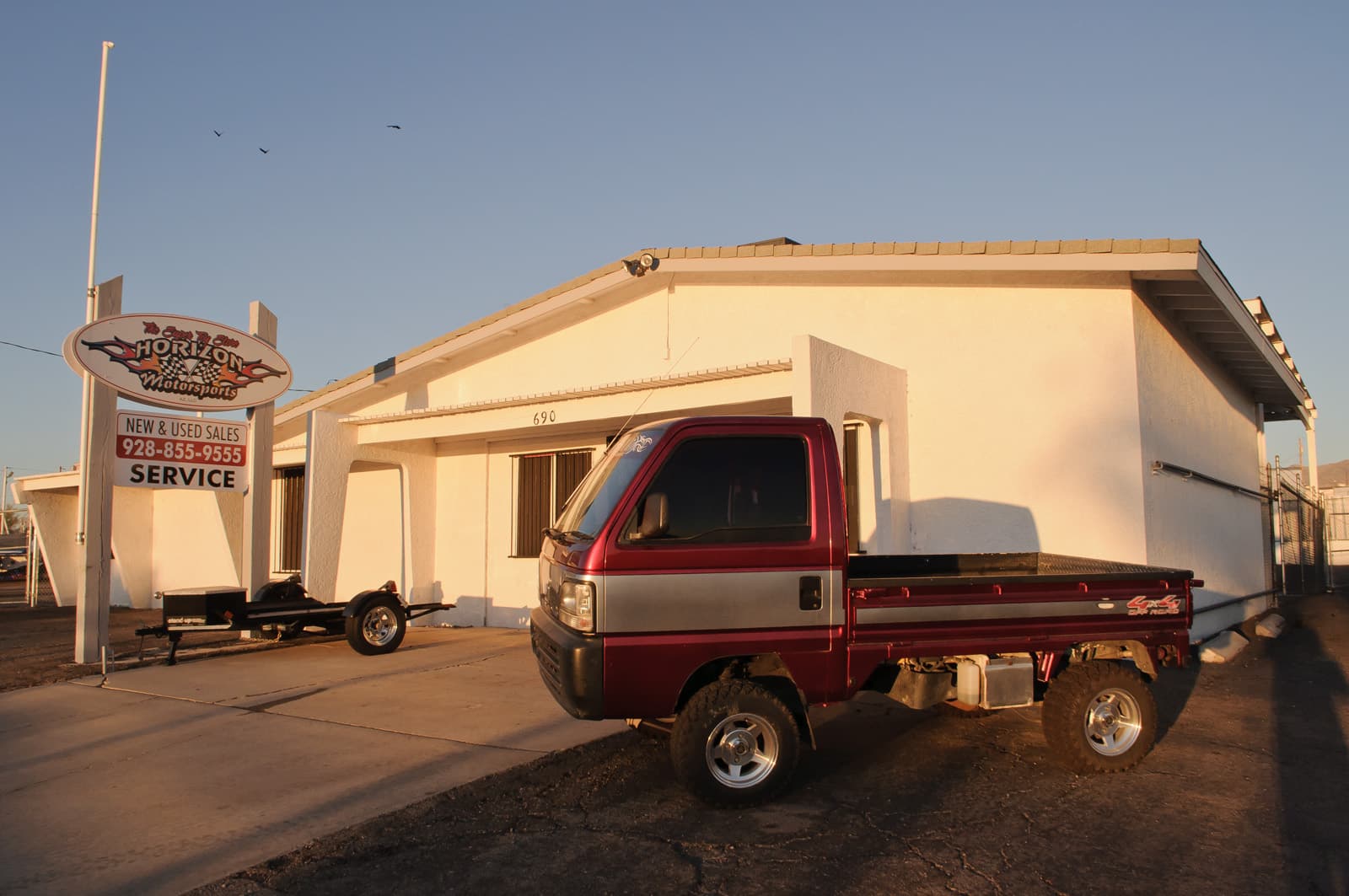
I daily a '96 Hijet and I have a '92 Minicab I call The Cab. I take neither on the interstate if I can help it, and the reason is not the one people assume.
This question comes up constantly and it gets answered as though "kei vehicle" were one thing. It is not. A kei truck and a kei sports car hit their highway limit for opposite reasons, and conflating them is why the advice online contradicts itself.
Before anything mechanical: check whether you are allowed
Worth settling first, because it makes the rest academic for a lot of people.
Plenty of states that will register a kei truck attach a road-class restriction — commonly no interstate access, or roads posted at or under 55mph. That is a legal limit that has nothing to do with what the truck can do, and it applies to a perfectly capable vehicle.
Check your own state on the regulations tracker before you plan a route. If the answer is "no highways", the mechanical discussion below is interesting but not actionable.
The kei truck problem is stability, not speed
Almost every kei truck will reach 65mph. Mine both will. The question is what it feels like when you get there, and the honest answer is busy.
Four things stack up, and none of them is engine power:
- You are sitting over the front axle. Cab-over layout means no bonnet ahead of you, and the front wheels are effectively under your feet. Every steering input feels immediate in a way that is fine at 35mph and twitchy at 65.
- Short wheelbase. Around 1.9m on most kei trucks. A short wheelbase reacts faster to bumps, expansion joints and camber changes than a long one — that is geometry, not a fault.
- Tall and narrow, and light. A tall slab side on a vehicle around 700-900kg is a sail. A passing semi will move you. So will a gust on an exposed bridge.
- Brakes sized for the job it was built for. These were designed for 40mph farm and delivery work. They are adequate, and they are not modern-highway adequate. Stopping distance from 65 is a long way from stopping distance from 40.
None of that is fixed by modification. You can add power, and you will arrive at the same unpleasantness faster. The limit is the vehicle's shape and wheelbase, which is also what makes it useful for everything else. Our safety guide covers the crash-structure side honestly.
What actually helps: correct tyre pressures and a good set of tyres in the right load rating — see the tire guide — plus a wheel alignment, which on a 25-year-old import is frequently overdue and makes far more difference than owners expect. A truck that wanders at 60 is often a truck with worn tie-rod ends, not a truck at its limit.
The kei car problem is gearing, not stability
Completely different vehicle, completely different complaint.
A Honda Beat, Suzuki Cappuccino or Autozam AZ-1 is low, mid- or front-engined and stable — a Beat is about 1,175mm tall, which is lower than most sports cars. Crosswinds are a non-issue. Nobody reports these feeling nervous at speed.
What they report is engine speed. These cars were geared for a 64hp ceiling and Japanese roads, so fifth gear is short. Sitting at 70mph means sitting at high revs, and while the engines will take it — they were built to rev — the noise makes a two-hour drive tiring.
So the fix is gearing, not power. A taller final drive or a fifth-gear swap drops cruising revs and transforms the experience. Adding boost without touching gearing makes the car quicker to get to the same tiring place.
Before spending anything: a kei car that feels frantic at 70 may just be geared as intended and running a tyre with the wrong rolling diameter. Check the tyre size against spec first — a shorter-than-stock tyre raises engine speed at any given road speed, and people fit them without realising.
The two failure modes, side by side
| Kei truck | Kei car (Beat, Cappuccino, AZ-1) | |
|---|---|---|
| Reaches 65mph? | Usually, yes | Comfortably |
| What limits it | Stability, crosswind, braking | Engine speed and noise |
| Feels | Busy, working, exposed | Stable, loud |
| The real fix | Alignment, tyres, and lower expectations | Taller final drive or 5th gear |
| Does more power help? | No | Not the actual problem |
What owners actually settle on
The pattern in owner reports is consistent, and it is not "buy mods":
Route around it. The truck is superb on 45-55mph roads and merely tolerable above that. Most owners who tried highway commuting stopped, not because it was unsafe but because it was tiring. A ten-minute-longer route on a state highway is a better drive.
Leave margin. Cruising a little below what the truck will do — rather than at it — leaves you something to react with. If keeping pace means the engine is at full noise, the road is wrong for the vehicle.
Fix the boring things first. Alignment, tyres, pressures, worn steering components. On a 25-year-old import that has been sat, these are usually the difference between "wanders alarmingly" and "fine", and they cost far less than any mod.
Be honest about the trip. A kei truck is a magnificent local vehicle. It is not a good interstate vehicle, and no amount of money makes it one. That is worth knowing before you buy rather than after — our daily driving guide covers what ownership is actually like day to day.
The short version
If you are asking about a truck: it will do 65, you probably will not enjoy it, and the limit is shape rather than power. Sort the alignment and tyres, then plan routes that suit it.
If you are asking about a car: it already handles the speed. What you want is taller gearing, not more power.
And if you are asking because you want to commute 40 miles of interstate daily — buy something else, and keep the kei for everything the other car is too big for. That is what most owners end up doing anyway.