Here's something that surprised me when I first moved to Tokyo: kei vehicles aren't just Japanese. They're everywhere.
Well — they start in Japan. Every kei truck, van, and car rolls off a Japanese assembly line. But Japan's rigorous vehicle inspection system — the shaken — means most vehicles are exported or scrapped by age 10-15. The ones that leave Japan don't disappear. They scatter across the globe, finding second lives in places their designers never imagined.
I spent three years in Tokyo watching kei trucks navigate the narrow lanes of Yanaka and deliver produce to Tsukiji's outer market. When I moved to Portland and saw my first US-registered Sambar, it felt like running into an old friend in a foreign city. But the story of kei vehicles abroad is much bigger than America's recent discovery. This is a map of where they end up — and what they become when they get there.
You can't understand kei vehicles globally without understanding their role at home. In Japan, kei vehicles account for roughly 37% of all new vehicle sales — over 1.5 million units per year. In rural prefectures like Nagano, Akita, and Kagoshima, that share climbs above 50%. They aren't niche. They're the default.
Japanese farmers depend on them for rice paddies, orchards, and fisheries — the kei truck is narrow enough for mountain terraced fields, rugged enough for unpaved farm roads, cheap enough that every household has one. In cities like Tokyo and Osaka, full-size trucks can't navigate residential streets, so kei trucks deliver everything from packages and produce to construction materials and vending machine inventory. Landscapers, plumbers, and electricians run their businesses from kei vans. In rural Japan, many households own both a kei car for daily driving and a kei truck for utility — yellow plates outnumber white plates in the countryside.
The shaken cycle is what sends them abroad. Japan's biennial vehicle inspection becomes increasingly expensive as vehicles age, and by year 10-13 the inspection cost can exceed the vehicle's value. This creates a massive surplus of mechanically sound, low-mileage vehicles that are economically worthless in Japan but invaluable everywhere else. An estimated 1-2 million used kei vehicles are exported from Japan annually, flowing outward like a tide — south to Southeast Asia, east to the Pacific Islands, west to Africa, and increasingly, east again to the Americas.
Step off a plane in Manila, Ho Chi Minh City, or Jakarta, and you'll see kei trucks within minutes. They're not curiosities — they're infrastructure.
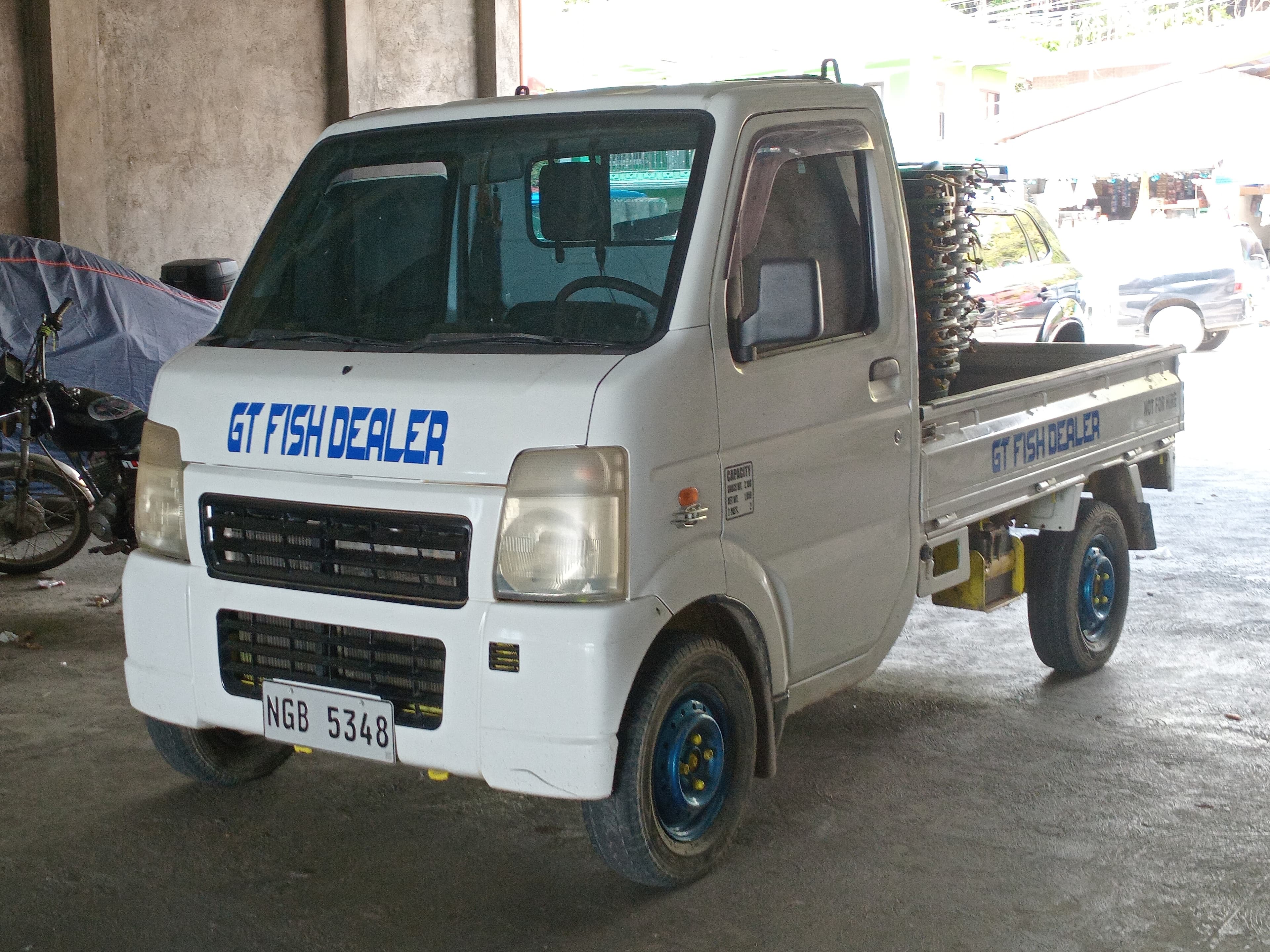
The Philippines is arguably the world's largest market for surplus Japanese kei vehicles outside Japan itself. Called "multicabs" locally — a genericized term originally from Suzuki Carry conversions — they've been transformed into something uniquely Filipino. Local fabricators buy imported kei trucks and rebuild them with extended cabs, bench seats welded into the bed, custom rooflines, and vivid paint. The result is a cheap, nimble public transport vehicle that navigates Manila's impossible traffic and the narrow roads of provincial islands. Hundreds of thousands are in service; in Cebu alone, multicabs are the dominant form of public transport outside the main bus routes. They're licensed, regulated, and essential.
Vietnamese importers bring in kei trucks for last-mile delivery in Hanoi and Ho Chi Minh City, where motorcycle-based delivery is reaching its limits — a kei truck carries 10x what a motorbike can, fits nearly everywhere a motorbike does, and costs a fraction of a standard delivery van. Small farms in the Mekong Delta and Central Highlands use them the same way Japanese farmers do, hauling rice, vegetables, and equipment on narrow dike roads where nothing larger could pass. Indonesia's archipelago geography makes kei vehicles ideal as well — on islands like Bali, Lombok, and Flores, road infrastructure favors small vehicles, and kei trucks work construction sites, deliver goods to small shops called warungs, and haul agricultural products from highland farms to coastal markets. The Indonesian government has periodically restricted used vehicle imports to protect the domestic auto industry, but kei trucks continue to enter through various channels.
In countries where a new Toyota Hilux costs more than a year's median income, used kei trucks are transformative.
Haiti may be the most striking example. Japanese surplus kei trucks arrive at Port-au-Prince and are immediately put to work — market vendors haul produce from rural farms to city markets, small contractors move building materials through the capital's notoriously narrow streets, and families use the beds as shared transport, eight to ten people at a time. The appeal is brutally practical: a running kei truck can be purchased for $2,000-$4,000, gets 35+ mpg in a country where fuel is expensive, and is mechanically simple enough for local mechanics to maintain without dealer diagnostics.
Similar patterns play out across the Caribbean and Central America. In the Dominican Republic, kei trucks work coffee and cacao plantations in the mountainous interior. In Guatemala, they navigate the steep, narrow streets of Antigua and haul goods through highland indigenous markets. The common thread is always the same: wherever roads are narrow, budgets are tight, and a full-size truck is overkill or unaffordable, kei vehicles fill the gap.
The UK and Europe represent a different kind of kei vehicle market — driven more by enthusiasm than necessity.
The UK allows Japanese vehicle imports with an IVA (Individual Vehicle Approval) test, and there's no 25-year rule — a 2005 Suzuki Every can be imported and registered today if it passes inspection. The British kei vehicle scene is small but passionate, with owners using them for estate and farm management, urban delivery in London where the congestion charge and narrow mews streets make kei vans practical, and enthusiast collecting as the affordable entry point to the mature UK JDM scene. Right-hand drive is a non-issue — kei vehicles come configured correctly for British roads.
The EU market is fragmented by national regulations. The Netherlands has the most active scene, with a Dutch appreciation for practical small vehicles. Germany has a growing JDM community that includes kei vehicles, though TUV inspection requirements add cost and complexity. France, Italy, and Spain have minimal kei vehicle presence — the domestic small car market fills the same niche at similar price points with easier parts access.
Australia is kei vehicle paradise for one reason: the 15-year import rule. Any vehicle over 15 years old can be imported under the Specialist and Enthusiast Vehicle Scheme with relatively straightforward compliance, which means Australians have access to kei vehicles 10 years newer than what Americans can import. A 2011 Suzuki Carry? Legal in Australia. Still a decade away from US eligibility.
Australian cattle and sheep stations use kei trucks as paddock runners — quick trips to check fences, water troughs, and livestock without burning diesel in the Land Cruiser. Small acreage owners use them for exactly the same tasks American owners do. And in coastal towns from Byron Bay to Margaret River, kei vans are emerging as surf wagons — they fit a longboard, they park at the beach, and they look cool. The Australian kei vehicle community, particularly in Queensland and New South Wales, is well-established and shares significant overlap with the broader JDM import scene.
If you want to see what happens when a country simply lets people import whatever they want, look at New Zealand. The import regulations are among the world's most permissive for used vehicles, and the result is that kei vehicles are everywhere — not exotic, just vehicles. You see them on farms, on city streets, on construction sites, at the supermarket. New Zealand has roughly 5 million people, an estimated 15-20% of vehicles on its roads are Japanese imports, and kei vehicles are a visible subset, particularly in rural Canterbury, Southland, and Hawke's Bay.
The New Zealand experience offers a preview of what the US market might look like in a decade: kei vehicles as normalized, unremarkable utility vehicles that happen to be Japanese, small, and extremely practical. The key difference? New Zealand never had a 25-year rule to overcome. The vehicles integrated naturally over decades. The US is trying to compress that same adoption curve into a much shorter window.
The African market for surplus Japanese vehicles is enormous and growing. While most attention focuses on Toyota HiAces and Land Cruisers, kei vehicles are increasingly part of the flow. East Africa — Kenya, Tanzania, Uganda — receives significant volumes of Japanese used vehicles through Mombasa port, with kei trucks and vans working as matatus on secondary routes, delivery vehicles in Nairobi's congested streets, and farm trucks in the highlands. West Africa has a growing market too, though the preference runs toward larger vehicles — kei trucks are appearing in urban areas where maneuverability matters. Southern Africa sees kei vehicles entering through South African ports and filtering northward through informal trade networks. The African market is price-driven: a kei truck that costs $2,000-$3,000 at Japanese auction can transform a small farmer's productivity. The limiting factor is parts availability — unlike Southeast Asia, there isn't yet a deep aftermarket for kei vehicle parts in most African countries.
The timeline tells the story of why the US was last. Southeast Asia has been importing kei vehicles since the 1980s, New Zealand since the 1990s, Australia since the early 2000s, the UK and Central America since the 2000s, Africa in growing numbers since the 2010s — and the United States effectively since 2015-2020. The US arrived late for one reason: the 25-year rule. The National Highway Traffic Safety Administration requires imported vehicles to meet Federal Motor Vehicle Safety Standards or be exempt by age, and that exemption kicks in at 25 years, among the strictest import thresholds in the world.
Other factors played a role too. Americans historically equated bigger with better — trucks meant F-150s, and the mental shift to accepting a 660cc truck as useful required social media proof. Unlike the UK, Australia, and New Zealand, American drivers had no cultural familiarity with right-hand drive vehicles. And UTVs, ATVs, and golf carts filled some of the same use cases, even if they were more expensive and less capable. But here's what's remarkable: once the 25-year rule opened the door, the US adopted kei vehicles faster than almost any other market. The jump from ~3,000 imports in 2019 to ~20,000 in 2025 is extraordinary. Americans didn't need convincing — they needed access.
I've watched kei trucks work a terraced rice paddy in Niigata, navigate a Manila traffic jam, and haul firewood on an Oregon homestead. The contexts couldn't be more different. But the appeal is always the same.
Kei vehicles succeed globally because they solve a universal problem: how do you move stuff cheaply, in tight spaces, without waste? Every country answers that question differently — the Filipino multicab, the Haitian market truck, the New Zealand farm runabout, the American homestead utility vehicle. But the foundation is always the same 660cc engine, the same 3.4-meter footprint, the same Japanese engineering philosophy of doing more with less.
There's something beautiful about that. A vehicle designed for the narrow lanes of rural Japan finding purpose on a Guatemalan mountainside, a Kenyan farm, and a Texas ranch. The designers at Suzuki, Honda, Daihatsu, and Subaru built these for Japanese farmers. The world decided they were for everyone.
For more on the Japanese origins of kei vehicles, see our History of Kei Trucks. If you're ready to join the global kei vehicle community from the US side, our Importing Step by Step guide covers everything you need to know.