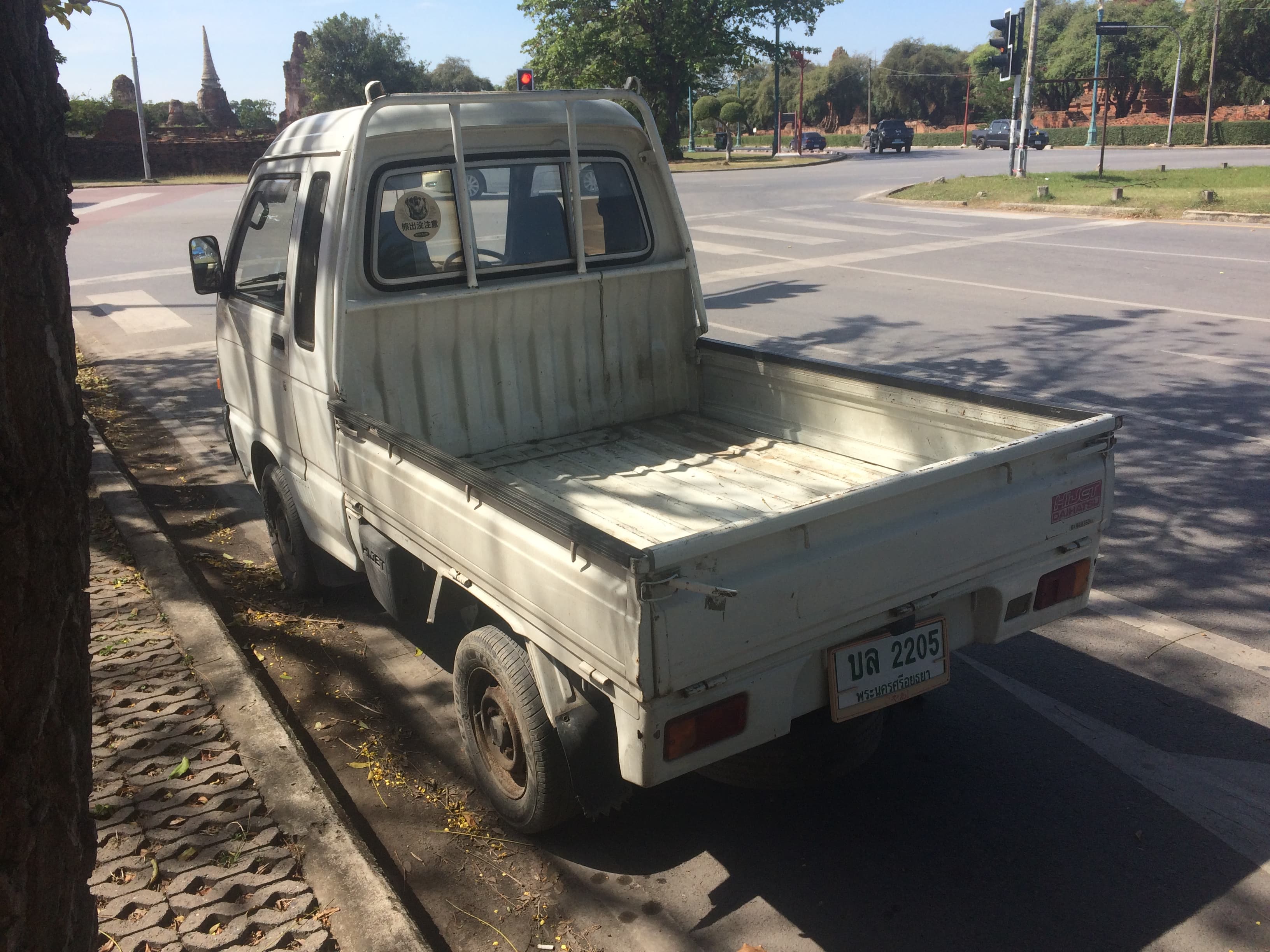
Your kei truck just rolled off the trailer. It ran when it was loaded in Japan. It probably still runs now. But "runs" and "reliable" are two very different things when you're talking about a vehicle old enough to rent a car.
I've been through this exact moment twice — once with The Hijet, once with The Cab. Both times I thought I'd save money by skipping a few steps. Both times the truck taught me otherwise. Ask me how I know.
Here are the 10 things you need to do before you trust your kei truck with anything more important than a trip around the block. In order of priority.
Before You Start: Tools You Need
Forget your SAE sockets. Everything on these trucks is metric. Here's your shopping list:
- Metric socket set: 8mm through 19mm, 3/8" drive. You'll live in 10mm, 12mm, and 14mm.
- JIS screwdrivers: This is not optional. Japanese Industrial Standard screwdrivers look like Phillips but have a tighter fit. Use a Phillips on Japanese screws and you will strip them. Vessel makes the gold standard — $8-$12 each.
- Torque wrench: 3/8" drive, 10-80 ft-lb range. Don't guess on drain plugs and head bolts.
- Jack and stands: The truck weighs 1,500 lbs. A standard 2-ton jack and stands work fine.
- Drain pan, funnel, rags: You know the drill.
Total tool cost if starting from zero: $150-$200. You'll use all of it forever.
1. Change the Engine Oil and Filter
This is job number one. You don't know what's in there. Could be the correct 5W-30. Could be whatever the last owner poured in. Could be something that was oil three years ago and is now expensive sludge.
What you need:
- Oil: 2.5-3 quarts of 5W-30 or 10W-30 (check your manual — most 660cc engines spec 5W-30). Stick with a Japanese brand if you want to be authentic. Idemitsu 5W-30 is what I run. $8-$12/quart.
- Filter: This is where it gets fun. These engines use small filters that cross-reference to common ones. For the Hijet EF series engine, the OEM is 15601-87204. That crosses to a Wix 51356 or NAPA Gold 1356. For Honda Acty E07A engines, try a Wix 51394. Check the parts lookup for your specific model. $5-$8.
- Drain plug washer: Aluminum crush washer, M12. Replace it every time. $0.50.
Procedure: Warm the engine for 5 minutes. Pull the drain plug (14mm on most models). Let it drain completely — these small sumps hold every drop close to the pickup. Replace the filter. Torque the drain plug to 25-30 ft-lb. Fill with oil, check the dipstick, run it for a minute, check again.
Cost: $30-$45. Time: 30 minutes.
2. Change the Coolant
Old coolant doesn't just lose its anti-freeze properties — it loses its anti-corrosion properties. And these little aluminum engines corrode fast when the coolant goes acidic.
Critical: Use Asian-formula coolant. That means blue or green long-life coolant designed for Japanese vehicles. NOT Dexcool (the orange stuff). NOT European spec. Dexcool and Japanese aluminum mix about as well as you'd expect — which is to say, they create a brown gel that clogs your heater core and eats your water pump. I've cleaned that mess out of The Cab's cooling system. It took an entire Saturday.
Zerex Asian Vehicle (blue bottle) is what I use. $15-$20 per gallon. You need about 1 gallon of premixed or a half gallon of concentrate.
Drain from the radiator petcock (bottom passenger side on most models), flush with distilled water twice, fill with fresh coolant, burp the system. If you want the full breakdown, check the cooling system guide.
Cost: $20-$30. Time: 1 hour.
3. Replace the Timing Belt and Water Pump
This is the "do this or die" item. Not you — the engine.
Most kei truck engines (Suzuki F6A, Daihatsu EF, Honda E07A, Mitsubishi 3G83) are interference engines. That means if the timing belt snaps, the pistons slam into the valves, and your $4,000 truck needs a $2,000 engine. The belt is a $30 part. The math is simple.
The rule: Replace the timing belt every 60,000-80,000 km (37,000-50,000 miles) or every 5-7 years, whichever comes first. Rubber degrades with age regardless of mileage. If you can't verify when it was last done — and you probably can't, because the maintenance records are in Japanese and may not exist — replace it now.
What you need:
- Timing belt kit: Belt + tensioner + water pump + seals. Buy the kit — doing just the belt is false economy since you're already in there. GMB and Aisin make kits for most models. $80-$150 for the kit.
- Coolant: You're draining it to get to the water pump. See item #2.
Difficulty: 6/10. This is a 3-4 hour job if you've done one before, a full day if you haven't. The engine bay is tight but the procedure is straightforward. If you're not confident, this is the one job worth paying a shop for. Find someone who knows these trucks through the mechanic directory.
Cost: $150-$300 parts. $300-$500 at a shop. Time: 3-6 hours DIY.
4. Check and Replace Brake Fluid
Brake fluid is hygroscopic — it absorbs water from the air. After 25 years, it's absorbed a lot of water. Water in brake fluid lowers the boiling point, which means when you ride the brakes on a hill, the fluid boils, you get air in the lines, and the pedal goes to the floor. Ask me how I know.
Spec: DOT 3 or DOT 4. Any brand. $8-$12 per bottle. You need one 12oz bottle.
Bleed all four corners, starting from the wheel furthest from the master cylinder (usually rear passenger). If the fluid coming out is dark brown or black, keep bleeding until it runs clear. For the full brake system walkthrough, see the brake upgrade guide.
Cost: $10-$15. Time: 45 minutes with a helper (or 30 minutes with a one-man bleeder valve).
5. Inspect Brake Pads and Shoes
While you're under there bleeding brakes, look at the friction material. Front brakes are usually disc (pads), rears are usually drum (shoes).
Pads: Minimum thickness is 3mm. Below that, replace them. OEM-equivalent pads for most kei trucks run $20-$35 per axle. The rotors are tiny — if they're grooved or below minimum thickness (stamped on the rotor), replace those too at $25-$40 each.
Shoes: Look through the inspection hole in the drum backing plate. If you can't see much material, pull the drum and inspect. Rear shoes are $20-$30 per axle.
These are 770 lb payload trucks with drum brakes on an axle that weighs nothing. Brakes are cheap. Don't push it.
Cost: $20-$70 depending on condition. Time: 30 minutes to inspect, 1-2 hours to replace.
6. Replace the Air Filter
The air filter on a kei truck is tiny. It's also probably full of 25 years of Japanese pollen, road dust, and whatever lived in the warehouse where it sat before export.
Most kei trucks use a flat panel filter in a small airbox. Pop the clips, pull the old filter, compare it to daylight. If you can't see light through it, it's done.
Cross-references: Carry (F6A) uses a filter that crosses to WIX 46253 or equivalent. Hijet EF engines cross to WIX 42824. Check parts lookup for your specific year and model.
Cost: $8-$15. Time: 5 minutes. There's no excuse not to do this one.
7. Check and Replace Spark Plugs
The 660cc three-cylinder engines in these trucks have three spark plugs. That's three chances to improve your idle, throttle response, and fuel economy for about $3 each.
The universal kei truck spark plug: NGK BPR6ES (stock #7131). This fits the Suzuki F6A, Daihatsu EF-SE, and many others. For the Honda E07A, you want a NGK BPR5ES. Always check, but BPR6ES is the starting point.
Gap them to 0.7-0.8mm (0.028-0.032"). Use the JIS screwdriver to remove the plug wire boots — don't pull by the wire. Torque plugs to 18-21 ft-lb on aluminum heads. Over-torque and you're pulling the head to fix stripped threads.
If the old plugs are oil-fouled, that's a conversation about valve stem seals. If they're white, the engine's running lean. If they're chocolate brown, everything's great and the engine owes you nothing.
Cost: $6-$10 for all three. Time: 20 minutes.
8. Inspect All Hoses and Belts
Rubber has a shelf life. After 25 years, every rubber component on the truck is living on borrowed time. Squeeze every coolant hose. If it's hard and crunchy, or soft and squishy, replace it. If it cracks when you squeeze it, it was about to fail anyway.
Check:
- Upper and lower radiator hoses
- Heater hoses (2-3 small ones)
- Accessory drive belt(s) — look for cracks, fraying, glazing
- Vacuum hoses (small rubber lines on the intake)
- Fuel lines (rubber sections near the engine — if they're original rubber, replace with fuel-rated hose)
Most of these hoses are available from Japanese parts suppliers or can be matched by inside diameter at any auto parts store. Bring the old hose, match the ID and length. Bulk coolant hose is $3-$5 per foot.
Cost: $20-$50 in hoses and a belt. Time: 1-2 hours.
9. Check All Lights and Electrical
This one's boring but it keeps you legal. Have someone walk around the truck while you work through the switches.
Check: Headlights (high and low), tail lights, brake lights, turn signals (front and rear), reverse lights, hazard flashers, license plate light, dash lights, horn.
Kei trucks use a mix of common bulb sizes. Most tail and turn signal bulbs cross to standard 1156 or 1157 bulbs. Headlights vary — many use H4 bulbs. If you're upgrading, Jake wrote a solid LED headlight guide that covers the kei truck specifics.
Check the grounds. Bad grounds cause 90% of weird electrical problems on old trucks. Clean every ground point you can find — wire brush, contact cleaner, re-bolt tight.
Cost: $5-$30 in bulbs. Time: 30 minutes.
10. Rust Inspection and Treatment
This is the one that determines whether your truck has 5 years left or 15. Japanese trucks live in a humid island climate and get sprayed with road salt every winter. Some prefectures are worse than others. Hokkaido trucks see more salt than Okinawa trucks see in a lifetime.
Inspect:
- Frame rails (the big ones running front to back)
- Bed floor (poke it with a screwdriver — if it goes through, that's structural)
- Cab corners (especially behind the rear wheels)
- Wheel arches
- Subframe and suspension mounting points
- Brake lines (if they're rusty and crusty, replace them before they fail on a hill)
Surface rust: Wire wheel it, treat with a rust converter like Corroseal ($15-$20), then seal with rubberized undercoating. $30-$50 in materials.
Structural rust: If the frame is perforated or the cab mounts are gone, you have a project, not a truck. Get a second opinion from a welder. The troubleshooting guide covers how to assess what's fixable vs. what's a money pit.
Cost: $30-$80 for treatment supplies. Time: 2-4 hours. More if you find surprises.
The Total Damage
Here's what a full first service looks like, DIY:
| Item | Parts Cost | Time |
|---|---|---|
| Oil + filter | $30-$45 | 30 min |
| Coolant | $20-$30 | 1 hr |
| Timing belt + water pump | $80-$150 | 3-6 hr |
| Brake fluid | $10-$15 | 45 min |
| Brake pads/shoes (if needed) | $20-$70 | 1-2 hr |
| Air filter | $8-$15 | 5 min |
| Spark plugs | $6-$10 | 20 min |
| Hoses + belts | $20-$50 | 1-2 hr |
| Lights + electrical | $5-$30 | 30 min |
| Rust treatment | $30-$80 | 2-4 hr |
| Total | $229-$495 | 10-17 hr |
Total time: Two weekends. Total cost: $300-$500. Difficulty: 4/10 average (6/10 for the timing belt).
That's less than a single visit to a dealer for a modern truck. And when you're done, you'll know every inch of your kei truck. You'll know which bolts are tight and which ones were finger-tight. You'll know where the rust is and where it isn't. You'll know the engine's happy because you made it that way.
That's worth more than any pre-purchase inspection.
Pro tip: Knock out items 1, 2, 4, 6, and 7 in a single Saturday morning. That's your "fluids and filters" day — about $75 in parts and 3 hours of work. Save the timing belt for a day when you're feeling ambitious and your better half is out of town.
If you don't have a workspace or the tools, check the mechanic directory for shops near you that know these trucks. And if something doesn't look right, the troubleshooting guide is your next stop.
Now go get your hands dirty. That truck's been waiting 25 years for someone who gives a damn.