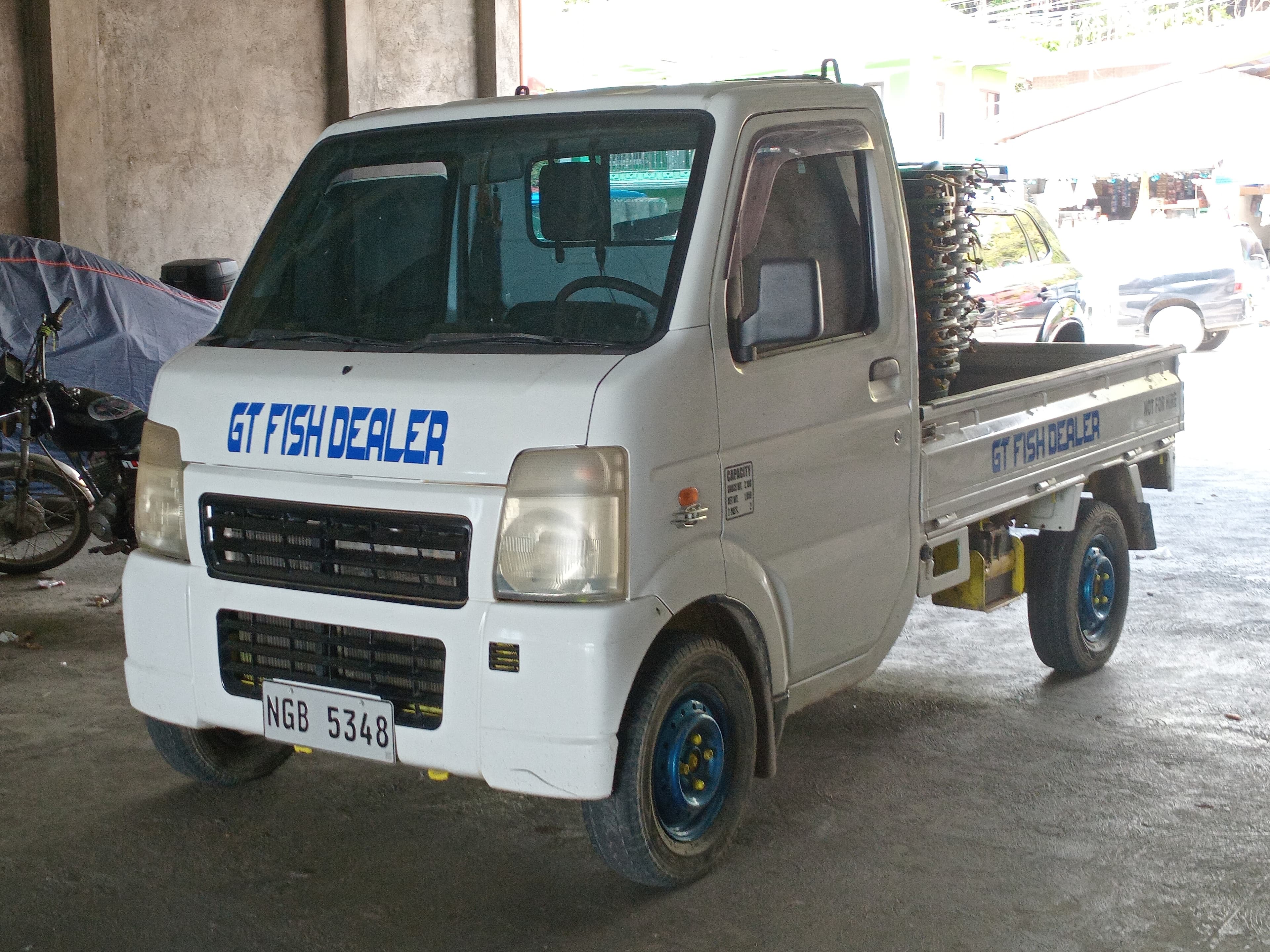
Your stock drum brakes stop the truck. I'm not going to lie to you and say they don't work. They work the way a dull knife cuts bread — you get through it eventually, you just won't feel good about it.
I drove The Hijet with stock drums for two years. Front and rear drums, original shoes, original hardware. It stopped. It stopped in a way that made me plan my stops three intersections ahead. It stopped in a way that made me avoid steep roads if I was hauling anything heavier than a cooler. Then one August afternoon I came down Route 307 with 400 pounds of flagstone in the bed, and the pedal went soft halfway to the floor. I pulled over, let everything cool for twenty minutes, and drove home at 25 mph.
I ordered a disc conversion kit that night. Ask me how I know it's worth it.
When You Actually Need to Upgrade
Not everyone needs disc brakes. If you're putting around a farm at 15 mph and your truck carries nothing heavier than a bale of hay, your drums are fine. Save the money.
You need to upgrade if any of these apply:
- You haul loads regularly (firewood, building materials, tools)
- You drive in hilly or mountainous terrain
- You daily drive your kei truck in traffic
- Your drums are worn and you're replacing them anyway
- You just want to stop like a truck built after 1985
That last one is valid. Peace of mind costs $200. That's cheaper than therapy. Rina would call that a data-driven decision. I call it common sense.
Which Models Already Have Front Discs
Before you order a conversion kit, check what you've got. A lot of later-model kei trucks came from the factory with front disc brakes:
- Suzuki Carry (DA63T, 1999+): Front discs standard
- Daihatsu Hijet (S200/S210, 1999+): Front discs standard
- Subaru Sambar (TT2, 1999+): Front discs standard
- Honda Acty (HA6/HA7, 1999+): Front discs standard
If your truck is 1998 or older, you're almost certainly running four-wheel drums. The Hijet is a 1996 S110P — drums all around. The Cab is a 1992 Minicab — drums all around, and the shoes looked like they were original to the Clinton administration.
Front Disc Conversion: The Big Upgrade
This is the single best safety mod you can do to a pre-1999 kei truck. Better than a lift kit. Better than lights. Better than anything Jake's going to tell you about on the fun side of things.
Parts You Need
A front disc conversion kit for a Hijet S110P includes:
- Brake calipers (new or remanufactured) — these are typically sourced from the later-model S200 series
- Vented rotors (usually 231mm diameter)
- Caliper mounting brackets
- Brake pads (I use Akebono ceramic pads, part ACT-xxxx series depending on caliper. Fight me.)
- Braided stainless brake lines (replace the rubber while you're in there)
- New banjo bolts and copper crush washers (10mm banjo bolts)
- Mounting hardware (12mm caliper bracket bolts, 14mm caliper slide pins)
Total parts cost: $150–$300 depending on whether you source from a Japanese parts importer or buy a pre-packaged kit. I paid $220 for The Hijet's kit from a Hijet-specific parts vendor. The Cab's Minicab conversion ran $180 because I found calipers from a later-model Minicab at a JDM dismantler.
The Conversion Process
Step 1: Remove the drum assembly. Pull the wheel (19mm lug nuts on the Hijet). Remove the drum — two 8mm Phillips-head screws hold the drum to the hub on most models. If the drum is stuck, which it will be, thread two 8mm bolts into the threaded holes on the drum face and tighten evenly. The drum will pop off. Do not beat on it with a hammer. Don't make the mistake I made.
Step 2: Remove the backing plate. Four 12mm bolts hold the backing plate to the steering knuckle. Remove the brake line from the wheel cylinder first (10mm flare nut wrench — do NOT use an open-end wrench, you will round it). Cap the brake line to minimize fluid loss.
Step 3: Install the caliper bracket. The conversion bracket bolts to the same four 12mm holes where the backing plate was. Torque to 55 ft-lbs. If the bracket doesn't align perfectly, do not force it. Check that you have the correct kit for your model year. S110P and S100P brackets are different.
Step 4: Install the rotor. The rotor slides onto the hub. Secure with the two 8mm screws. These are just holding screws — the wheel bolts do the clamping.
Step 5: Install the caliper and pads. Slide the pads into the bracket. Set the caliper over the rotor and pads. Tighten the caliper slide pins (14mm, torque to 25 ft-lbs). Connect the new braided stainless brake line to the caliper (10mm banjo bolt with new copper crush washers on both sides of the banjo fitting, torque to 17 ft-lbs).
Step 6: Connect to the hard line. Attach the other end of the braided line to the existing hard line using the factory fitting. This is where you find out if your hard lines are corroded. More on that below.
Step 7: Bleed the brakes. Start from the wheel farthest from the master cylinder. On the Hijet, that's the rear passenger side. Work your way to the front driver side. Use DOT 4 fluid. Pump the pedal, hold, crack the bleeder (8mm), close, release. Repeat until no bubbles. Pro tip: get a one-man bleeder valve or a friend. Doing it alone with a hose and a bottle works but takes twice as long.
Upgraded Pads and Rotors for Existing Disc Brakes
If your truck already has front discs, you can still improve stopping power significantly.
Pads: Swap the OEM semi-metallic pads for ceramic. Akebono or Nisshinbo make direct-fit pads for most kei truck calipers. Ceramic pads produce less dust, less noise, and more consistent stopping — especially when hot. Cost: $30–$50 per axle.
Rotors: If your rotors are scored or below minimum thickness (check with a micrometer — minimum is usually stamped on the rotor), replace them with quality aftermarket rotors. Brembo doesn't make kei truck rotors, so you're looking at Japanese aftermarket brands. Cost: $40–$80 per pair.
Slotted rotors: I've seen guys run slotted rotors on kei trucks. They work. They improve wet-weather braking and help clear pad material. But they wear pads slightly faster. Your call. Cost: $60–$100 per pair.
Brake Fluid: The Stuff Everyone Ignores
Brake fluid is hygroscopic. It absorbs water from the air. After two years, your fluid has enough water content to lower its boiling point by 50°F or more. Boil your brake fluid and you get vapor in the lines. Vapor compresses. Pedal goes to the floor.
Use DOT 4 fluid. It has a higher dry boiling point (446°F vs 401°F for DOT 3) and a higher wet boiling point (311°F vs 284°F). DOT 4 costs $2 more per bottle. Spend the $2.
Change your brake fluid every two years. No exceptions. The system takes about 1 liter total. Bleed until the fluid coming out of each bleeder is clean and clear.
I use Prestone DOT 4 Synthetic. I keep three bottles in the garage. Fight me.
Brake Line Inspection: The Forgotten Step
Your kei truck is at least 25 years old. The rubber brake hoses at each wheel are original. Rubber degrades. It cracks on the outside and flakes on the inside. Interior flaking creates a one-way valve — fluid goes in but doesn't come back. The caliper stays applied. You feel a pull to one side.
Inspect every rubber hose. Look for cracks, bulges, or weeping. If you see any of those, replace immediately. If you don't see anything wrong but the hoses are original, replace them anyway. They're $15–$25 each and take ten minutes to swap.
Hard lines are steel and they rust. Pennsylvania salt and Pennsylvania winters turned The Hijet's rear hard lines into something that looked like a rusty pipe cleaner. I replaced all four hard lines when I did the front disc conversion. Pre-bent replacement lines are available for most models. If you can't find pre-bent, buy a roll of 3/16" brake line and a double-flare tool. Double flare, not bubble flare — Japanese brake fittings use double flare (also called SAE flare).
Pro tip: if a hard line fitting won't break loose, don't force it. Hit it with PB Blaster, wait 20 minutes, try again. A rounded flare nut or a snapped brake line means a much worse day than a 20-minute wait.
What Can Go Wrong
Seized bleeder screws. Heat them with a small torch. If they snap off, you need a new caliper or wheel cylinder. Budget $40–$60 for a replacement.
Corroded hard lines. A flare nut rounds or a line snaps when you try to disconnect it. This turns a 3-hour job into a full-day job. Budget extra time and have replacement line material on hand.
Wrong kit for your model. S110P is not S100P. DA52T is not DA63T. Verify your chassis code before ordering. The chassis code is on the plate inside the driver's door jamb.
Air in the lines. If the pedal is soft after bleeding, you still have air. Bleed again. Then bleed again. If it's still soft, check your master cylinder — a failing master cylinder lets fluid bypass internally.
Master cylinder compatibility. A front disc conversion increases the fluid volume required. On most kei trucks, the stock master cylinder handles it fine. But if your pedal feels long even after thorough bleeding, you may need a master cylinder with a larger bore. This is rare but worth knowing about.
Cost Breakdown
| Upgrade | Cost Range |
|---|---|
| Front disc conversion kit | $150–$300 |
| Upgraded pads (ceramic) | $30–$50 per axle |
| Upgraded rotors | $40–$80 per pair |
| Braided stainless lines (4) | $60–$100 |
| DOT 4 brake fluid (3 bottles) | $20–$30 |
| Hard line replacement (full set) | $40–$80 |
| Flare tool (if needed) | $25–$40 |
Front disc conversion with new fluid and lines: $250–$400. Upgraded pads and rotors on existing discs: $80–$150.
Jake asked me once if the disc conversion was the best money he could spend on his Carry. I told him it's the best money he could spend on not dying. He ordered the kit that afternoon. Suki asked the same question about her Sambar Van. Same answer. Same result.
Total time: 4–6 hours for a front disc conversion (both sides). Total cost: $250–$400. Difficulty: 5/10.
It's not hard. It's just brakes. But brakes are the one system where "close enough" isn't good enough. Take your time, torque everything to spec, bleed until the pedal is firm, and test at low speed before you trust it on a hill. Your kei truck will stop like it should have from the factory. And you'll stop planning your stops three intersections ahead.