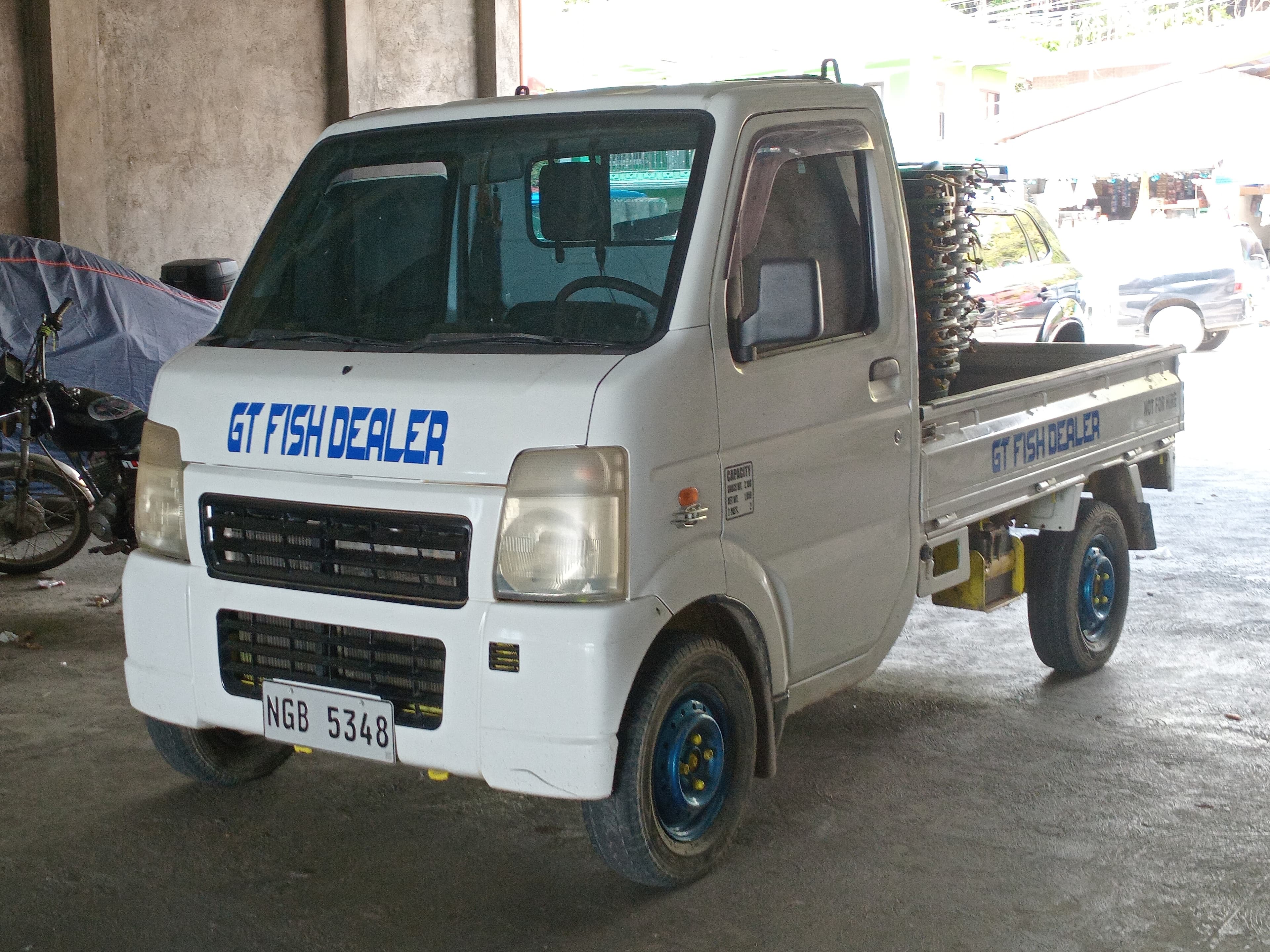
Updated April 2026 with Trump's federal kei vehicle endorsement, Oregon's legalization bill, Rhode Island developments, and new legal analysis from Covington & Burling LLP.
The short answer is this: if you own a kei truck in New York, your registration is at risk. The long answer follows.
Since late 2025, the New York Department of Motor Vehicles has been systematically canceling registrations for Japanese kei trucks and mini vehicles that were previously registered without issue. Owners who have been driving legally — some for years — are receiving letters informing them that their vehicles no longer meet state requirements for road use. No grace period. No grandfathering. Just a letter and a deadline.
This is not a rumor circulating on Reddit. It is happening to real people, with real trucks, who paid real money to register them through the same DMV now revoking those registrations. My dad's 1995 Carry sits in my uncle's driveway in Chesapeake, Virginia, where it's perfectly legal. Had he bought it in Buffalo instead of Norfolk, he'd be getting one of those letters right now.
Here's what the law actually says — and what you can do about it.
The Timeline: How We Got Here
Pre-2024: New York had no explicit policy on kei trucks. Some county DMV offices registered them as "special use" vehicles. Others processed them as standard passenger vehicles. A few flagged them and refused. It was a patchwork, and owners who got lucky at one office stayed quiet about it. The r/keitruck subreddit is full of posts from New York owners who drove their registered trucks for years without incident.
Late 2024: The AAMVA — the American Association of Motor Vehicle Administrators — updated its "Best Practice" guidance on non-FMVSS-compliant vehicles. This is the document that changed everything, and we need to talk about what the AAMVA actually is.
Early 2025: New York's DMV began implementing the updated AAMVA guidelines. New registration applications for kei trucks were denied at the counter. Owners reported being told their vehicles "don't meet federal safety standards."
Mid-2025: The DMV began the retroactive phase. Existing registrations were flagged through VIN audits. Owners received cancellation notices by mail — their vehicles reclassified as non-road-legal.
2026: The crackdown is now systematic. Multiple owner reports confirm that NY DMV is actively searching its database for vehicles with engine displacements under 660cc and wheelbases that match kei specifications. If your truck is in the system, they are looking for it.
The Organization Behind the Bans
The AAMVA is a nonprofit organization that advises state DMVs on policy. It does not make law. It does not have enforcement authority. What it does is publish "Best Practice" documents that state DMV administrators treat as gospel.
As Jalopnik reported, the AAMVA is the common thread behind kei vehicle restrictions across multiple states. Their guidance document essentially says: if a vehicle was not built to Federal Motor Vehicle Safety Standards (FMVSS), states should not register it for road use.
Here's the problem with that logic. The federal 25-year import rule (49 U.S.C. 30112(b)(9)) explicitly exempts vehicles older than 25 years from FMVSS compliance requirements for the purpose of importation. A 1995 kei truck can be legally imported into the United States. U.S. Customs and Border Protection will clear it. The federal government says it's fine.
But — and this is the gap that the AAMVA exploits — importation and registration are two different things. The federal government controls the border. States control the roads. There is no federal law requiring states to register any particular vehicle, and there is no federal law preventing them from doing so. It's a gray zone, and the AAMVA has decided to fill it with restrictions.
The Autopian put it well: states are banning these vehicles "for no good reason" while owners fight back. Hagerty dubbed it "The Kei Kerfuffle" — an apt name for what is fundamentally a bureaucratic turf war being fought on the driveways of individual owners.
Who's Affected
This is not abstract. Real numbers from my tracking:
- Owners who registered kei trucks at NY county DMV offices between 2019 and 2024 are receiving cancellation letters
- Vehicles affected include Suzuki Carries, Honda Actys, Daihatsu Hijets, Subaru Sambars, and other kei trucks and vans
- The cancellation applies regardless of inspection status — trucks that passed NY safety inspection are still being pulled
- Commercial operators (landscapers, farmers, small business owners) who bought kei trucks as affordable work vehicles are losing the tools they depend on
One owner on the r/keitruck subreddit reported receiving a cancellation letter for a Suzuki Carry he had registered, insured, and inspected annually for three years. His insurance company confirmed the registration was valid when he bought the policy. Now it's not. His insurance is void because the registration is void. He has a truck he can't drive, can't insure, and — in the current New York market — will struggle to sell.
The Legal Landscape: What Other States Have Done
New York is not alone, but it's also not the majority. Most states still allow kei truck registration in some form. Here's how the map looks:
States that cracked down (following AAMVA guidance):
- Maine — one of the first states to ban kei truck registrations, sparking national attention
- Rhode Island — the DMV sent letters asking owners to return their registrations. A grandfather bill has been proposed but hasn't passed yet.
- Hawaii — restricted registration citing safety concerns on mixed-traffic roads
States that pushed back:
- Colorado — passed HB25-1281 unanimously in May 2025, signed by Governor Polis. Creates a full regulatory framework for kei vehicles — registration opens January 2028. This is the gold standard.
- Massachusetts — reversed a short-lived ban in September 2024 after public outcry. Proof that bans can be undone quickly when owners speak up.
- Oregon — bipartisan SB 1213 introduced in 2025 by Senator Anthony Broadman to explicitly legalize kei trucks. Still in committee.
- Texas — reversed its ban in April 2024 after advocacy by Lone Star Kei, founded by David McChristian. Their model is now being replicated in other states.
- Pennsylvania — continues to register kei trucks with standard titling procedures
- New Hampshire — "Live Free or Die" applies to vehicle registration too, apparently
The full picture is more nuanced than any list can capture. Check our 50-state regulations page for current status in every state, including links to actual DMV and DOT sources.
The key takeaway: the AAMVA guidance is not law. States choose whether to follow it. Some have. Most haven't. And at least one — Colorado — has explicitly rejected it through legislation.
The Legal Argument, Plainly Stated
The core legal question is straightforward:
- Federal law permits the importation of vehicles over 25 years old without FMVSS compliance
- State law controls vehicle registration on public roads
- No federal law requires states to register imported vehicles — or prohibits them from doing so
- The AAMVA recommends against registration, but this is guidance, not law
The strongest argument for kei truck owners is this: these vehicles were legally imported under federal law. Denying registration to a legally imported vehicle — especially retroactively revoking registrations that were properly issued — raises due process questions. You followed the rules. The state changed the rules. And now they're applying the new rules backward.
Whether that argument holds up in court depends on state administrative law. I am not a lawyer (I'm a paralegal by training and a spreadsheet enthusiast by nature), and nothing here is legal advice. But the argument has legs, and it's the argument Colorado used to pass HB25-1281.
Five Things New York Owners Can Do Right Now
I don't do helplessness. Here are concrete steps, ranked by impact:
1. Contact Your State Legislator — Today
Colorado didn't get HB25-1281 because legislators woke up one morning thinking about 660cc engines. Owners called. They wrote. They showed up. New York has a legislative session, and your representatives need to hear from you.
Find your state senator at nysenate.gov and your assembly member at nyassembly.gov. Tell them: you own a legally imported vehicle, you registered it through proper channels, and the state is now revoking that registration without legislation. Ask them to introduce a bill modeled on Colorado's HB25-1281.
Be specific. Be polite. Include your VIN, your registration history, and what this vehicle means to your livelihood or daily life.
2. Join an Advocacy Group
You are not fighting this alone. The Japanese Mini Truck Alliance on Facebook and r/keitruck on Reddit are organizing responses. Strength in numbers matters when you're dealing with a state bureaucracy.
3. Document Everything
Keep copies of your original registration, insurance cards, inspection certificates, and any correspondence from the DMV. If your registration is canceled, keep the cancellation letter. If this ever goes to court or to a legislative hearing, paper trails win arguments.
4. Consult a Lawyer
If you've received a cancellation notice, talk to an attorney who handles administrative law or vehicle titling issues. Some owners have successfully appealed cancellations through administrative hearings. The initial consultation is usually free or cheap, and knowing your options is worth more than guessing.
5. Explore Legal Alternatives
Depending on your situation:
- Off-highway registration: Some NY counties issue off-highway plates for farm or property use. Your truck won't be street-legal, but it won't be illegal on your own land.
- Neighboring state registration: If you have a legitimate address in Pennsylvania, Vermont, or Connecticut, those states currently allow registration. I am not telling you to commit registration fraud. I am telling you that if you actually have a second address, look into it.
- Sell to an out-of-state buyer: If you can't use the truck, someone in a registration-friendly state can. The market is national. Check our dealer directory for contacts who facilitate interstate sales.
How to Advocate Effectively
I've tracked advocacy efforts in six states over the past two years. Here's what works:
What works: personal stories from constituent-owners, economic impact data (kei trucks as affordable work vehicles for small businesses and farms), safety data showing kei trucks' actual accident record (spoiler: it's excellent), and comparisons to other vehicles that are legal — ATVs, golf carts, and autocycles are all less safe and fully registrable in most states.
What doesn't work: angry rants, conspiracy theories about automaker lobbying, or showing up to a hearing in a shirt that says "Don't Tread on My Kei." (Yes, I've seen this. No, it did not help.)
The Colorado model worked because owners presented data, partnered with rural and agricultural advocates, and framed kei trucks as practical vehicles for underserved use cases — not just hobbyist toys. Lone Star Kei in Texas used the same playbook. Colorado Kei Advocates, the nonprofit started by Ryan Albarelli, was instrumental in getting HB25-1281 through committee. These groups have publicly shared their strategies — reach out to them.
New York has farms. New York has small businesses. New York has people who need an affordable, efficient work vehicle. Frame it that way.
The Federal Wild Card: Trump's Kei Vehicle Endorsement
In December 2025, President Trump posted on Truth Social: "I have just approved TINY CARS to be built in America." He tasked Secretary of Transportation Sean Duffy to review regulations around small vehicles. This is significant — not because it changes anything today, but because it opens a federal path.
Covington & Burling LLP, one of the most respected regulatory law firms in Washington, published an analysis in December 2025 noting that the DOT has expressed commitment to "rescind, withdraw, or amend burdensome regulations that do not enhance safety." Their assessment: NHTSA could modify how FMVSS applies to kei trucks, potentially creating a new vehicle class that would preempt state-level bans entirely.
In practice, that means: if federal rulemaking creates a kei vehicle classification with appropriate safety standards, states like New York would lose their legal basis for denying registration. The AAMVA guidance would become moot overnight.
This is speculative. Federal rulemaking takes years, and "Trump said something on Truth Social" is not the same as "NHTSA published a final rule." But it's the first time a sitting president has publicly endorsed kei vehicles, and the legal infrastructure for change — Covington's analysis, bipartisan state bills, a DOT mandate to reduce regulatory burden — is real.
I have a spreadsheet tracking this. (Obviously.) The timeline for federal action, if it happens, is 2027 at the earliest. New York owners can't wait that long.
What Happens Next
The New York situation is a bellwether. If owners organize and push back — as Colorado did — legislation is possible. If they don't, more states will follow. The AAMVA is not going to stop publishing guidance, and state DMVs are not going to stop reading it.
My spreadsheet tracks 22 states that have considered kei vehicle policy changes since 2023. Fourteen moved toward allowing registration. Eight moved toward restricting it. The trend line is actually positive — but only because owners in those fourteen states showed up and made noise.
New York can go either way. The state has a large and active kei truck community, a legislative process that responds to constituent pressure, and a precedent in Colorado that proves legalization is achievable.
What to Do Next
- Check your state's current status on our regulations page — we track every state with links to official sources
- Read the full New York breakdown at our New York regulations page for specific registration requirements and DMV contacts
- Understand what you're buying with our complete buying guide — especially the section on registration before purchase
- Know the import process end-to-end with our importing step-by-step guide
- Get insured properly — read our insurance guide to understand how registration status affects coverage
- Contact your legislator — today, not tomorrow
The bureaucracy moves slowly until it doesn't. When it moves fast, it moves against the people who weren't paying attention. Pay attention. The data says this fight is winnable. But only if you show up.
Have information about the New York situation? Received a cancellation letter? Email us at keijirateam@gmail.com — I'm tracking every data point.