The fog hasn't lifted yet. It hangs low over the Tillamook State Forest like a wool blanket draped across the canopy, and the gravel road ahead of me narrows to a single lane — barely wider than Samu-chan herself. I'm thirty miles from the coast, somewhere on a forest service road that doesn't appear on Google Maps, and my 1994 Subaru Sambar Van is idling happily at 2,000 RPM, her 660cc engine barely whispering beneath the sound of rain on the roof. A Roosevelt elk watches me from the tree line. I kill the headlights and pour coffee from a thermos.
This is overlanding. Not the version you see on Instagram — no $80,000 Gladiator with a rooftop tent that costs more than my van, no bull bar wrapped in Baja Designs pods, no recovery boards I'll never use. Just a thirty-year-old Japanese van on a road that was built for vehicles exactly this size. And something shifts. The forest feels closer. The adventure feels more immediate. The truck isn't separating me from the landscape — it's threading me through it.
There's a word for this in Japanese: taru wo shiru — knowing what is enough.
Over the past two years, kei trucks have been showing up at Overland Expo events — West in Flagstaff, PNW in Redmond, East in Arrington — and they're drawing crowds. Not because they're the most capable vehicles in the lot, but because they represent something the overland community has been slowly rediscovering: you don't need a $60,000 truck to go places. Browse r/overlanding on any given week and you'll find a post titled something like "Am I crazy for wanting to overland in a kei truck?" The comments split predictably — half the people call it impractical, the other half say they've never had more fun on a trail. The kei truck contingent is growing, and they're not interested in arguing. They're too busy driving.
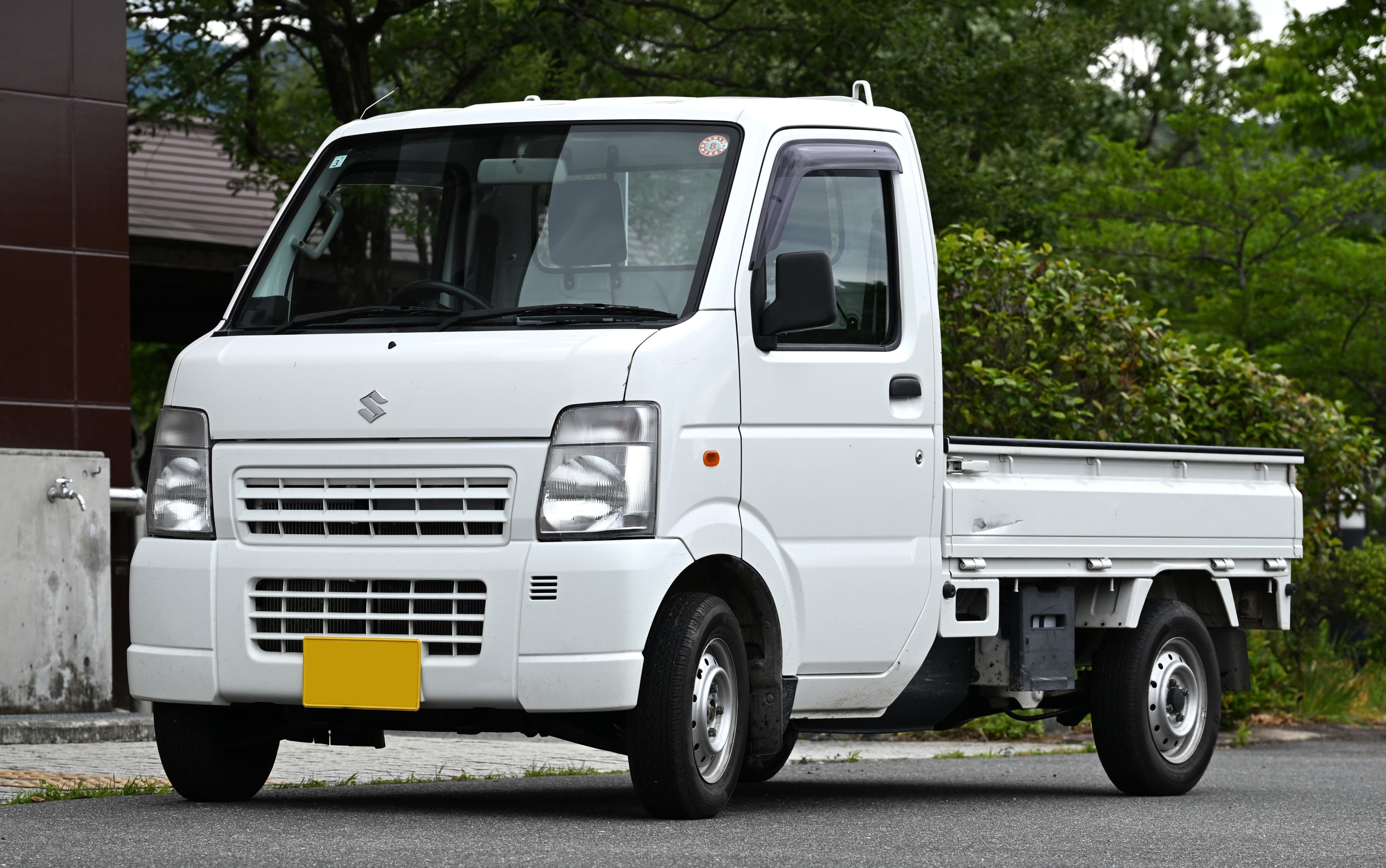
The math is simple. A clean, imported Suzuki Carry 4WD costs $6,000-$9,000. A 2-inch lift kit runs $300-$600. A set of all-terrain tires is $400. A bed rack and rooftop tent — if you even want one — adds another $1,500-$2,500. All in, you're looking at $8,000-$12,000 for a complete overland rig. A comparable Tacoma build starts at $40,000 and climbs fast. The kei truck doesn't just cost less — it costs so much less that the comparison almost feels unfair.
But cost isn't the real reason people are falling for these trucks. It's the size.
Most overlanders — the honest ones, anyway — will tell you that 90% of their trail time is spent on forest service roads, fire roads, and well-graded dirt tracks. The kind of roads where a stock Subaru Outback would do fine. The kind of roads that were originally built for vehicles hauling timber, maintaining utility lines, or accessing fire lookouts — vehicles not much bigger than a kei truck.
Here's what nobody talks about in the overland world: full-size trucks are terrible on narrow mountain roads. A Tacoma is 75 inches wide, a 4Runner is 76, a full-size Silverado is 81. Now put that on a single-lane forest road with a cliff on one side and a rock wall on the other, and you're white-knuckling it the whole way. A Suzuki Carry is 51 inches wide. A Sambar is 52. You have two feet of extra clearance on each side compared to a Tacoma. On the tight switchbacks of the Coast Range or the narrow fire roads of the Cascades, that's not just a comfort thing — it's the difference between making the turn and having to reverse a quarter mile to find a pullout.
Jake Mori — our editor-in-chief and the guy who's driven his '97 Carry on more questionable roads than I can count — puts it this way: "The kei truck doesn't go harder. It goes further. It fits where the big trucks give up."
The overland industry has a gear problem. Scroll through any build thread and you'll see recovery boards, hi-lift jacks, air compressors, dual-battery systems, water filtration, solar panels, fridges, awnings, shower setups — thousands of dollars of equipment bolted to a truck that's already expensive, heavy, and thirsty. The weight compounds. The complexity compounds. The anxiety compounds. Did I pack enough? Is my rig ready? What if I get stuck?
A kei truck forces you to answer a different question: what do I actually need?
The bed is 6 feet long — enough for a sleeping platform, a sheet of plywood, a foam mattress, a sleeping bag. You have 770-880 pounds of payload capacity — enough for two people, a camp stove, water, food for a week, and a change of clothes. The 660cc engine drinks fuel like a motorcycle, pulling 35-45 MPG on the trail, enough to drive for three days on a single tank.
Taru wo shiru isn't about deprivation. It's about the recognition that enough is a real place — and that going past it doesn't add to the experience. It subtracts from it. The overlanders I've met who drive kei trucks aren't making do with less. They've figured out that less is more. The smaller the vehicle, the bigger the world feels around you. The less gear you carry, the more present you are in the landscape. There's a related concept — mottainai — the sense of wastefulness, the regret of not using something to its full potential. A $70,000 overland rig that sees trail twice a year? That's mottainai. A $8,000 kei truck that you take out every weekend because it's cheap to run, easy to park, and impossible not to smile in? That's the opposite.
Not all kei trucks are created equal for overlanding, and the model you choose matters.
The Suzuki Carry 4WD (DD51T) is the overlander's default — part-time 4WD with low range, the most aftermarket support of any kei truck in the US, and the simplest drivetrain to maintain on the road. Dave Russo, our mods editor who's torn apart more kei trucks than anyone I know, calls the Carry "the one you can fix with a socket set and a YouTube video." Check out his lift kit installation guide for the Carry-specific walkthrough.
The Subaru Sambar 4WD (KS4) is my pick, obviously. The Sambar's full-time AWD and rear-mounted engine give it weight distribution that's almost supernatural on loose surfaces — it climbs like a mountain goat. The supercharged EN07 models add enough power for loaded trail driving without losing the fuel economy that makes kei trucks so practical. If you want to understand why I've put 47,000 miles on Samu-chan, take one on a wet gravel road.
For the van-life overlanders, the Subaru Sambar Van and Suzuki Every are micro-campers waiting to happen. The enclosed cabin means you sleep inside the vehicle — no tent, no rack, no setup time. Park, fold the seats, roll out your pad. You're home. I've spent dozens of nights in Samu-chan on the Oregon coast — Cannon Beach, Cape Lookout, the dispersed sites south of Astoria — and never once wished I had a bigger vehicle.
For the complete mod list, Dave's bed rack build guide covers everything from lumber rack conversions to full expedition setups. If you're buying your first truck specifically for overlanding, Jake's complete buying guide will walk you through what to look for and what to avoid.
I'm not going to pretend a kei truck is a Tacoma. Highway cruising tops out at 55-60 MPH — and that's with the engine working — so if your overlanding involves long interstate transits to reach the trailhead, you'll feel every mile. Plan shorter drives to closer trails, or trailer the truck to basecamp. Two adults fit in the cab, period; three is possible in a bench-seat model but miserable past thirty minutes. The 770-880 pound payload limit means every item earns its place, with no room for "just in case" gear or redundant systems — a feature or a limitation depending on your mindset. And there's no power steering on most models, no cruise control, minimal sound insulation. The ride is direct, unfiltered, and on a washboard road at 25 MPH genuinely rattly. You will feel every rock.
What you gain is everything else. Roads that turn back full-size trucks are just roads for a kei truck — gates with 60-inch width limits, overgrown two-tracks, forest service roads that haven't been graded since 2019. They were built for vehicles this size. The economy is staggering: 35-45 MPG means you can explore for days on $30 of gas, insurance runs $300-$500 a year, and registration is minimal, making the total cost of ownership low enough to justify a kei truck as a dedicated adventure vehicle even on a modest budget. The simplicity is liberating — no computers, no turbo lag, no DEF fluid, no infotainment system to crash. Carbureted models can be rebuilt trailside with basic tools, and when something breaks the fix is mechanical, logical, and cheap. And then there's the joy — the one nobody quantifies but everyone mentions. There is something irreducibly fun about driving a tiny truck on a big landscape. The world scales differently when your vehicle is small. Mountains look taller. Roads look longer. The forest closes in around you in a way that feels intimate rather than claustrophobic. You wave at other drivers and they wave back — confused, delighted, curious. You arrive at camp grinning.
Check our events page for upcoming kei truck meetups — several Overland Expo events now have kei truck representation, and the community is organizing dedicated kei truck trail runs on the side. The r/keitruck subreddit is another good resource for overlanding-specific build threads and trail reports.
I'm still parked on that forest road in the Tillamook. The elk has wandered off. The fog is thinning and I can see the ridge now — a dark green line against the pewter sky, maybe four miles out. The road ahead narrows further, barely two tire tracks through the ferns. My phone has no signal. My van has a full tank of gas and a half-thermos of coffee.
This is the part where a bigger truck might hesitate. Samu-chan doesn't hesitate. She's been on roads like this for thirty years — in the mountains of Nagano, on the farms of Hokkaido, and now here, in the wet forests of the Pacific Northwest, with Nori curled up on the passenger seat and City Pop on the Bluetooth speaker I zip-tied to the sun visor.
I put her in low range, ease off the clutch, and roll forward into the fog.
Taru wo shiru. Enough is a real place. And it's usually down a road like this — barely there, just wide enough, and exactly where you want to be.