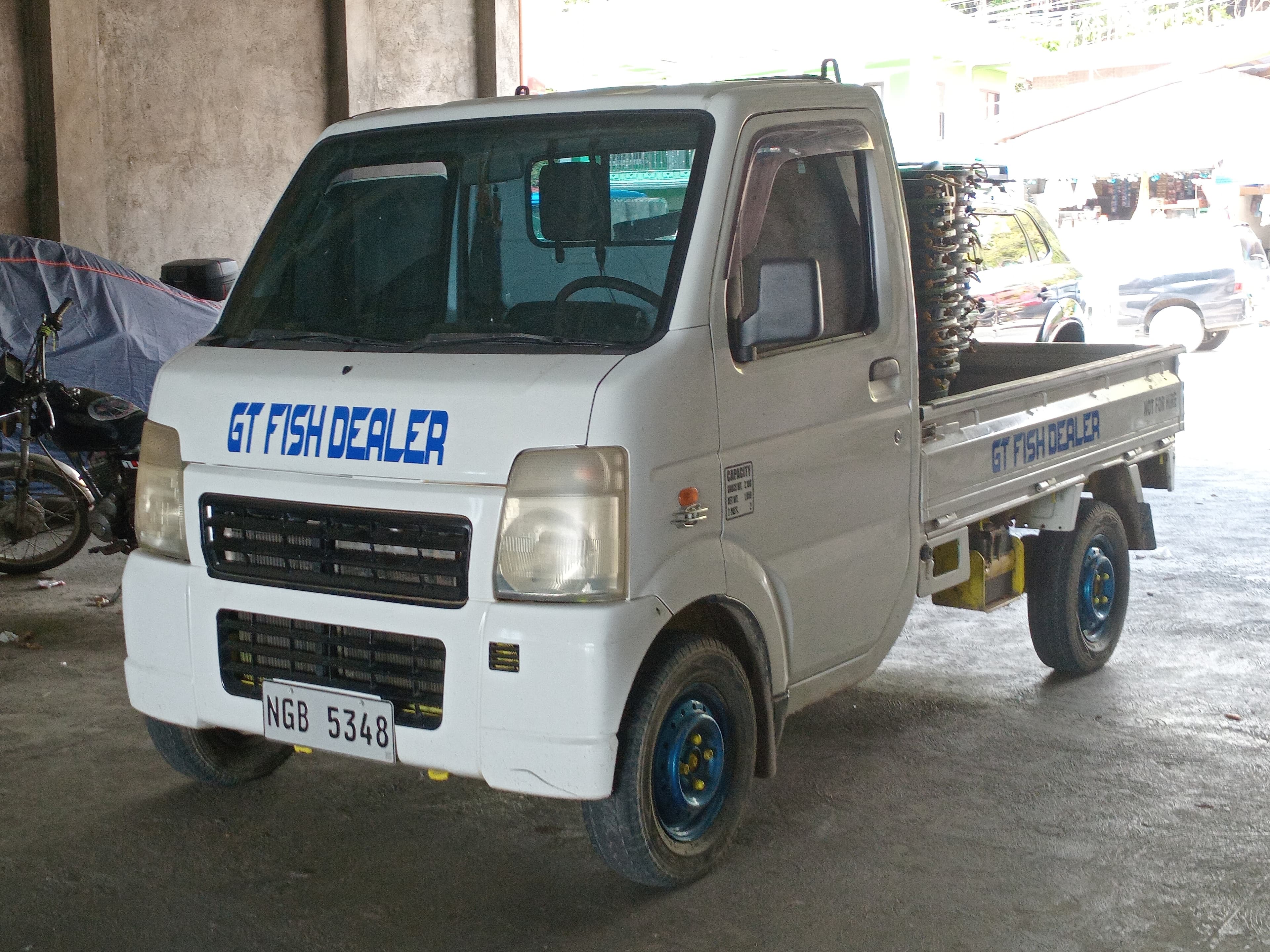
It starts — it always starts — with someone seeing one for the first time.
Maybe it's a Suzuki Carry parked next to a Dodge Ram in a Home Depot parking lot, looking like it accidentally wandered in from another dimension. Maybe it's a Daihatsu Hijet loaded with hay bales on a Montana ranch road, doing exactly what a truck is supposed to do, just smaller. Maybe it's a TikTok video with eleven million views and a caption that says "why is this the cutest truck I've ever seen."
However it starts, the reaction is always the same: a kind of delighted confusion. What is that thing? Is that street legal? Where do I get one?
That reaction — multiplied by millions of people, accelerated by social media, enabled by a loophole in federal law, and fueled by the simple fact that these trucks are genuinely good — is how a vehicle class designed for postwar Japanese tax regulations became one of the most unlikely automotive movements in American history.
This is how it happened.
Nothing about the kei truck movement in America makes sense without understanding one law: the 25-year import exemption.
Under normal circumstances, any vehicle imported into the US must comply with Federal Motor Vehicle Safety Standards (FMVSS) and EPA emissions requirements. Kei trucks — with their 660cc engines, cab-over designs, and lack of features like airbags or side-impact beams — don't come close to meeting those standards. They were never designed to. But the law provides an exemption: vehicles 25 years or older are exempt from FMVSS compliance entirely. The rule was originally written with classic cars in mind — Ferraris, vintage Porsches, British roadsters. Nobody in Congress in 1988 was thinking about Japanese micro-trucks.
And yet. In 2015, 1990-model-year kei trucks became eligible. In 2020, 1995 models. In 2025, the year 2000 models. Each year, a new vintage of kei trucks crosses the threshold, and each year the pool of importable vehicles grows. The golden era of kei truck production — roughly 1990 to 1999, when Suzuki, Daihatsu, Honda, Subaru, and Mitsubishi were all building refined, reliable 660cc trucks — is now almost entirely importable. The door was always there. It just took a while for people to realize what was on the other side.
The first kei trucks in America weren't Instagram props. They were work vehicles.
Farmers, ranchers, and rural property owners were the early adopters, and the appeal was immediate and practical: a 4WD mini truck that could navigate between barn rows, carry 800 pounds of feed, fit on narrow paths, and cost less than a good riding mower. In states like Montana, Idaho, and the Carolinas, where agricultural use didn't require street registration, kei trucks started appearing on farms without anyone making a fuss about it.
Duncan Imports & Classic Cars in Christiansburg, Virginia was among the earliest large-scale importers, building what Hagerty called "the largest collection of Japanese domestic market machines in North America." Gary Duncan saw the potential before most Americans had ever heard the word "kei." His operation — which now stocks over 1,200 vehicles across two facilities — helped establish the import pipeline that hundreds of smaller dealers would later use.
The numbers tell the story of this era's modesty: in 2014, approximately 797 kei vehicles were imported to the United States. It was a trickle. The trucks were curiosities. Most Americans who saw one had no idea what they were looking at. But on the farms and ranches where they actually worked, people were talking — not on social media, just across fences, at feed stores, at county fairs. The kind of word of mouth that moves slow but moves deep. You should see my neighbor's little Japanese truck. Thing's incredible.
Then the internet found them.
The exact moment is impossible to pin down — cultural shifts don't have timestamps — but somewhere around 2018-2019, kei trucks started appearing on Reddit, Instagram, and YouTube with increasing frequency. The r/keitruck subreddit, now home to over 23,000 members, became a hub for early enthusiasts. Facebook groups like "Kei Trucks & Cars USA" grew from dozens to thousands of members. The algorithm did what algorithms do — a lifted Carry on 25-inch tires gets shared, a time-lapse of a Sambar van camper conversion goes viral, someone posts their new Hijet next to their F-250 with the caption "same job, $50K less" and it resonates with an audience tired of $60,000 pickup trucks.
Then TikTok happened. Kei trucks are, it turns out, perfectly engineered for TikTok — visually distinctive, immediately provocative, fitting neatly into the platform's love of surprising, small, aesthetically pleasing things. Videos of custom kei trucks — lowered, lifted, wrapped, converted — started racking up millions of views. The trucks went from "niche JDM thing" to "mainstream internet phenomenon" in the span of about eighteen months. As Fast Company reported, kei trucks became "the anti-Cybertruck" — small where everything else was big, cheap where everything else was expensive, charming where everything else was aggressive. In a culture exhausted by excess, the kei truck was a breath of fresh (and tiny) air.
The import numbers make the acceleration visible:
| Year | Approximate US Imports | Notable Threshold |
|---|---|---|
| 2014 | ~797 | Baseline |
| 2019 | ~2,500 | Pre-pandemic growth |
| 2020 | ~3,000 | Pandemic drives rural interest |
| 2022 | ~5,000 | Social media acceleration |
| 2023 | ~7,500 | Mainstream media coverage |
| 2024 | ~7,500 | Market maturation |
Sources: CNN Business, NBC News, ShelfTrend
That's roughly a 10x increase in a decade, and these are just the trucks that go through formal import channels — the actual number of kei vehicles operating in the US, including those imported years ago and still running, is estimated in the tens of thousands. For context: Ford sold 750,789 F-150s in 2023. Kei trucks are not threatening anyone's market share. But 7,500 units of a vehicle class that most Americans didn't know existed five years earlier? That's a cultural movement, not a market anomaly.
The real signal that kei trucks had arrived wasn't TikTok views — it was the media coverage. CNN Business asked: "Is it a sign of a growing 'tiny truck' movement?" NBC News declared: "Move over, Ford and Chevy: Kei trucks are pulling up." The Wall Street Journal ran "What Is That Thing?" features. NPR covered the Pacific Northwest's love affair with Japanese fire trucks. Hagerty wrote about "The Kei Kerfuffle." Autoblog profiled kei truck experts. Even Covington & Burling, one of DC's most prestigious law firms, published a legal analysis on kei truck regulation. Kei trucks had gone from "fun internet thing" to "legitimate cultural and economic story."
With visibility came scrutiny — and not all of it friendly.
Starting around 2021, several states began restricting or outright revoking kei vehicle registrations. Maine and Rhode Island were the most aggressive early movers, with Rhode Island going so far as to notify existing owners that their registrations were being revoked and they should surrender their plates. New York, Georgia, and other states followed with various restrictions. The driving force behind many of these bans was the AAMVA — the American Association of Motor Vehicle Administrators, a non-profit that advises state DMVs — whose "Best Practice" guidelines labeled kei vehicles as substandard for safety, citing the lack of FMVSS compliance. As Jalopnik reported, the AAMVA's influence on state-level policy was significant, with multiple states adopting near-identical language in their restrictions.
The kei truck community fought back. The Autopian documented owners organizing, attending DMV hearings, and lobbying state legislators. In Colorado, community advocacy helped pass HB25-1281, which was signed by Governor Jared Polis in May 2025, explicitly legalizing kei vehicle registration. The legal landscape remains complicated — Rina tracks all 50 states on our regulations page — but the trend line is cautiously positive. More states are clarifying rules in favor of kei trucks than against them.
And then, in a twist nobody predicted, the President of the United States weighed in.
After visiting Japan in October 2025, President Trump returned enthusiastic about kei vehicles, calling them "very small" and "really cute." On December 3, he told reporters he found the regulations preventing their sale "silly." Two days later, he posted on Truth Social that he had "just approved TINY CARS to be built in America." He directed Secretary of Transportation Sean Duffy to explore changing FMVSS regulations to accommodate kei vehicles — a move that, as NPR noted, surprised and delighted American kei car enthusiasts while raising complex questions about safety standards, trade policy, and what Americans are willing to drive.
The announcement was part of broader US-Japan trade negotiations, with kei vehicles serving as a diplomatic gesture — The Japan Times reported that it was reciprocal to discussions about exporting American pickups to Japan. Whether this actually leads to new kei trucks being manufactured and sold in the US remains uncertain — the regulatory barriers are immense, as kei trucks lack airbags, crumple zones, and other features required by current FMVSS. But the symbolic weight of a presidential endorsement can't be understated. It legitimized an entire vehicle class in the eyes of millions of Americans who had never heard of a kei truck.
The kei truck community in 2026 defies easy categorization. Walk through any kei truck meet and you'll find farmers and ranchers who bought their trucks to work and never looked back, JDM enthusiasts who came from the Skyline/Supra scene and found something more personal, small business owners — landscapers, mobile vendors, delivery operators — who did the cost math and couldn't argue with the numbers, van lifers converting Sambar vans and Every vans into micro-campers, first-time car owners attracted by the low price of entry, and people who just think they're cool — and that's enough.
The r/keitruck subreddit (23,000+ members), Facebook groups (multiple groups with 10,000+ members each), and Instagram's #keitruck community (95,000+ followers on the Kei Trucks Appreciation Society alone) form the digital backbone. But the real magic happens at events — the meets and shows where a lifted farm Carry parks next to a slammed show Hijet and the owners swap stories like old friends. Organized clubs are emerging too — the Capital Kei Car Club in the DC metro area runs monthly meets and an annual cherry blossom cruise, the SoCal Kei Club hosts annual shows in California, and regional groups are forming in Texas, the Pacific Northwest, the Midwest, and the Southeast.
The kei truck movement sits at an inflection point.
On one side: continued import growth, expanding state legalization, growing cultural acceptance, a presidential endorsement, and a community that's organizing faster than the opposition. The infrastructure is building — more dealers (66 across 40 states and growing), more mechanics who know these engines, more parts sources, more events. On the other side: regulatory uncertainty, the AAMVA's continued influence, potential tariff impacts, and the fundamental question of whether a vehicle class designed for Japanese conditions can scale in America.
What I know — what I feel, driving Samu-chan through Portland on a Saturday morning with the windows down and City Pop on the speakers — is that this movement has something most automotive trends don't. It has warmth. People don't just like their kei trucks. They love them in the way you love something imperfect and personal and entirely your own.
Seven hundred and ninety-seven imports in 2014. Seven thousand five hundred in 2024. And a president calling them cute on national television.
Not bad for a truck the size of a punchline.